
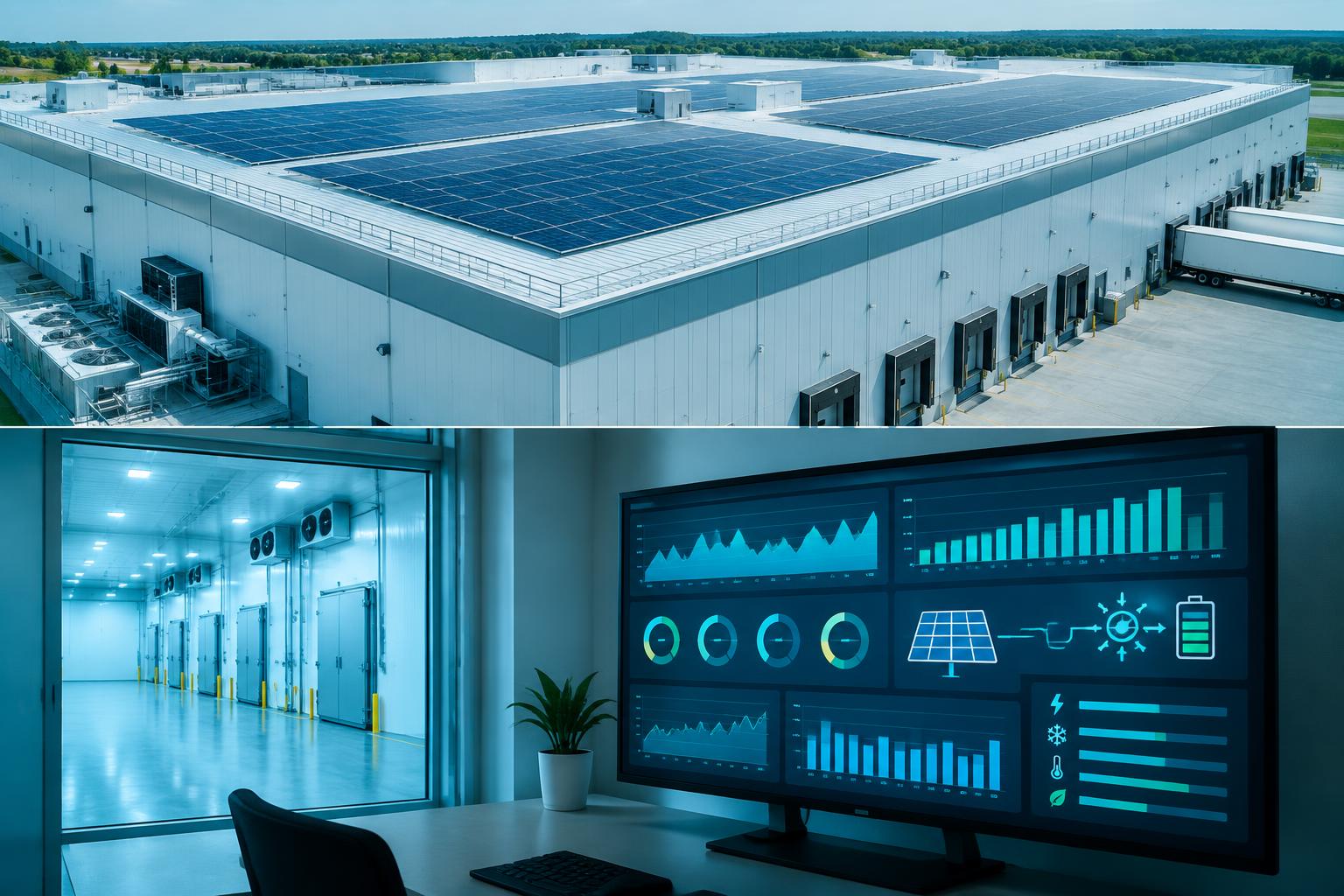
Quick answer
Refrigeration modernization should follow a documented baseline, diagnosis and comparison of feasible options, not a promised savings percentage. Compare energy under similar throughput, product temperatures and weather, then include maintenance, changeover losses and total installed investment. IPMVP provides a measurement-and-verification framework, not a refrigeration performance guarantee. Use scenario tools for screening; qualified engineers must confirm safety, design and acceptance tests.
Key takeaways
- What is the fastest way to cut cold storage energy use? Fix door discipline, damaged gaskets and dirty coils and condensers.
- Does demand defrost really save energy? Yes.
- Should I lower or raise set points to save energy? Store products at the temperature they require, not colder.
- Is solar worthwhile for a cold store? Often, because refrigeration peaks during sunny daytime hours.
Reviewed: 2026-10-15 · ColdMatch Group
Electricity is usually the largest controllable operating cost of a refrigerated warehouse. Refrigeration runs every hour of the year, and small losses — a door left open, an iced coil, a condenser full of dust — repeat thousands of times. This how-to guide is written for owners, operations managers and project buyers who want a structured method rather than a list of random tips. You can estimate your own running cost with the cold storage OPEX estimator and compare scenarios with the energy savings calculator.
Step 1: Measure before you change anything
You cannot manage what you do not measure. Start with twelve months of electricity bills and, if possible, sub-metering on the refrigeration plant, evaporator fans, lighting, door heaters and battery charging. Record room temperatures, suction and discharge pressures, compressor running hours and the number of door openings per day.
Calculate a simple benchmark: annual kWh per cubic metre of refrigerated volume, or per pallet position. Compare chilled and frozen rooms separately, because frozen rooms naturally use more energy. A rising trend over two or three years usually points to maintenance problems; a high figure from day one usually points to design issues.
- Install or check energy meters on the main refrigeration panel.
- Log temperatures and pressures at least hourly.
- Note seasonal peaks and the hours of heaviest loading.
Step 2: Fix the envelope and doors
Heat that enters the building must be removed by the refrigeration plant. The envelope — insulated panels, roof, floor and doors — is therefore the first place to look. Walk the building with a thermal camera on a warm day. Look for ice build-up around panel joints, damaged panels from forklift impacts, gaps at pipe penetrations and failed door gaskets.
Doors are often the largest single heat load in a busy store. Each opening lets warm, humid air in, which also adds ice to evaporators. Check that high-speed doors close quickly, that strip curtains or air curtains are intact, and that staff do not prop doors open during loading. The door infiltration load calculator shows how much cooling capacity a single busy door can consume.
Step 3: Tune defrost, fans and set points

Defrost is necessary, but excessive defrost wastes energy twice: once to heat the coil and again to remove that heat from the room. Many plants still run fixed timer defrost several times a day regardless of need. Demand-based defrost, triggered by coil temperature, pressure drop or airflow sensors, can cut defrost energy considerably.
Evaporator fans run continuously in most rooms. Variable-speed fans that slow down when the room is at temperature reduce both fan power and the heat the fans themselves add. Clean coils keep airflow high and suction temperature stable.
Review set points too. Storing chilled goods colder than the product requires, or frozen goods far below the specified temperature, adds load without adding value. Check product requirements against the storage temperature chart and agree set points with quality staff.
Step 4: Improve condensing and plant control
Every degree of lower condensing temperature reduces compressor work. Keep condensers clean, ensure free airflow around them and, where the system allows, use floating head pressure so condensing temperature falls in cooler weather instead of being held at a fixed summer value. In hot climates, adiabatic pre-cooling or evaporative condensers can help, subject to water availability.
On the suction side, raise suction temperature as far as the product allows. Check that compressors are sequenced correctly so the plant does not run several machines at part load when one could carry the duty. Variable-speed drives on at least one compressor often smooth control and reduce short cycling.
Step 5: Look at lighting, chargers and auxiliary loads
Lighting inside cold rooms adds heat that refrigeration must remove. LED fixtures with motion sensors reduce both electricity and heat load. Battery charging areas, door frame heaters, underfloor heating in freezer rooms and office air conditioning also appear on the bill. Verify that frame heaters are controlled rather than permanently on, and that underfloor heating is not running hotter than needed.
Step 6: Plan larger upgrades with a business case
Once operational savings are captured, consider capital projects: heat recovery from the refrigeration plant for hot water or underfloor heating, rooftop solar to offset daytime peaks, thermal storage, or replacing an old plant with a modern NH₃, CO₂ or low-GWP system. Each should be assessed on measured data, not catalogue claims. Ask suppliers to state assumptions clearly, including climate, operating hours and electricity tariff.
For a structured comparison of options, read our NH₃ vs CO₂ refrigeration buyer's guide and use the ROI and payback guide. Indicative cost ranges are kept in one place in the cold storage cost guide.
Common mistakes to avoid
- Buying new equipment before fixing doors, gaskets and coils.
- Comparing energy figures without separating chilled and frozen rooms.
- Accepting supplier savings claims without stated assumptions.
- Cutting maintenance budgets, which almost always increases energy use later.
- Forgetting that staff habits — door discipline, loading times — are part of energy performance.
A simple monthly routine
Energy savings fade if nobody owns them. Assign one person to review energy per pallet or per cubic metre every month, check condenser and coil cleanliness, look at defrost logs and walk the doors. Share the figure with the team. A short monthly review keeps the store efficient long after an initial improvement project ends.
When to ask for outside help
If energy use keeps rising despite good maintenance, or a major upgrade is on the table, an independent review helps. ColdMatch Group reviews projects of USD 250K and above, prepares a clear brief and introduces suitable, vendor-neutral suppliers. Start with the project request form or check the cold storage health check first.
Plan it with ColdMatch tools
Turn this guide into project numbers with these planning tools. Results are estimates from your own inputs, not supplier quotations.
- Submit your project for a reviewed supplier brief — For commercial projects from USD 250,000, ColdMatch reviews the brief before introducing independent suppliers.
Related reading: Why Energy Efficiency Decides Cold Storage Lifetime Cost · Cold Room Panels and Doors: How to Choose and Specify
Sources and how to read this guide
Regulatory and technical statements refer to the official sources below. Project-specific values such as capacities, loads and costs must be confirmed by your engineer and supplier proposals.
How do production records make energy comparisons fair?
Match metered kWh to throughput, inlet temperature, ambient conditions, door traffic and defrost from the same period. Separate unrelated plant loads. Illustrative arithmetic, not a client result: A = 120,000 kWh / 2,000 tonnes = 60 kWh/t; B = 132,000 kWh / 2,400 tonnes = 55 kWh/t. Total electricity rose 10%; per tonne fell about 8.3%. Neither proves efficiency without comparable duty, climate and meter boundaries. Energy-only cost = kWh × applicable tariff, in stated currency; demand charges, taxes and maintenance remain separate.
Planning education only: ERP, packaging and certification are complementary interfaces, not a new ColdMatch product catalogue. No affiliation, certification, engineering approval, lot release or savings is implied. Codex provides a hygiene/HACCP framework; FAO/UNEP provides system context, not universal temperature or sensor-spacing rules.
Codex CXC 1-1969 · FAO/UNEP 2022
Three steps to a reviewed refrigeration RFQ
- Define product, site, peak throughput and evidenced problem.
- For industrial projects from USD 250,000, submit one refrigeration brief with logs, assumptions and interface responsibilities.
- ColdMatch reviews and organises the request, contacts suitable suppliers on your behalf and presents organised responses for human comparison; no automatic contact or guaranteed outcome.
When is this method useful?
Use when a metered existing plant can be compared against a defined upgrade on a common duty. Do not rank options by catalogue efficiency alone or assume every old plant has the same savings potential.
- Define baseline meters and a representative period.
- Record throughput, incoming temperature, ambient conditions and operating hours.
- Compare maintenance/control fixes, targeted retrofit and replacement on equal duty.
- State measurement boundaries, adjustments, uncertainty and commissioning tests before award.
- Keep hypothetical savings separate from measured savings; do not monetise unverified reliability claims.
Decision gates before committing CAPEX
| Buyer / question | Evidence to collect | Decision gate |
|---|---|---|
| Operations: what changed? | kWh, tonnes, operating hours, weather and meter boundary for the same period | Diagnose before specifying replacement |
| Quality: why was product rejected? | Lot condition, product limits, calibration, raw logs and handover times | Qualified hold/release; missing is not zero |
| Procurement: which option fits? | Equal duty, inclusions, exclusions, service and acceptance tests | Request clarification before scoring |
| Finance: does the investment hold up? | Incremental margin, avoided costs, full CAPEX, recurring OPEX, ramp-up and downside | No double counting or guaranteed return |
Evidence and planning worksheet
Sources checked 15 October 2026: FAO/UNEP (2022), system-level food cold chains; Codex CXC 1-1969 (2023 publication), hygiene/HACCP; EVO IPMVP, measurement and verification; World Bank procurement framework, value-for-money principles. These sources do not validate this project, local permits, a specific savings rate or sensor spacing. Confirm applicable local rules with competent professionals.
FAO/UNEP 2022 · Codex · EVO IPMVP · World Bank
Blank planning worksheet (CSV; no email required)
From evidence to a reviewed RFQ
- Define product, site, peak duty and evidence gaps.
- Submit a supplier-neutral brief for industrial projects from USD 250,000; ColdMatch qualifies and organises it.
- The ColdMatch team contacts suitable suppliers on your behalf and presents organised responses for human comparison. No automatic supplier connection, supplier certification, promised quote count or guaranteed result. ColdMatch is the industrial refrigeration vertical of Global B2B Group, not a manufacturer, installer or lender.
Planning calculator (English) · Prepare the three-step RFQ · Global B2B Group procurement framework
Run the numbers
Calculators for this project type
Indicative planning figures only — final sizing belongs to the supplier's or consultant's detailed design.
Fruit & vegetable cold storage ROI calculator
Pre-cooling and storage capacity plus indicative payback from spoilage reduction.
Energy & backup powerSolar & backup power calculator
Solar-assisted cooling, generator run hours and indicative savings where grid supply is unstable.
Frequently asked questions
Plan the numbers before you send an RFQ
The reference pages buyers use most before requesting quotes.