Pull to refresh
ColdMatch Group — industrial cooling and cold chain procurement platform
ColdMatchGroupMulti-Bid Cold Chain Sourcing
SolutionsIndustriesKnowledge CenterMarketsToolsFinancingLogistics
ColdMatch Group — industrial cooling and cold chain procurement platform
ColdMatchGroup
SolutionsIndustriesKnowledge CenterIntelligence Center & CalculatorsIndustry IntelligenceExecutive Knowledge CenterPlanning CenterEquipment IntelligenceInnovation & TechnologyProcurement AcademyCase StudiesMarkets by CountryTools & CalculatorsCertificationsFind SuppliersFinancingLogisticsGet Free Quotes
DashboardPrepare a Professional RFQ
DashboardSign inPrepare a Professional RFQ
Cold-chain project financing.Financing for qualified cold-chain projects — introduced to independent financing partners.FinancingFinancing Center
Home

Offline — reconnect before saving or submitting. Changes on this page have not been sent.

Industrial cold-storage warehouse with insulated wall panels, pallet racking, ceiling-mounted evaporators and a closed high-speed freezer door.
← Insights
Operations Oct 2026·6 min read

Why Energy Efficiency Decides Cold Storage Lifetime Cost

Why energy often outweighs purchase price in cold storage—and how to compare refrigeration proposals on lifetime cost.

EnglishالعربيةPortuguês (Brasil)עבריתРусскийfi

Quick answer

Why energy often outweighs purchase price in cold storage—and how to compare refrigeration proposals on lifetime cost. No. It often dominates refrigeration operating expenditure and can outweigh the initial equipment purchase, but complete facility economics depend on construction scope, utilization, climate, tariffs and the evaluation period. Compare energy against the correct capital boundary, and include maintenance and replacement costs rather than assuming every cold store has the same cost structure.

Key takeaways

  • ▸Does electricity always dominate a cold store's lifetime cost? No.
  • ▸Is thicker insulation always the best energy investment? Not necessarily.
  • ▸Do variable-speed drives guarantee lower energy consumption? No.
  • ▸What information is needed for a fair TCO comparison? Start with common temperatures, throughput, weather assumptions, door activity, operating hours and reliability requirements.

In this article

  1. 01. Why can energy matter more than the purchase price?
  2. 02. Which cooling-load assumptions determine the energy bill?
  3. 03. How do insulation and doors reduce refrigeration demand?
  4. 04. Why do defrost and condensing temperature affect compressor work?
  5. 05. Where do variable speed, controls and monitoring add value?
  6. 06. How should buyers compare supplier energy claims?
  7. 07. What belongs in a credible total-cost-of-ownership model?
  8. 08. What are the next steps for a lifetime-cost comparison?

Reviewed: Oct 2026 · ColdMatch Group

Short answer: Operating energy often outweighs the initial refrigeration purchase price because a cold store must continuously remove heat throughout its working life. Compare proposals on a common cooling duty, operating profile and lifecycle basis—not just equipment price—to identify the strongest long-term value.

# Why Energy Efficiency Decides Cold Storage Lifetime Cost

Why can energy matter more than the purchase price?

A purchase price is visible at approval; electricity costs accumulate throughout operation. Heat enters through the building envelope, doors, incoming product and internal equipment. Refrigeration must remove it while maintaining the required product conditions, whether the warehouse is busy or quiet.

That makes efficiency a recurring commercial issue. A cheaper installation can become more expensive if it needs greater compressor power, excessive defrost or avoidable fan operation. However, energy does not automatically dominate every project's total cost: building scope, utilization, climate, maintenance and the evaluation period all matter. Distinguish refrigeration-system cost from the complete facility investment, and use cold-storage cost benchmarks to establish the relevant capital scope.

Which cooling-load assumptions determine the energy bill?

Installed refrigeration capacity is not annual electricity consumption. Capacity describes the ability to remove heat at specified conditions; consumption depends on the changing load, operating hours and system efficiency across those conditions. Oversizing without effective capacity control can produce inefficient cycling rather than useful resilience.

Give every bidder the same design brief: - Storage temperatures, product types and incoming product temperatures. - Daily throughput, pull-down requirements and operating schedules. - Site weather conditions, room dimensions and envelope construction. - Door sizes, opening patterns, loading arrangements and internal heat sources. - Required redundancy and acceptable recovery times.

Use a cooling-load calculator to structure an initial estimate, then require suppliers to validate the inputs. Storage of already-frozen goods and freezing incoming product are different duties; treating them as equivalent makes energy comparisons unreliable.

How do insulation and doors reduce refrigeration demand?

The most effective energy measure may be preventing heat from entering. Insulation performance depends on more than nominal panel thickness: continuity, joints, thermal bridges, vapor control and installation quality all influence the completed envelope. Floors and penetrations deserve the same scrutiny as walls and ceilings.

Doors create a variable load driven by traffic and the difference between indoor and outdoor conditions. Infiltration also introduces moisture, which can increase coil icing and defrost requirements. Match door speed, seals, vestibules and dock arrangements to actual material-handling patterns. A technically efficient door offers little benefit if the workflow requires it to remain open.

Ask suppliers to explain envelope and infiltration assumptions explicitly. Otherwise, one proposal may appear efficient simply because it assumes fewer openings or better construction than the buyer intends to provide.

Why do defrost and condensing temperature affect compressor work?
Refrigeration technician inspecting an industrial cold-store evaporator with frost on the coil, drain piping and an adjacent temperature sensor.
Coil condition, defrost control and heat-rejection performance all influence the energy required to maintain cold-storage temperatures.

Defrost restores evaporator performance, but it can also introduce heat that refrigeration must subsequently remove. Excessive defrost wastes energy; insufficient defrost allows ice to restrict airflow and heat transfer. Compare the proposed method, initiation logic, termination controls, drainage and return-to-cooling sequence—not merely the timer schedule.

Condensing temperature influences the pressure difference compressors must overcome. Suitable condenser sizing, clean heat-transfer surfaces and well-managed airflow or water systems can reduce that burden. Floating condensing pressure can exploit favorable weather, provided the refrigerant-feed arrangement and other components remain within their operating limits.

Evaluate the whole system rather than pursuing the lowest condensing temperature in isolation. Extra fan or pump power can offset compressor savings. Request performance across realistic ambient and load conditions, including any water consumption, treatment and maintenance associated with the proposed heat-rejection system.

Where do variable speed, controls and monitoring add value?

Variable-speed compressors, fans and pumps can match output to changing demand, but the label alone does not demonstrate savings. Value depends on the load profile, equipment operating range and coordination between components. Ask how the system stages equipment at low load and maintains required oil management, refrigerant circulation and temperature stability.

Controls should coordinate suction pressure, condensing pressure, evaporator fans and defrost rather than optimize each independently. Higher evaporating temperatures can improve compressor efficiency where product and room requirements permit, but energy savings must never depend on relaxing the specified storage conditions.

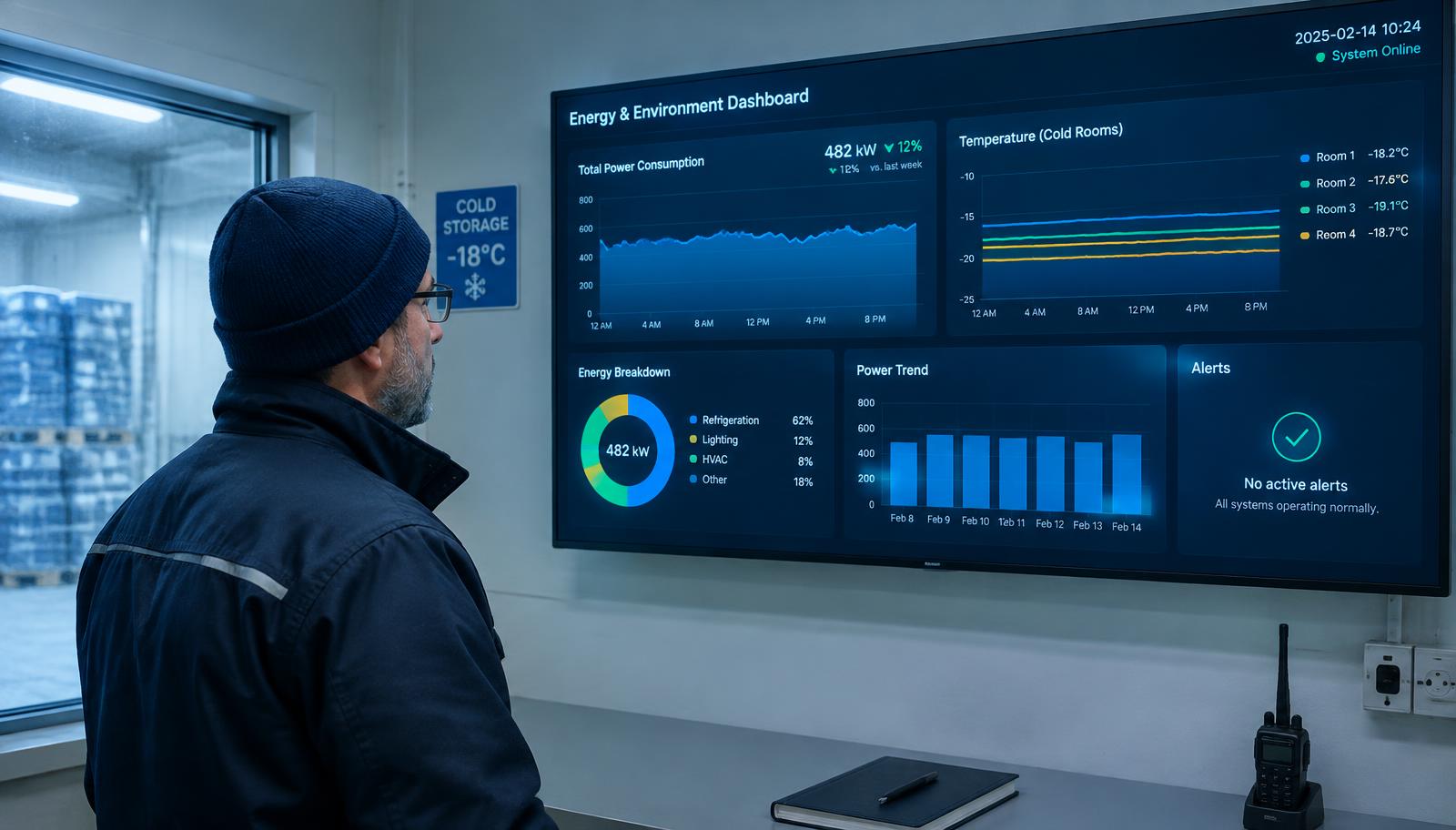
Monitoring makes performance visible after handover. Specify electrical metering, room-temperature records, relevant pressure and temperature trends, alarms and accessible historical data. Review consumption alongside throughput, weather and door activity so operational changes are not mistaken for equipment deterioration. Assign responsibility for investigating persistent deviations.

How should buyers compare supplier energy claims?

Require a common comparison schedule rather than accepting unrelated headline efficiencies. Each supplier should state: - Annual electricity consumption and the method used to estimate it. - Weather, throughput, door-use and temperature assumptions. - Part-load performance and included auxiliary loads. - Defrost energy and any heat-recovery assumptions. - Electricity tariff assumptions, including applicable demand charges. - Exclusions, commissioning scope and proposed performance verification.

Check whether estimates include evaporator fans, condenser fans, pumps, heaters and other refrigeration-related loads. Separate modeled consumption from any contractual performance commitment. Specify how commissioning will verify operation and what ongoing data will support a meaningful review. A structured supplier-proposal comparison helps expose mismatched scope before commercial negotiation.

What belongs in a credible total-cost-of-ownership model?

Total cost of ownership should combine installed capital cost with energy, planned maintenance, inspections, consumables, repairs and expected component replacements over a stated evaluation period. Include end-of-life costs or residual value where material. Treat downtime and product-loss exposure as explicit risk scenarios rather than unsupported expected savings.

Use the same evaluation period, operating assumptions and treatment of future cash flows for every option. Avoid double-counting costs already included in service agreements. Test sensitivity to electricity prices, throughput, weather and maintenance requirements: the preferred solution should remain credible when assumptions change.

A refrigeration TCO calculator can organize that comparison, but supplier evidence must support its inputs. Present both the purchase-price difference and the operating-cost difference. Simple payback can help screening, yet it does not capture replacement timing or costs beyond the payback point.

What are the next steps for a lifetime-cost comparison?

Prepare a project brief covering temperatures, throughput, site conditions, operating schedules, reliability requirements and procurement scope. Request comparable energy estimates and lifecycle-cost schedules before narrowing the supplier list.

ColdMatch Group is Global B2B Group's industrial refrigeration and cold-chain procurement platform, focused on projects of USD 250K+. It is vendor-neutral, with a network of 100+ suppliers, and is not an automatic marketplace. Buyers submit a request; ColdMatch reviews it, prepares a brief and manually introduces qualified suppliers. Learn how the procurement process works, or submit a project for review to begin a structured comparison.

Turn this guidance into comparable supplier quotes for your warehouse or cold store project. ColdMatch is supplier-neutral and free for buyers. For industrial projects from USD 250,000, the team qualifies the brief, contacts suitable suppliers on your behalf and presents organised responses; no automatic supplier connection.

Start a structured cold storage RFQ

Run the numbers

Calculators for this project type

Indicative planning figures only — final sizing belongs to the supplier's or consultant's detailed design.

Refrigeration sizing

Cold storage capacity calculator

Pallet positions, chamber volume and indicative build cost for a refrigerated warehouse.

Energy & backup power

Energy & backup power cost calculator

Annual energy spend from load and running hours, plus the cost of generator hours during outages.

Related solutions
Industrial Pumps Industrial Refrigeration Systems Cold Rooms All solutions
Turn these numbers into a cold storage RFQ Free for buyers · Supplier-neutral · One scope to several suppliers
Request a quote

Frequently asked questions

Plan the numbers before you send an RFQ

The reference pages buyers use most before requesting quotes.

Cold room cost guideUSD/m³ and USD/pallet benchmarks by temperature class.Cold storage construction cost guideCAPEX breakdown: envelope, refrigeration, racking, civil works.Refrigerant phase-out guideF-gas / Kigali timelines and NH3, CO2 and HFO options.Cold storage calculatorSize the room, load and energy spend in under two minutes.Project financingLease, term and export-credit structures for cold chain CAPEX.RFQ BuilderOne structured RFQ to qualified suppliers and EPCs.

In this article

  1. Why can energy matter more than the purchase price?
  2. Which cooling-load assumptions determine the energy bill?
  3. How do insulation and doors reduce refrigeration demand?
  4. Why do defrost and condensing temperature affect compressor work?
  5. Where do variable speed, controls and monitoring add value?
  6. How should buyers compare supplier energy claims?
  7. What belongs in a credible total-cost-of-ownership model?
  8. What are the next steps for a lifetime-cost comparison?

Planning a project?

One brief, reviewed by a specialist, compared across qualified suppliers.

Start your project

Related insights

Planning & Procurement

Free Tools to Size and Compare Cold Storage

Use ColdMatch's free calculators to plan cold room capacity, cooling load, refrigeration energy cost and lifecycle cost, then compare complete proposals.

Procurement & Sourcing

How to Compare Cold Storage Supplier Proposals Like a Pro

What a good outcome looks like: how to compare cold storage and refrigeration proposals on scope, energy, service, risk and price — and avoid the.

Refrigeration Technology

NH₃ vs CO₂ Refrigeration: Total Cost of Ownership Comparison for Large Cold Storage

A vendor-neutral engineering and procurement comparison of ammonia (NH₃, R717) and CO₂ (R744) refrigeration for large-scale cold storage — energy efficiency by climate and evaporating temperature, safety and compliance obligations, capex versus 15-year opex, and how to build a defensible total cost of ownership model before you shortlist suppliers.

Cost & Finance

Cold Storage Refrigeration System Cost: Energy, Refrigerants and 10-Year TCO (2026)

Compare cold storage refrigeration system cost, sizing, CO₂ and ammonia, EU F-gas scope, installed costs and 10-year TCO before a reviewed RFQ.

Procurement

Cold Storage Projects: Engineering & Lifetime Cost First

Why cold storage buyers should fix heat load, temperature, energy and OPEX before comparing supplier prices: formulas, worksheets and a staged roadmap.

Energy

Cold Storage Energy Upgrades: The Cost and ROI Assumptions That Matter

Which assumptions drive the return on energy upgrades in existing cold stores, how to compare options such as controls, drives, condensers and door upgrades, and how to verify results after installation.

Project request

Submit your project for expert review

Send your requirements. A ColdMatch specialist reviews every request, prepares a brief and introduces qualified suppliers — free for qualified buyers.

ColdMatch Group — industrial cooling and cold chain procurement platform
ColdMatchGroup

Because we care more.

ColdMatch Group is the industrial refrigeration and cold-chain procurement platform of Global B2B Group, where commercial and industrial buyers build a project and submit an RFQ; the ColdMatch team validates and organizes it, contacts suitable refrigeration technology and equipment suppliers on the buyer's behalf, and presents organized responses through ColdMatch.

support@coldmatchgroup.com
Follow on LinkedIn
Language
Sourcing & Financing
  • Get Free Quotes
  • RFQ Builder
  • Urgent Procurement
  • Solutions
  • Suppliers
  • Refrigeration Marketplace
  • Global Coverage
  • Project Financing
  • Financing Center
Tools & Knowledge
  • Planning Center
  • Calculators
  • Innovation & Technology
  • Projects Hub
  • Knowledge Hub
  • Cold Chain Answers
  • Cost Benchmarks 2026
  • AI Agents (MCP)
Markets
  • All Country Markets
  • Zambia
  • Ghana
  • Malawi
  • Kenya
  • Nigeria
  • Mauritius
  • Israel
  • Finland
  • Hungary
Company
  • About ColdMatch
  • How ColdMatch Works
  • Solutions by Buyer Type
  • Consultant Partner Program
  • Supplier Qualification
  • Trust Center
  • Case Studies
  • Blog
  • Contact
Business and supplier disclaimer

ColdMatch Group is the industrial refrigeration and cold-chain procurement platform of Global B2B Group, where commercial and industrial buyers build a project and submit an RFQ; the ColdMatch team validates and organizes it, contacts suitable refrigeration technology and equipment suppliers on the buyer's behalf, and presents organized responses through ColdMatch. It helps buyers prepare technical requirements and structured RFQs before suitable third-party suppliers, manufacturers, EPC contractors and turnkey providers are introduced manually. ColdMatch is not an equipment manufacturer, reseller, distributor, EPC contractor, installer, insurer, lender, bank or financial advisor, and is not a party to any supply, construction or finance contract. Quotes, equipment and services are provided solely by the matched third-party supplier, who is solely responsible for quality, delivery, installation, safety and performance. ColdMatch makes no guarantee of availability, price, quality or approval and disclaims all liability for any service provided by a supplier or other third party. See Terms and How ColdMatch Works.

Financing disclaimer: ColdMatch does not provide or guarantee finance. Any financing pathway is evaluated and supplied solely by independent third-party providers under their own checks and terms. See Terms.

ColdMatch Group is the industrial refrigeration and cold-chain procurement platform of Global B2B Group, where commercial and industrial buyers build a project and submit an RFQ; the ColdMatch team validates and organizes it, contacts suitable refrigeration technology and equipment suppliers on the buyer's behalf, and presents organized responses through ColdMatch. It helps buyers prepare technical requirements and structured RFQs before suitable third-party suppliers, manufacturers, EPC contractors and turnkey providers are introduced manually. ColdMatch is not an equipment manufacturer, reseller, distributor, EPC contractor, installer, insurer, lender, bank or financial advisor, and is not a party to any supply, construction or finance contract. Quotes, equipment and services are provided solely by the matched third-party supplier, who is solely responsible for quality, delivery, installation, safety and performance. ColdMatch makes no guarantee of availability, price, quality or approval and disclaims all liability for any service provided by a supplier or other third party. See Terms and How ColdMatch Works.

Disclaimer: ColdMatch Group is the specialized industrial refrigeration and cold-chain procurement platform of Global B2B Group. ColdMatch Group is not a manufacturer, reseller, distributor, EPC contractor, installer, insurer, lender, bank, credit provider, financial advisor, investment advisor, underwriter or regulated financial services provider. Any financing, leasing, trade finance, working capital or project-finance option mentioned on this website is provided solely by independent third-party financing providers, subject to their own eligibility checks, KYC, due diligence, compliance review, approval, terms and documentation. ColdMatch Group does not provide financial advice, does not arrange regulated financial products, does not guarantee financing approval, and is not responsible for any financing decision, offer, rejection, delay, cost, term or outcome. Quotes, equipment, services, delivery, installation, commissioning, warranties and project performance are provided solely by independent third-party suppliers, EPC contractors or service providers. See Terms.

ColdMatch Group · Global Refrigeration & Cold-Chain Sourcing
How ColdMatch Works·Cold Chain Project Markets·Project Guide·RFQ Process·AI Agent Brief·For AI Cold Chain & Refrigeration Procurement Agents·Supplier Qualification·Trust Center·Legal Center·Terms of Service·Privacy Policy·Agency Policy·Contact·Client Login (Buyer Portal)·Accessibility·Accessibility Support
Legal Documents
Terms of Service·Privacy Policy·Agency Policy·Cookie Policy·General Disclaimer·Legal Notice·RFQ Terms·Buyer Terms·Supplier Terms·Financing Disclaimer·Acceptable Use Policy·Marketplace Rules·Intellectual Property & Copyright Policy·Data Protection & GDPR·AML, Sanctions, Export & Anti-Bribery Policy·Cyber Security & Responsible Disclosure·AI & Third-Party Content Disclaimer
EnglishالعربيةעבריתPortuguêsPortuguês (Brasil)РусскийSuomiMagyarTürkçe
Operated from the Republic of Cyprus · We are committed to WCAG 2.1 AA accessibility — report barriers to accessibility@coldmatchgroup.com.© 2026 ColdMatch Group · All rights reserved.ColdMatch Group is the specialized commercial cold-chain platform of Global B2B Group — a global B2B procurement & project development ecosystem. Sister platforms: FishMatch Group, HatchMatch Group, FeedMatch Group, SeedMatch Group. About ColdMatch Group.ColdMatch helps buyers prepare cold chain RFQs and source suitable suppliers. Supplier matching and introductions are managed manually by ColdMatch — not an automatic marketplace. How it works.
CalculatorsGuidesFinancingGet a Quote

Get updates

Cold-chain reading, project resources and technology evidence.

Email subscriptions are not active. Your details will not be sent or saved.

Get updates

Separate from project enquiries. You can unsubscribe or change preferences in every update email once the service is active. Privacy notice