

Quick answer
Build a realistic cold storage project budget before requesting quotes: scope, capacity, cost line items, ten-year operating cost, exclusions and contingency. Building or fit-out scope, envelope, refrigeration, electrical, automation, monitoring, fees, contingency and a clear list of exclusions.
Key takeaways
- What should a cold storage budget include? Building or fit-out scope, envelope, refrigeration, electrical, automation, monitoring, fees, contingency and a clear list of exclusions.
- Where can I find indicative cost ranges? In the ColdMatch cold storage cost guide and the build and operating cost calculator, which use one published baseline.
- Why include operating costs in a project budget? Energy and maintenance over ten years can outweigh differences in build cost and change which option is best.
- How large should contingency be? Larger at concept stage and smaller once detailed design is complete.
Reviewed: Oct 2026 · ColdMatch Group
Short answer: To prepare a cold storage project budget, define the scope and capacity first, use published benchmark ranges to set an indicative figure, split it into clear line items (building, envelope, refrigeration, electrical, automation, equipment, fees), add operating costs over ten years and a contingency, and refine the numbers once suppliers quote against one shared brief.
Many cold storage projects start with a single number — often a figure heard from a contact or seen online — and a vague scope. That leads to proposals that cannot be compared and budgets that grow during construction. This how-to guide explains how buyers build a budget that holds up with lenders, boards and suppliers. It deliberately contains no price figures: all indicative ranges are kept in one place, the cold storage cost guide, so they stay consistent.
Step 1: Define what you are building
Write down the purpose of the facility, products, temperature zones, throughput and expected growth. Decide whether the budget covers land and building shell, or only the cold store fit-out inside an existing building. These choices change the total far more than any equipment selection. Use the cold storage calculator to turn tonnage into pallet positions and floor area.
Step 2: Fix capacity and temperature zones
Capacity in pallet positions or cubic metres, combined with temperature, drives most of the cost. Frozen rooms need thicker insulation, insulated floors and larger plants than chilled rooms. Pharma rooms add monitoring, mapping and documentation. Size each zone separately; our cold room sizing worked example shows the method.
Step 3: Set an indicative figure from benchmarks
With scope and capacity defined, use benchmark ranges to set a first indicative budget. The cold storage build and operating cost calculator gives a planning range by capacity, temperature, scope and region, drawn from the site's published cost guide. Treat this as a starting point, not a quotation.
Step 4: Split the budget into clear line items
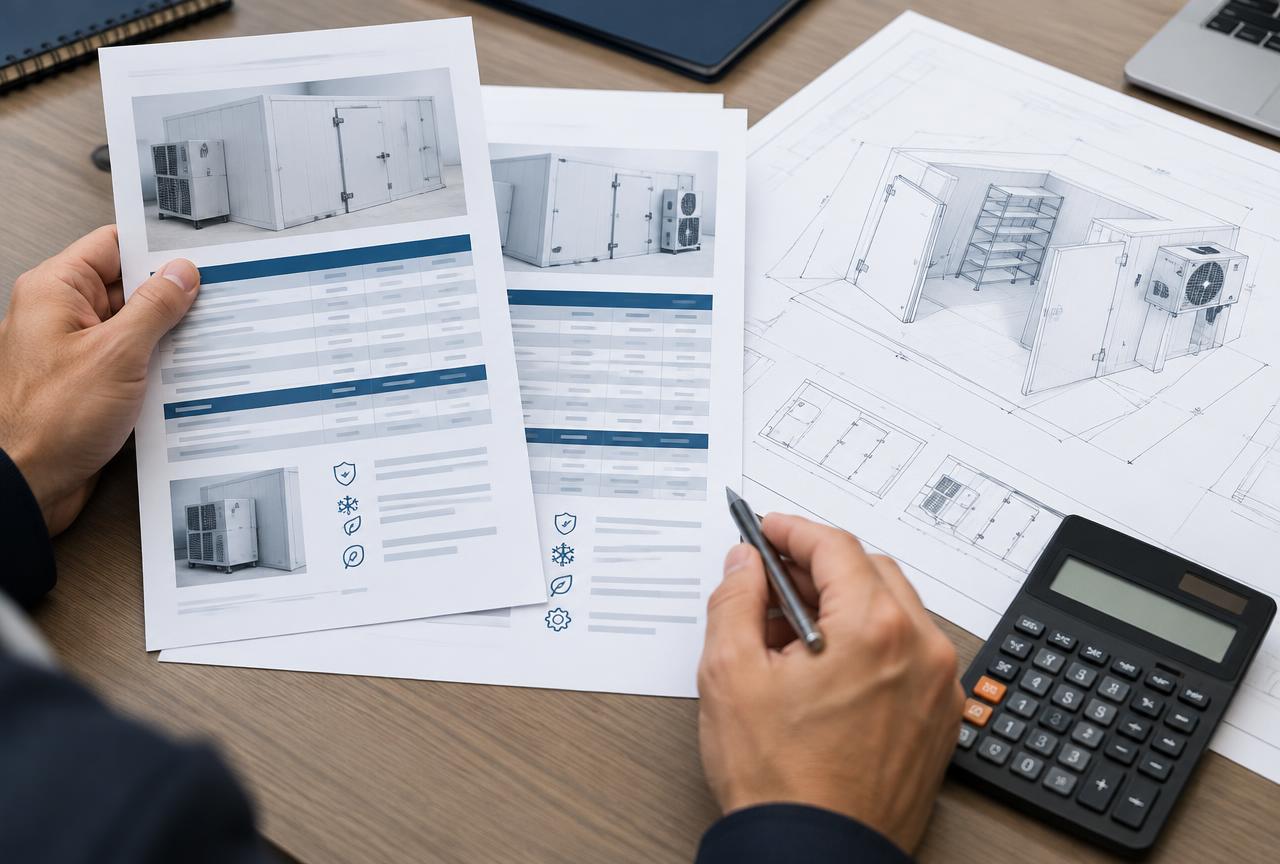
A single total hides risk. Split the budget into lines that suppliers will also quote against:
- Land, permits and site works (if included).
- Building shell and foundations.
- Insulated envelope, floors and doors.
- Refrigeration plant, piping and controls.
- Electrical supply, switchgear and backup power.
- Racking, automation and material handling.
- Monitoring, IT and security.
- Design, engineering, project management and commissioning.
- Contingency.
This structure makes it easy to see where proposals differ and which items one supplier has left out.
Step 5: Add operating costs over ten years
The cheapest plant to build is rarely the cheapest to own. Estimate annual energy, maintenance, staff, insurance and refrigerant costs, and look at a ten-year total. The cold storage OPEX estimator helps with energy and maintenance. Comparing proposals on lifetime cost often changes which option is best; see the ROI and payback guide.
Step 6: Include contingency and exclusions
Every project meets surprises: ground conditions, grid connection delays, design changes, currency movements. Hold a contingency appropriate to how developed the design is — larger at concept stage, smaller once detailed design is complete. List exclusions explicitly, such as duties, taxes, financing costs and land, so nobody assumes they are covered.
Step 7: Refine with supplier quotes
Send one written brief to a small number of qualified suppliers, ask them to quote against your line items, and compare like for like. Our guide on comparing supplier proposals explains what to check. Update the budget with real figures before seeking final approval or financing.
Common mistakes to avoid
- Starting from a single headline number without a defined scope.
- Mixing projects with and without land or building shell in comparisons.
- Ignoring operating costs and judging only on build cost.
- No contingency, or contingency used to absorb scope creep.
- Not stating currency, exchange-rate assumptions and exclusions.
A note on financing
Lenders and investors expect a structured budget, clear scope and realistic operating costs. ColdMatch Group does not lend money or give financial advice; qualified projects may be introduced to independent financing partners. See the financing page for details.
A simple example of budget structure
Consider a processor planning a frozen store with a small chilled area inside an existing building. The first draft budget is one headline number. After defining capacity and zones, the team uses the build and operating cost calculator for a planning range, then splits it into envelope, refrigeration, electrical, racking, monitoring and fees, with a contingency and a list of exclusions: building shell, land, duties and financing. When three suppliers quote against this structure, one has omitted electrical works and another has included racking. Because the line items are fixed, these differences are visible immediately rather than discovered after signing.
Presenting the budget to decision-makers
Boards and lenders want to see more than a total. Present the scope, capacity and temperature zones, the line-item budget, the ten-year operating estimate, contingency, exclusions and the assumptions behind each figure, including currency and exchange rates. State clearly which figures come from benchmarks and which from supplier quotes. A transparent budget builds confidence and makes later changes easier to approve.
Updating the budget during the project
A budget is not fixed at approval. Review it at each design stage and whenever scope changes. Track committed costs against each line, record approved changes, and report how much contingency remains. This discipline keeps surprises visible early, when they are still manageable.
Getting a reviewed brief
For projects of USD 250K and above, ColdMatch Group reviews your scope and budget assumptions, prepares a brief suppliers can price consistently, and introduces vendor-neutral suppliers. Start with the project request form.
Plan it with ColdMatch tools
Turn this guide into project numbers with these planning tools. Results are estimates from your own inputs, not supplier quotations.
- Submit your project for a reviewed supplier brief — For commercial projects from USD 250,000, ColdMatch reviews the brief before introducing independent suppliers.
Related reading: Cold Storage Warehouse Planning: Survey to Contractor · Why Vendor-Neutral Procurement Matters in Cold Chain
Sources and how to read this guide
Regulatory and technical statements refer to the official sources below. Project-specific values such as capacities, loads and costs must be confirmed by your engineer and supplier proposals.
Run the numbers
Calculators for this project type
Indicative planning figures only — final sizing belongs to the supplier's or consultant's detailed design.
Medical cold chain calculator
Vaccine, pharma and ULT storage volume with redundancy and monitoring requirements.
Energy & backup powerEnergy & backup power cost calculator
Annual energy spend from load and running hours, plus the cost of generator hours during outages.
Frequently asked questions
Plan the numbers before you send an RFQ
The reference pages buyers use most before requesting quotes.