
Quick answer
Step-by-step guide to temperature monitoring and mapping in cold stores: sensor placement, alarms, data records, calibration and GDP-ready documentation. A study using many temporary loggers across a room to find warm and cold spots and how the room behaves during loading and defrost.
Key takeaways
- What is temperature mapping? A study using many temporary loggers across a room to find warm and cold spots and how the room behaves during loading and defrost.
- Why should monitoring be separate from refrigeration controls? So a controller fault cannot also hide a temperature problem.
- How often should sensors be calibrated? On a fixed schedule against a traceable reference, typically at least yearly, or as your quality system and customers require.
- Where should permanent sensors go? At the warmest and coldest points found during mapping, plus a reference point near the controller sensor.
Reviewed: Oct 2026 · ColdMatch Group
Short answer: To set up cold storage temperature monitoring, define product limits, choose a monitoring system with independent sensors, map each room to find hot and cold spots, place permanent sensors at those risk points, configure tiered alarms with clear escalation, keep secure records and calibrate sensors on a schedule. Pharma stores must also document all of this to meet GDP expectations.
A refrigeration controller keeps a room at temperature; a monitoring system proves it. Buyers, auditors and insurers increasingly expect continuous, tamper-resistant records. For food, monitoring protects quality and safety; for medicines, it is a regulatory expectation. This how-to guide covers the steps in a practical order. For pharma-specific requirements, also read our pharma GDP cold storage buyer's guide.
Step 1: Define limits and responsibilities
Start with the product. Record the required temperature range for each room — for example +2 to +8 °C for many medicines, or −18 °C and colder for frozen food — and any humidity limits. Check the storage temperature chart for common products. Decide who owns monitoring, who responds to alarms at night and weekends, and who approves deviations.
Step 2: Choose the monitoring system
Monitoring should be independent of the refrigeration controls, so a controller fault does not also hide the problem. Options range from wired sensors to wireless loggers with cloud dashboards. Key questions:
- Does the system keep data if the network or power fails?
- Are records secure, time-stamped and protected against editing?
- Can it send alarms by SMS, phone call and email?
- Does it support audit trails and electronic signatures where required?
- Are sensor accuracy and calibration certificates provided?
Step 3: Map the room before fixing sensor positions

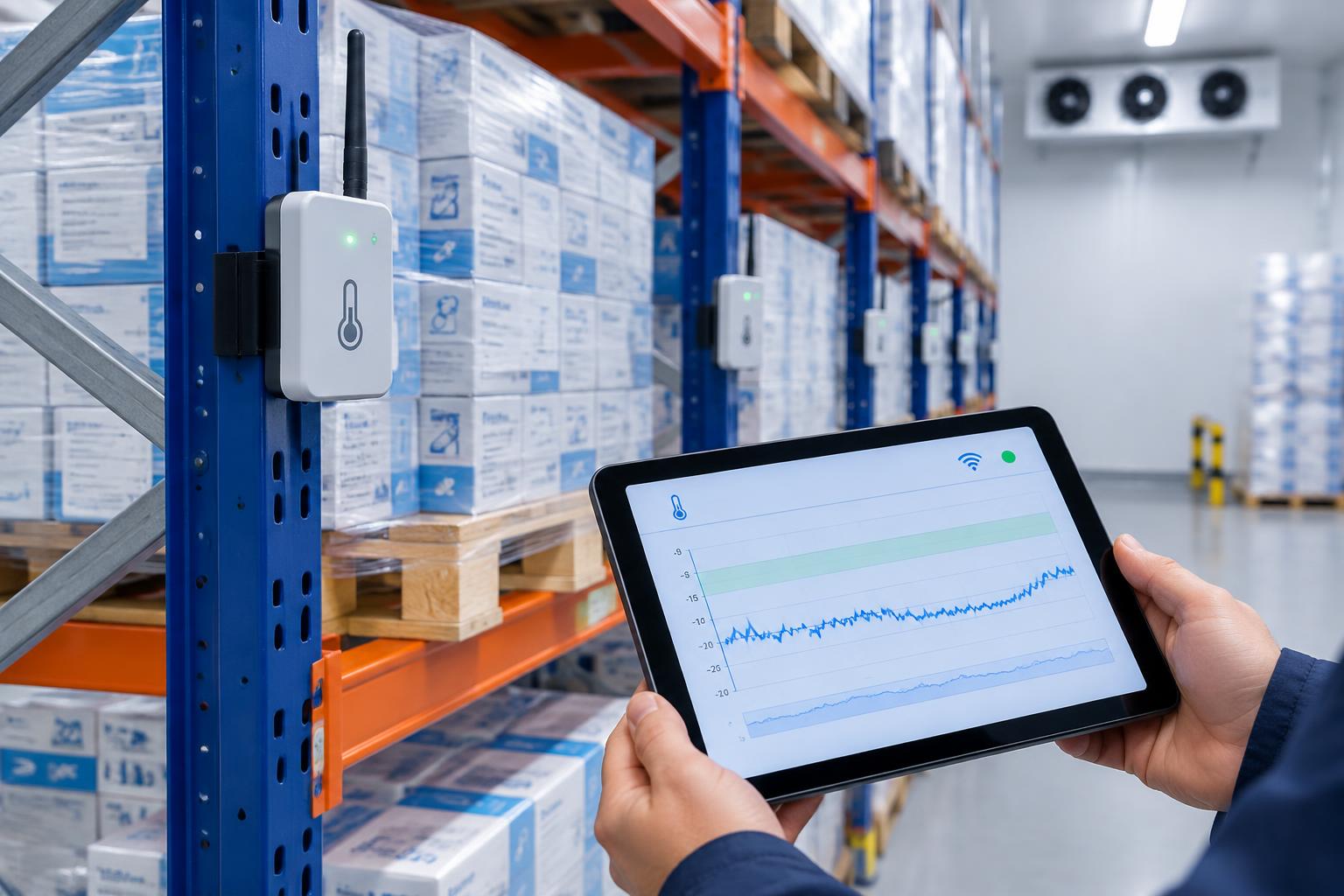
Temperature mapping places many temporary loggers across a room — at different heights, near doors, evaporators, walls and in the middle of racking — for a defined period. It reveals where the room is warmest and coldest, how it behaves during loading and defrost, and how quickly it recovers after a door opening.
Map empty and loaded conditions where possible, and in summer and winter for rooms affected by outside climate. The results tell you where permanent sensors belong. Repeat mapping after significant changes such as new racking, a new evaporator or a change of use.
Step 4: Place permanent sensors at risk points
Place permanent sensors at the warmest and coldest locations found in mapping, plus a reference point near the controller sensor. Avoid locations directly in the air discharge of evaporators, which can mislead. Large rooms need more sensors; tall racking needs sensors at several heights. Label every sensor and record its position on a plan.
Step 5: Configure alarms that people act on
Use tiered alarms: a warning when temperature approaches the limit, and an alarm when it exceeds the limit for a set time. Short delays prevent false alarms during door openings and defrost, but delays must not hide real excursions. Define an escalation chain — first responder, supervisor, manager — and test it regularly, including at night.
Step 6: Keep records and calibrate
Store data securely for the period your customers and regulations require. Review trends weekly, not only alarms; slow drifts often warn of maintenance problems before they cause an excursion. Calibrate sensors against a traceable reference on a fixed schedule and keep the certificates. Document every excursion, its cause, its impact on product and the corrective action.
Common mistakes to avoid
- Relying only on the refrigeration controller display.
- Placing sensors where it is convenient rather than where mapping shows risk.
- Alarm delays so long that excursions are missed.
- No one assigned to respond outside working hours.
- Skipping re-mapping after layout changes.
Monitoring in new projects
In a new cold store, include monitoring in the initial specification rather than adding it later. Ask suppliers to quote mapping during commissioning, the monitoring system, alarm integration and training. Our commissioning and handover guide describes how mapping fits into acceptance testing, and the cold storage health check helps existing sites spot gaps.
A short example
A distributor adding a +2 to +8 °C room for medicines maps the empty room over several days and finds a warm zone near the dock door and a cold zone under the evaporator. Permanent sensors are placed in both zones and at the controller reference point. Alarms go first to the shift supervisor and then to the quality manager. During the first summer, weekly trend reviews show the warm zone drifting upward; a door seal is replaced before any excursion occurs.
Choosing between wired and wireless sensors
Wired sensors are robust and do not depend on batteries or radio coverage, which suits large permanent installations and harsh freezer environments. Wireless loggers are faster to install, easy to move during mapping and convenient for existing buildings where cabling is difficult. Many sites combine both: wired sensors at critical permanent points and wireless loggers for mapping and temporary checks. Whichever you choose, confirm battery life at your operating temperature, signal coverage through insulated panels and steel racking, and what happens to data if a gateway goes offline.
What auditors usually ask to see
Auditors and demanding customers typically ask for the mapping report, the sensor location plan, calibration certificates, alarm settings and escalation list, records of alarm tests, and the log of excursions with corrective actions. Keeping these documents together in one controlled file saves time during every audit and shows that monitoring is managed, not just installed.
Using data to improve operations
Monitoring data is not only for compliance. Recovery time after loading shows whether door practices are working; rising temperatures during defrost can reveal settings that need adjustment; and slow upward drift often signals dirty coils or failing seals. Reviewing these patterns with maintenance staff turns the monitoring system into an early-warning tool.
Planning a project?
For new builds and major upgrades of USD 250K and above, ColdMatch Group prepares a clear brief that includes monitoring and mapping requirements, and introduces vendor-neutral suppliers. Start with the project request form.
Plan it with ColdMatch tools
Turn this guide into project numbers with these planning tools. Results are estimates from your own inputs, not supplier quotations.
- Submit your project for a reviewed supplier brief — For commercial projects from USD 250,000, ColdMatch reviews the brief before introducing independent suppliers.
Related reading: Cold Storage Design for Hot Climates: Planning Guide · Cold Storage Warehouse Planning: Survey to Contractor
Sources and how to read this guide
Regulatory and technical statements refer to the official sources below. Project-specific values such as capacities, loads and costs must be confirmed by your engineer and supplier proposals.
Run the numbers
Calculators for this project type
Indicative planning figures only — final sizing belongs to the supplier's or consultant's detailed design.
Medical cold chain calculator
Vaccine, pharma and ULT storage volume with redundancy and monitoring requirements.
Energy & backup powerEnergy & backup power cost calculator
Annual energy spend from load and running hours, plus the cost of generator hours during outages.
Frequently asked questions
Plan the numbers before you send an RFQ
The reference pages buyers use most before requesting quotes.