
Quick answer
Plan a GDP-compliant pharmaceutical cold store: temperature zones, mapping, monitoring, redundancy, validation and the RFQ details suppliers need to quote. GDP requires that products are stored within their labelled temperature ranges, that storage areas are qualified and temperature-mapped, that temperatures are continuously monitored with alarms, and that procedures, records and corrective actions are documented.
Key takeaways
- What does GDP require for pharmaceutical cold storage? GDP requires that products are stored within their labelled temperature ranges, that storage areas are qualified and temperature-mapped, that temperatures are continuously monitored with alarms, and that…
- Is N+1 refrigeration mandatory for a 2–8 °C pharma room? GDP does not name a redundancy level, but you must show that a single failure will not put product at risk.
- How often should a pharma cold room be temperature-mapped? Map before first use in empty and loaded states and in seasonal extremes, after significant changes to equipment or layout, and periodically according to your risk assessment and quality system.
- Who provides validation documents — the supplier or a consultant? Either can, depending on contract.
Reviewed: Oct 2026 · ColdMatch Group
Pharmaceutical cold storage is judged by one question: can you prove that every product stayed within its labelled temperature range from the moment it arrived to the moment it left? Good Distribution Practice (GDP) — set out in the EU GDP Guidelines (2013/C 343/01), WHO technical guidance and national equivalents — turns that question into requirements for design, equipment, monitoring and documentation. This guide explains what those requirements mean for a buyer building or upgrading a pharma cold store, which decisions drive cost and risk, and what to include in a request for quotation so suppliers quote the same project.
Short answer: a GDP-ready cold store needs defined temperature zones, a qualified refrigeration design with redundancy, continuous independent monitoring with alarms, temperature mapping in empty and loaded states and in seasonal extremes, documented qualification (DQ, IQ, OQ, PQ), backup power and written procedures. The building is only half the project; the evidence is the other half.
Temperature zones and what they demand
Most pharma facilities combine several ranges. Controlled room temperature (15–25 °C) is the largest zone in many distribution centres. The 2–8 °C cold room holds vaccines, insulin, biologics and many injectables and is where most compliance risk sits. Frozen zones (−15 °C to −25 °C) and ultra-low freezers (−60 °C to −80 °C and below) serve specific biologics and cell and gene therapies. Each zone needs its own control strategy, alarm limits and mapping plan. Define volumes per zone early — our pharmaceutical cold room calculator and pharma capacity planner help translate pallet counts into room sizes.
Design principles that make compliance easier
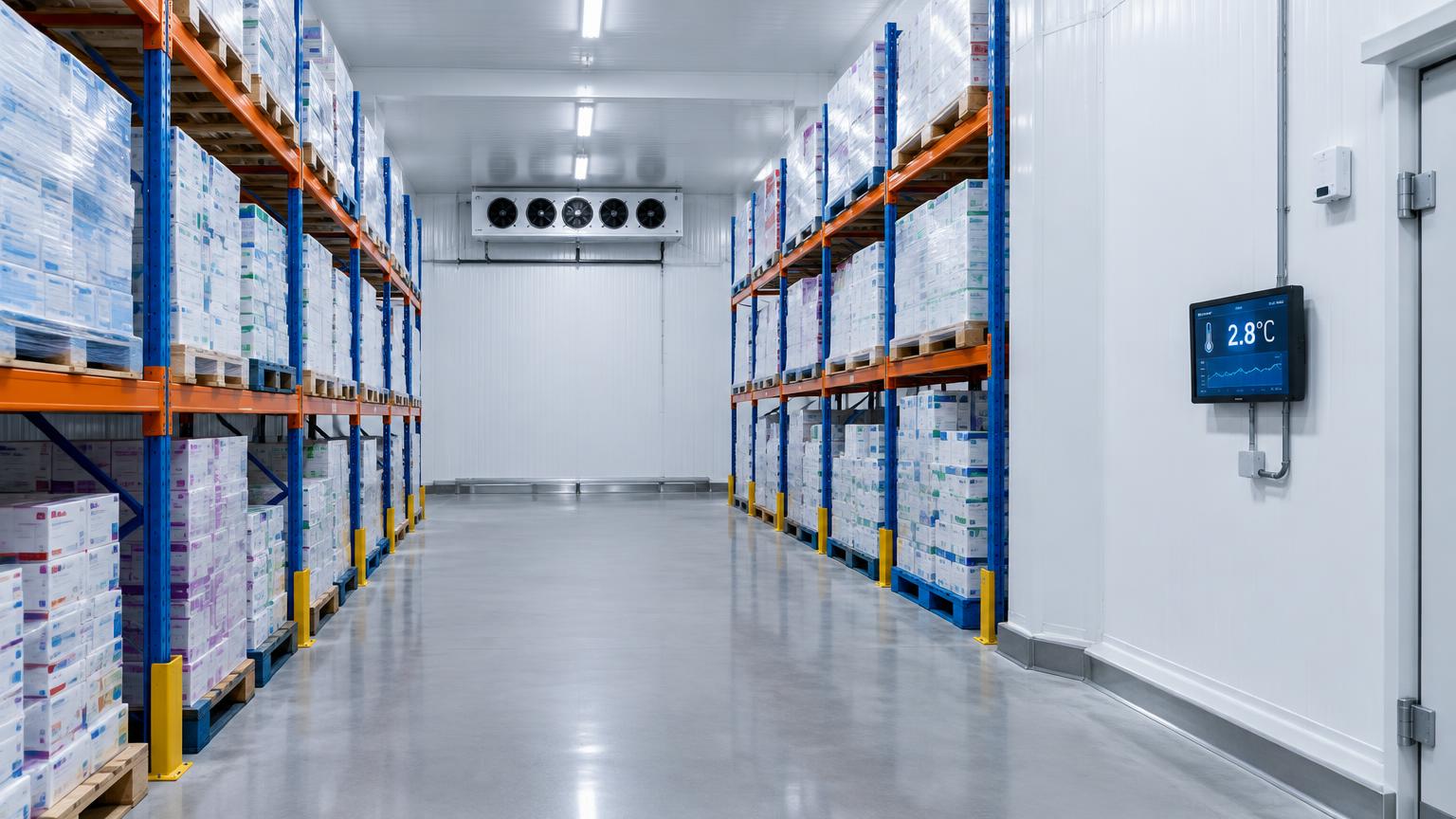
Temperature uniformity is the core design goal. In a 2–8 °C room, air distribution matters as much as capacity: evaporators must be positioned and sized so that no rack position drifts outside range, including top levels near the ceiling and positions close to doors. Practical measures include:
- Insulated panels with adequate thickness, sealed joints and thermal-break floors to avoid cold bridges and condensation.
- Anterooms or airlocks and fast-acting doors to limit warm-air infiltration at loading points — check the load with the door infiltration calculator.
- Controlled defrost strategies so defrost cycles do not cause temperature excursions.
- Hygienic, cleanable surfaces and layouts that keep products off walls and floors.
- Separation of quarantine, released, returned and rejected stock.
Redundancy: designing for failure
GDP does not prescribe a specific redundancy level, but inspectors expect you to show that a single equipment failure will not put product at risk. For 2–8 °C rooms this usually means N+1 refrigeration — two independent units or circuits, each able to hold the room alone — with automatic changeover. Backup power from a generator sized for refrigeration and monitoring, plus UPS for controls and data loggers, closes the most common failure path. The pharma refrigeration redundancy planner and backup generator calculator help you size these elements before supplier discussions.
Monitoring, alarms and data integrity
Monitoring must be continuous, independent of the control system and calibrated. Sensors are placed at the positions identified by mapping as the warmest and coldest. Alarms need defined thresholds, escalation to on-call staff around the clock and tested response procedures. Data must be secure, attributable and retained — computerised systems are expected to follow data integrity principles such as ALCOA+ and, where applicable, EU GMP Annex 11 or 21 CFR Part 11. Ask suppliers whether the monitoring system is supplied, validated and supported by them or by a specialist third party.
Temperature mapping and qualification

Before a room stores product it must be qualified. Design qualification confirms the specification meets requirements; installation qualification confirms what was built matches the design; operational qualification tests the room's performance, alarms and recovery after door openings or power loss; and performance qualification proves it under real load. Temperature mapping — data loggers placed in a three-dimensional grid — is repeated in empty and loaded states and in summer and winter conditions. Mapping should be repeated after significant changes and periodically thereafter. Clarify in your RFQ whether the supplier delivers qualification documents and mapping, or whether a separate validation contractor does.
Cost and risk drivers
The equipment price is usually not the largest variable. Costs and risks come from:
- Redundancy level and automatic changeover.
- Monitoring and validation scope, including software validation.
- Mapping and qualification across seasons.
- Energy: 2–8 °C rooms run year-round; efficient design pays back — test it with the pharma cold storage energy calculator.
- Climate and power quality: hot climates and unstable grids raise capacity and backup needs.
- Service: guaranteed response times and spare parts held locally.
For budget ranges based on ColdMatch's published baseline, see the cold storage cost guide. Treat early numbers as ranges until suppliers quote against a defined scope.
Refrigerant and system choice
Pharma rooms are often served by packaged condensing units or chillers with secondary glycol loops; larger warehouses may use central NH₃ or CO₂ plants. The refrigerant decision depends on size, climate and occupied-space safety — compare options in our NH₃ vs CO₂ refrigeration guide. Whatever the system, the requirement is the same: stable temperature, redundancy and documented performance.
RFQ checklist for pharma cold storage
Give suppliers enough detail to quote a comparable, compliant scope:
- Product categories and temperature ranges per zone, with pallet positions and throughput.
- Applicable regulations: EU GDP, WHO, national authority rules, client quality agreements.
- Site data: location, design ambient temperature, power availability and quality.
- Redundancy requirement, backup power and changeover expectations.
- Monitoring system scope, alarm escalation and data retention.
- Qualification deliverables: DQ, IQ, OQ, PQ, mapping protocols and reports.
- Installation, commissioning, training, service levels and spare-parts strategy.
- Timeline, budget band and decision process.
Use the pharma cold chain readiness planner and the pharmaceutical cold chain checklist to prepare, then the RFQ builder to submit.
How ColdMatch supports pharma buyers
ColdMatch Group is a supplier-neutral procurement platform. It does not design, validate or certify facilities and does not replace your quality team or validation consultant. A specialist reviews your request, prepares a structured brief and introduces qualified suppliers of pharma-grade cold rooms, refrigeration and monitoring for projects from USD 250K upward, so proposals arrive on the same basis. There is no sourcing fee for qualified buyers. When your scope is ready, start your project.
Run the numbers
Calculators for this project type
Indicative planning figures only — final sizing belongs to the supplier's or consultant's detailed design.
Medical cold chain calculator
Vaccine, pharma and ULT storage volume with redundancy and monitoring requirements.
Energy & backup powerEnergy & backup power cost calculator
Annual energy spend from load and running hours, plus the cost of generator hours during outages.
Frequently asked questions
Plan the numbers before you send an RFQ
The reference pages buyers use most before requesting quotes.