
Quick answer
A practical way to plan a cold storage warehouse or industrial refrigeration project: write one design basis — product, temperature bands, throughput, site, uptime, energy, monitoring and service — so every supplier quotes on the same assumptions. The written assumptions a system is designed to: products, temperature bands, throughput, peak load, site and ambient conditions, uptime, energy, monitoring and service scope.
Key takeaways
- What is a design basis in industrial refrigeration? The written assumptions a system is designed to: products, temperature bands, throughput, peak load, site and ambient conditions, uptime, energy, monitoring and service scope.
- What temperature should my cold storage warehouse run at? It depends on the product, its state and the rules that apply.
- Why do refrigeration quotes differ so much? Usually because suppliers assumed different peak loads, ambient conditions, redundancy or scope.
- Do I need an engineer if I use the calculators? Yes for final design.
Reviewed: Oct 2026 · ColdMatch Group
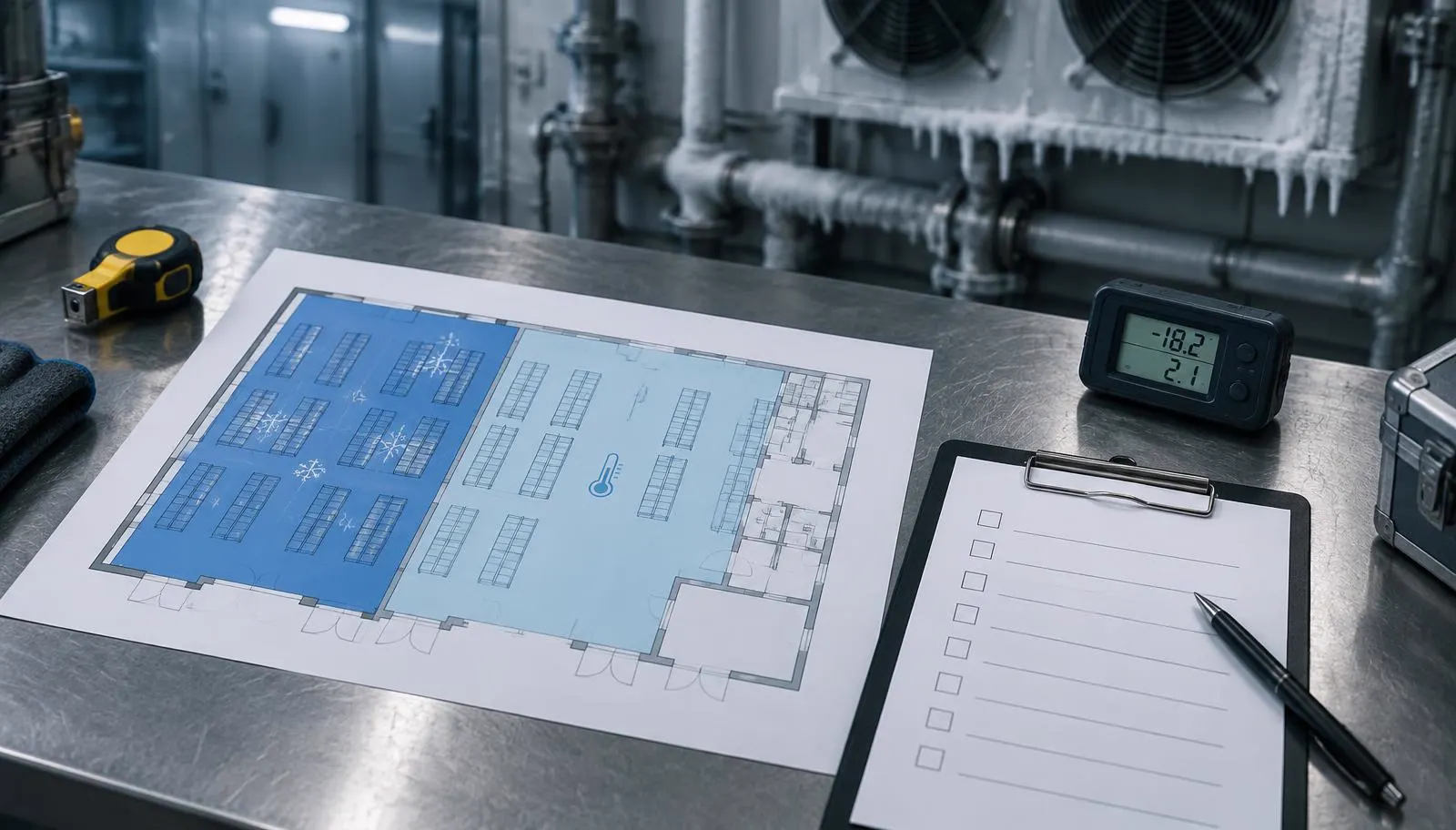
Short answer: before asking anyone for a price, write a one-page *design basis* — the shared assumptions every refrigeration supplier must design to. It covers what you store, the temperature bands your product documentation requires, how much moves in and out on a peak day, the site and climate, how much downtime you can tolerate, energy and lifecycle cost, monitoring, maintenance, commissioning and service. When every proposal answers the same design basis, you can compare them honestly.
Key takeaways
- A design basis is a list of assumptions, not a design. Suppliers and qualified local engineers do the design.
- Most "cheaper" quotes are cheaper because they assume something different — a lower peak load, a milder climate or fewer redundant parts.
- Our planning calculators and guides are free for buyers, with no subscription or obligation.
- Final sizing, setpoints and code compliance must be confirmed by qualified local professionals.
What is a design basis for a cold-chain project?
A design basis is the written set of inputs a refrigeration system is designed against. Think of it as the question every supplier answers. Without it, one contractor sizes for an average day, another for the worst week of summer, and their prices cannot be compared.
1. Product and temperature bands
List each product, its state (fresh, chilled, frozen) and the storage range stated in the product specification, customer contract or regulation — not a number copied from the internet. Note products that must be kept apart because their ranges or odours differ. Each distinct band usually becomes its own room or zone.
2. Daily throughput and peak load
Record pallets or tonnes received and dispatched per day, the *peak* day or season, and the temperature at which product arrives. Warm product arriving in bulk is often a large share of the refrigeration load, so a realistic peak matters more than an annual average. The free cold room size calculator turns pallet counts into a first estimate of floor area and volume.
3. Storage and dispatch flow
Sketch how goods move: receiving dock, any pre-cooling or blast freezing, storage, picking and dispatch. Count door openings and dock positions, and state forklift type and racking. Material flow drives door heat gain, floor layout and the number of evaporators.
4. Site, building envelope and ambient conditions
State whether this is a new build or a retrofit, the available electrical capacity, water, roof and plant space, and the local design summer temperature from a recognised source. Insulation, floor heating and vapour barriers belong in the same package as refrigeration, or the interface must be written down.
5. Redundancy and uptime
Decide what happens if one compressor, evaporator or power feed fails. Write the outcome you need (for example, "hold product within range during a single component failure") and let suppliers propose how — spare capacity, split circuits or backup power. The free backup generator sizing calculator can frame the power question.
6. Energy and lifecycle cost
Ask each supplier to state efficiency at defined conditions and estimate annual energy, then price it with your own tariff in the electricity cost calculator. The U.S. Department of Energy's Better Buildings refrigeration resources collect practical efficiency measures, and its cold-storage data-analytics case study shows how one operator used measured data to manage energy. Treat such examples as context, not a promise for your site.
7. Monitoring, maintenance and service scope
Specify what is monitored (room temperatures, alarms, door status, energy), who receives alarms and how records are kept. Our cold-chain monitoring planner helps scope sensors and data. Then define maintenance: visit frequency, response time, spare parts held locally and who handles refrigerant records.
8. Commissioning and acceptance
Write acceptance tests into the request: pull-down to the agreed range under stated conditions, alarm and backup tests, defrost checks, documentation and operator training. ASHRAE publishes a free refrigeration commissioning guide that is a helpful reference.
The one-page design basis checklist
| Item | What you provide | What each supplier must state |
|---|---|---|
| Products & temperature bands | Products, states, documented ranges, separation needs | Rooms/zones designed and how ranges are held |
| Throughput & peak | Daily in/out, peak day, entry temperature | Load basis and margin used |
| Flow | Docks, doors, racking, forklifts | Door protection and evaporator layout |
| Site & ambient | Power, water, space, design summer temperature | Assumed ambient and site works excluded |
| Redundancy | Failure tolerance required | How it is achieved |
| Energy | Your tariff and operating hours | Efficiency at stated conditions, annual kWh estimate |
| Monitoring | Points, alarm recipients, record keeping | System offered, data access |
| Service | Response time, spares expectation | Maintenance plan, local presence, warranty |
| Commissioning | Acceptance tests and documents | Tests included in price |
How do you compare proposals on equivalent assumptions?
Put each proposal into the same rows. Mark anything a supplier did not state as *missing*, ask them to confirm it, and only then compare price. The free proposal comparison matrix lays quotes side by side and lists the follow-up questions. A higher price that includes redundancy, commissioning and a local service plan may be the like-for-like cheaper option.
Where can ColdMatch help?
Everything above can be done on your own with our free tools — no subscription, no obligation. If you would like help, for commercial and industrial projects of USD 250,000 or more our team can review your design basis, organise it into an RFQ and contact suitable manufacturers and suppliers on your behalf so you can compare fit and proposals. This is optional; we cannot guarantee that a particular supplier will respond, and you decide whether and whom to select. To start, build your RFQ.
*Written by the ColdMatch editorial team, reviewed October 2026. Planning guidance only — not engineering, food-safety or legal advice. Final design, setpoints and code compliance require qualified local professionals.*
Run the numbers
Calculators for this project type
Indicative planning figures only — final sizing belongs to the supplier's or consultant's detailed design.
Fruit & vegetable cold storage ROI calculator
Pre-cooling and storage capacity plus indicative payback from spoilage reduction.
Energy & backup powerEnergy & backup power cost calculator
Annual energy spend from load and running hours, plus the cost of generator hours during outages.
Frequently asked questions
Plan the numbers before you send an RFQ
The reference pages buyers use most before requesting quotes.