
Cold Storage: Types, Temperatures, Capacity, Cost and Procurement
9 min read · Updated 2026-09-13
Cold storage is temperature-controlled warehousing that holds products within a defined temperature band — typically +12 to +15 °C for controlled ambient, +2 to +8 °C for chilled and pharmaceutical goods, 0 to +4 °C for fresh produce and −18 to −25 °C for frozen goods, with deep-freeze and ULT facilities going lower. A cold storage facility is defined by its product, temperature class, pallet capacity, daily throughput, insulated envelope, refrigeration load and energy supply. Those parameters, not floor area, determine the plant size, construction cost and running cost, and they should be defined before suppliers are approached.
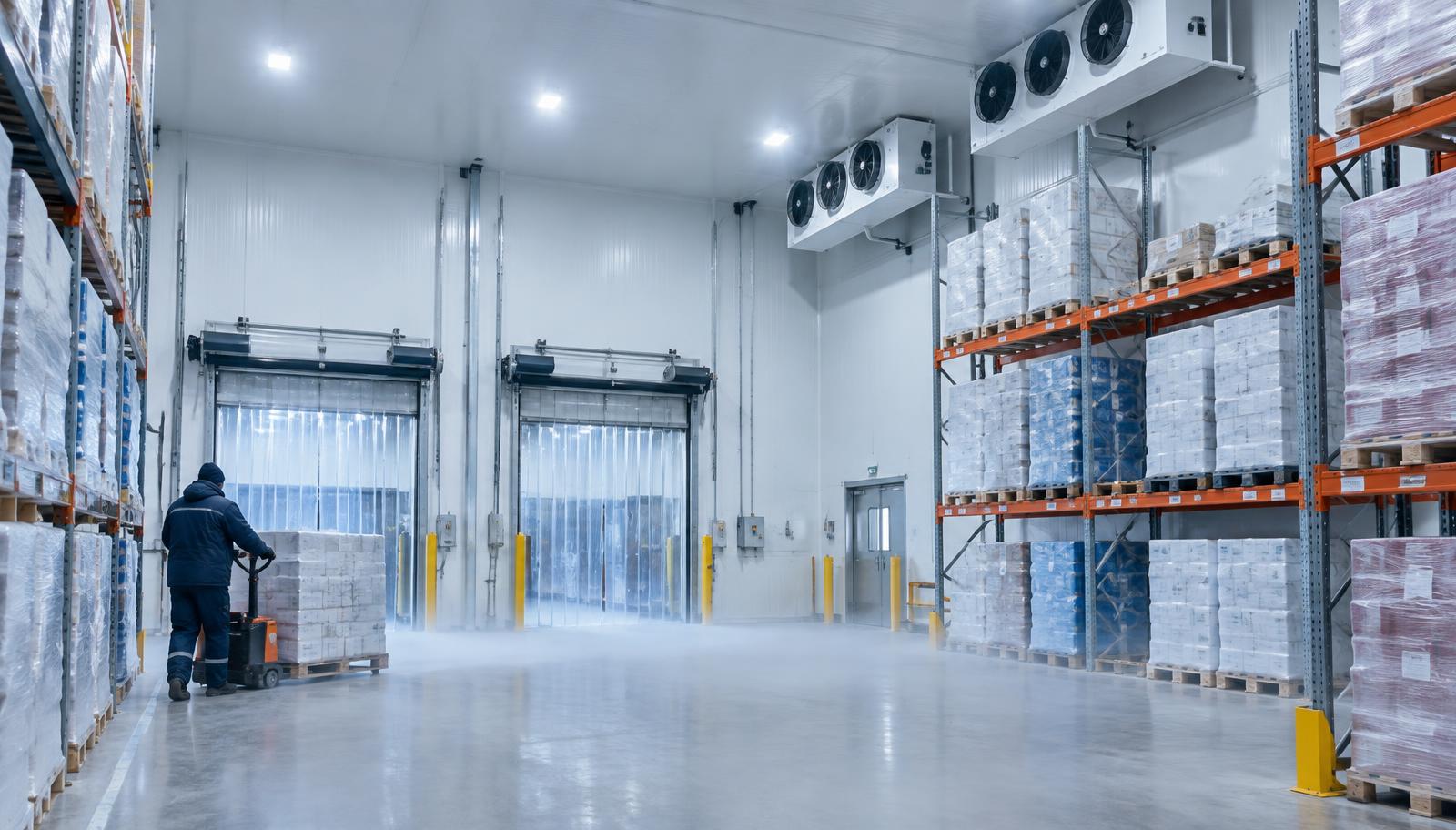
Cold storage projects are usually described in square metres and budgets. They are decided by product, temperature, throughput, climate and energy — and those are the parameters a refrigeration supplier needs before a quotation means anything.
This guide covers what a cold store is, the main facility types, temperature classes, how capacity and cooling load are calculated, the technology and envelope choices that follow, what it costs to build and run, and how to structure the RFQ.
Sizing a cold store? Start with the cold room capacity and load calculator and the cold storage cost calculator before requesting supplier quotations.
Key takeaways
- Temperature class, not floor area, drives plant size, cost and energy consumption.
- Capacity is measured in pallet positions and stored tonnage at peak, not square metres.
- An indicative cooling load calculated before the RFQ makes quotations comparable.
- The insulated envelope and controls are part of the refrigeration system.
- Electricity over the facility life often exceeds the original plant purchase price.
1. What cold storage actually is
A cold store is not a refrigerated box. It is a system in which the insulated envelope, the refrigeration plant, the controls and the way the building is operated each set limits on the others.
The product decides the temperature band. The temperature band and the daily intake decide the heat that must be removed every hour. The envelope decides how much of that heat leaks back in. The controls and the operating discipline decide how much of the design efficiency survives real traffic.
- Insulated envelope: panels, floor build-up, vapour control, doors and dock seals
- Refrigeration plant: compressors, condensers, evaporators, refrigerant and piping
- Distribution and airflow: fan selection, coil placement, racking clearance
- Controls, monitoring and alarms, including out-of-hours response
- Operating discipline: door traffic, defrost timing, stock rotation, housekeeping
2. Types of cold storage facility
Different applications place very different demands on the same nominal volume. Naming the type early stops a quotation from being priced as generic warehousing.
- Chilled distribution stores for dairy, meat, produce and retail supply
- Frozen and deep-freeze stores for food, seafood and long-hold inventory
- Blast freezing, IQF, spiral and plate freezing before frozen holding
- Pre-cooling, ripening and controlled-atmosphere rooms for fresh produce
- Pharmaceutical and GDP-qualified stores requiring mapping and validation
- Multi-temperature 3PL warehouses with mixed chambers and dock strategies
- Mobile, containerised and solar cold rooms for temporary or off-grid sites
Explore by type: industrial cold storage, refrigerated warehouses, blast freezing, 3PL cold storage, mobile cold rooms and solar cold rooms. See also cold storage project profiles with temperature, capacity, technology and energy cost, and the cold room case study that runs one project from cooling load to a comparable cold room RFQ.
3. Temperature classes and what they change
Temperature class is the single largest driver of plant size, insulation specification and lifetime energy cost. It also decides which suppliers can credibly quote.
| Temperature class | Typical applications | Planning considerations |
|---|---|---|
| Controlled ambient, roughly +12 to +15 °C | Pharmaceutical CRT, dry goods, chocolate | Lighter plant, but tolerance and monitoring still apply |
| Chilled, +2 to +8 °C | Dairy, meat, pharmaceuticals, ready meals | Tight setpoint control, frequent short door traffic |
| Fresh produce, 0 to +4 °C | Fruit, vegetables, flowers | High humidity, airflow uniformity, pre-cooling duty |
| Frozen, −18 to −25 °C | Frozen food, seafood, logistics holding | Thicker envelope, floor heating, defrost strategy |
| Blast freezing and lower | Freezing lines, ULT and specialist storage | High peak duty, separate from holding load |
Application detail: pharma cold storage design, food cold chain and the Cold Chain Hub.
4. Capacity: pallet positions, not square metres
Floor area is a poor proxy for capacity. Two stores with identical footprints can differ by thousands of pallet positions once clear height, racking type and aisle strategy are decided.
Work from usable volume to pallet positions, then to stored tonnage at real product density, then check the number against peak season and the daily intake and dispatch profile.
- Clear internal height and permitted stacking or racking height
- Racking type: selective, drive-in, push-back, mobile or automated
- Aisle widths, handling equipment and airflow clearances
- Pallet footprint, overhang and product density per pallet
- Peak stored tonnage, not annual average
- Daily intake and dispatch, dock capacity and staging space
5. Calculate the refrigeration load before buying equipment
The cooling load is the number that makes quotations comparable. Without it, each supplier fills the gap with its own assumption about ambient temperature, intake and door traffic — and the plant sizes diverge.
The load components are the product pull-down or freezing duty, transmission through the envelope, door infiltration, and internal gains from fans, lighting, people, forklifts and defrost. Add a safety margin, then divide by the compressor running hours per day to get the design duty in kW.
- Product load: incoming temperature, daily tonnage, required pull-down or freezing time
- Transmission: panel thickness, floor build-up, roof exposure and ambient design temperature
- Infiltration: door count, door type, protection and openings per day
- Internal gains: evaporator fans, lighting, people and handling equipment
- Defrost load and its scheduling
- Safety margin and assumed compressor running hours per day
Run indicative numbers with the refrigeration load calculator, cooling load calculator, cold room size calculator, electricity cost calculator and the full calculator directory. Results are indicative planning figures, not an engineering design.
6. Refrigeration technology options
There is no universally best refrigeration system. Scale, temperature, regulation, available service expertise and site conditions decide which options are plausible for a given project.
| System | Typical strengths | Planning considerations |
|---|---|---|
| Ammonia (NH₃) | High efficiency at industrial scale, low-GWP natural refrigerant | Toxicity, machinery-room separation, safety systems, trained operators |
| CO₂ (R744) | Natural, low-GWP, suits transcritical and cascade layouts | High operating pressure, hot-ambient adaptation, specialist service |
| HFC / HFO packaged | Fast deployment, compact plant, wide service availability | Refrigerant regulation and phase-down, long-term running cost |
| Centralised plant | Efficiency and redundancy across multiple chambers | Plantroom space, pipework runs, higher upfront engineering |
| Packaged / monoblock | Simple installation, suits smaller rooms and phased builds | Limited scalability, per-unit efficiency and noise |
Deeper reading: industrial refrigeration hub, ammonia refrigeration, CO₂ refrigeration, CO₂ vs ammonia, compressors and pump stations.
7. Insulation, floors and doors are part of the plant
The envelope sets the transmission and infiltration load that the plant must remove every hour for the life of the building. Money saved on panel thickness, floor insulation, vapour control or door quality usually reappears as permanent energy cost and, in frozen stores, as structural risk.
- Panel core and thickness matched to the temperature class
- Joint quality, vapour barriers and thermal-bridge detailing
- Floor insulation and, for frozen stores, heating against frost heave
- Door type, count and protection: air curtains, strip curtains, high-speed doors
- Dock seals, staging areas and traffic routing
See insulated panels and the cold room insulation guide.
8. Energy cost over the life of the facility
Cold storage is an energy asset. Annual electricity consumption follows the refrigeration duty, running hours, climate, envelope and operating discipline, then gets priced at the local tariff.
Model the running cost during planning, not after commissioning. It changes which technology, which insulation specification and which level of control and monitoring are actually the cheaper decision.
See energy optimisation, cold room energy costs and the cold storage cost benchmarks.
9. Backup, redundancy and product risk
Ask what a failure costs before deciding how much redundancy to buy. A store holding high-value pharmaceutical or seafood inventory justifies N+1 plant, standby power and alarm escalation that a low-value dry-adjacent chilled room does not.
- Tolerable downtime and thermal buffer before the product is at risk
- N+1 compressors or split plant against single points of failure
- Standby generation and automatic changeover
- Continuous monitoring, alarm escalation and documented response
- Critical spares held locally and service response times
10. Structure the cold storage RFQ
One structured RFQ sent to several qualified suppliers produces quotations that can be compared line by line. Several informal enquiries produce five documents built on five different sets of assumptions.
Use the RFQ builder, the cold room RFQ page and how to prepare a cold storage RFQ.
11. Compare complete solutions, not equipment prices
Normalise quotations before comparing them: same ambient design temperature, same room temperature, same intake, same insulation specification and the same scope boundaries. Then compare capacity, inclusions, exclusions, energy assumptions, redundancy, warranty and service coverage. Only after that is the price line meaningful.
12. How ColdMatch supports cold storage procurement
ColdMatch Group is the industrial refrigeration and cold-chain procurement platform of Global B2B Group. It is not a manufacturer, contractor, EPC firm, engineering consultancy or lender, and it is not an automatic marketplace — buyers are never connected to suppliers automatically.
Buyers use the calculators and guides to structure the requirement. When a project is submitted, David and the human team review it and prepare a brief before any supplier search begins, generally from USD 250,000 expected total project value. Below that threshold, the educational guidance and calculators remain freely available.
Neither ColdMatch nor Global B2B Group lends or gives financial advice. Qualified projects may be introduced to independent financing partners. See also why projects should start with the cooling requirement.
Cold storage planning checklist
Work through this before any supplier conversation. Mark each line as confirmed, assumed or still open.
- Product, packaging and hygiene or GDP requirements
- Required storage temperature, humidity and tolerance
- Incoming product temperature and required pull-down or freezing time
- Peak stored tonnage and pallet positions
- Daily intake and dispatch, operating hours and seasonality
- Room dimensions, clear height, racking and aisle layout
- Site location, ambient design temperature and humidity
- Envelope: panel thickness, floor construction, doors and dock seals
- Indicative refrigeration load from the calculators
- Plausible technology options for the scale and regulation
- Electrical supply, confirmed spare capacity and tariff
- Backup power, redundancy and tolerable downtime
- Monitoring, alarms and out-of-hours response
- Installation, commissioning, acceptance tests and training scope
- Warranty, service coverage and critical spares
- Budget range, schedule and any financing requirement
Price your cold store before you ask for quotations
The free cold storage cost calculator returns an indicative installed range, cost per m³, pallet estimate and annual electricity cost — no sign-up. Use the cold room capacity and load calculator for pallet positions and cooling duty, then carry both into the cold room RFQ. Indicative planning figures only — not a quotation.
Frequently asked questions
How ColdMatch Group works — independent B2B procurement and sourcing platform — ColdMatch Group is an independent B2B procurement and sourcing platform for industrial refrigeration, cold storage and cold-chain projects from USD $250K+, connecting buyers with qualified third-party suppliers, EPC contractors and independent financing providers.
Conclusion: define the cold store before you price it
A cold store is a twenty-year energy and risk decision wrapped in a building. Product sets the temperature, temperature and throughput set the load, the load and the site set the technology, and the envelope and controls decide the running cost for the rest of the facility's life.
Define the product. Calculate the capacity and load. Choose a plausible system. Structure one RFQ. Compare complete solutions. Then choose the supplier.
Planning a cold storage facility?
Send ColdMatch the location, application, temperature and required capacity and we can help structure the procurement process. David and the human team review qualifying projects — generally from USD 250,000 expected total project value — before any supplier is approached. ColdMatch is not a manufacturer, contractor, engineering firm, lender or automatic marketplace.
Supplier and manufacturer listings are provided for research, transparency and discovery only. ColdMatch Group does not provide automatic buyer-supplier introductions. Every cold chain project request is reviewed manually by David / ColdMatch Group, and supplier introductions are made only after internal approval.