
Quick answer
China's GACC Announcement No. 140, signed 21 September 2026, allows South African fresh sweet cherries only from orchards, packhouses and treatment facilities registered by both countries, after cold treatment (1.11 °C pulp or below for 14 days, 1.67 °C for 16 days or 2.22 °C for 18 days) or methyl bromide fumigation. Reuters reported on 21 October 2026 that China had not yet confirmed the first shipment, and stone fruit is not covered by these sources, so confirm both before investing in pre-cooling, cold-treatment rooms or monitoring.
Key takeaways
- Can South African cherries be shipped to China now? GACC Announcement No. 140 permits them under the protocol, but Reuters reported on 21 October 2026 that China must still confirm all requirements are met before the first shipment.
- Which cold-treatment options does China allow for South African cherries? Fruit-pulp temperature of 1.11 °C or below for at least 14 days, 1.67 °C or below for at least 16 days, or 2.22 °C or below for at least 18 days, before export or in transit; or methyl bromide fumigation…
- Is South African stone fruit covered by the cherry protocol? Not by the sources used here.
- What should a cherry cold-chain RFQ include? Harvest-day peak volume, treatment route (before export or in transit), chosen protocol option, pre-cooling and room capacity, probe count and calibration method, data-logging and report format, redundancy,…
Reviewed: 2026-10-25 · ColdMatch Group
Edition note — 25 October 2026. By the ColdMatch Group editorial team. Part of the export-corridor series with Indian grapes to Vietnam and Canadian seafood to Vietnam, Oman and Armenia. This is general buyer guidance, not legal, regulatory, phytosanitary or engineering advice. ColdMatch does not buy, sell or export cherries or other produce, does not operate or book transport, does not certify treatments and holds no contracts on this lane.
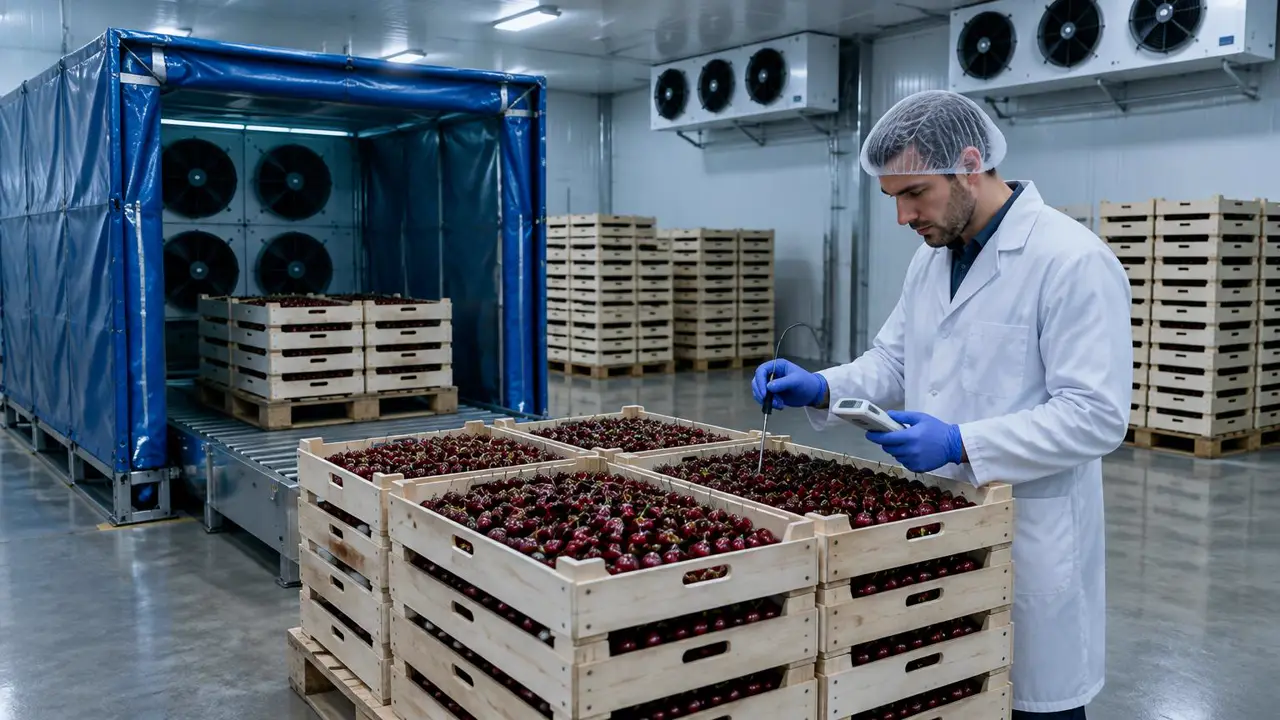
On this lane the cold chain does two jobs at once. It protects fruit quality, and it is one of China's quarantine conditions of entry: the official protocol allows cold treatment at set fruit-pulp temperatures for 14 to 18 days, either before export or in transit. That turns pre-cooling, cold rooms, reefer containers and temperature probes into compliance equipment. A packhouse that cannot document the treatment, or that is not on the jointly registered list, cannot ship to China however good its fruit is.
Status at a glance (checked 25 October 2026)
| Item | What the source says | Status |
|---|---|---|
| Market access | Imports of South African fresh cherries that meet the protocol are permitted with immediate effect (GACC No. 140, signed 21 Sep 2026, posted 23 Sep 2026) | Published rule |
| First shipment | Before the first shipment China must confirm all requirements are met; the South African agriculture minister expected approval by year-end (Reuters, 21 Oct 2026) | Pending — confirm |
| Product | Fresh sweet cherries (Prunus avium) from South African cherry-producing areas (GACC No. 140) | Published rule |
| Stone fruit | Not covered by the sources used for this guide | Unknown — confirm |
| Registered facilities | Orchards, packhouses and treatment facilities approved by South Africa and jointly registered; the list is published on the GACC website before each season (GACC No. 140) | Published rule |
| Season | Reuters reported growers aim for September–October, ahead of Chilean supply | Reported, not a rule |
Temperature and treatment requirements in GACC No. 140
The announcement sets treatment conditions, not a general storage specification. The temperature that counts is the fruit pulp, measured by probes, not the air or the setpoint.
| Option | Fruit-pulp temperature | Minimum duration | Where |
|---|---|---|---|
| Cold treatment 1 | 1.11 °C or below | 14 days | Before export or in transit |
| Cold treatment 2 | 1.67 °C or below | 16 days | Before export or in transit |
| Cold treatment 3 | 2.22 °C or below | 18 days | Before export or in transit |
| Fumigation | Methyl bromide, 32 g/m³ at 21.1 °C or above (concentration limits in the announcement) | 2 hours | Before export |
What the sources do not state: a storage temperature or humidity for cherries outside treatment, a pre-cooling method or time, transit times, and port cold-storage capacity in China. Treat those as open items for your postharvest technologist, shipping line and importer rather than as numbers to copy from another market. The detailed probe numbers and placement sit in annexes to the announcement that this guide did not review.
The cold-chain problem to solve
The main design choice is where the treatment happens. Treatment before export needs cold-treatment rooms at origin that hold the protocol pulp temperature for 14 to 18 days with calibrated probes, plus enough storage to keep the season flowing while fruit sits in treatment. In-transit treatment moves that requirement into the reefer and the voyage, so container performance, probe set-up and data records become the critical path. Either way, the packhouse must keep China-bound fruit separated: GACC No. 140 requires receiving, processing, treatment and storage areas to be separated from fruit not destined for China, and packed fruit to be stored immediately and separately to avoid reinfestation.
Questions to put in a cold-chain RFQ
Ask every supplier to answer the same questions, so offers can be compared on one basis.
Pre-cooling
- What pre-cooling capacity is offered for the harvest-day peak, in crates or tonnes per day, not the season average?
- How long does the proposed system take to bring fruit from field temperature to the treatment start temperature you specify, and on what assumptions?
- How is China-bound fruit kept separate during receiving, pre-cooling and packing?
- What pulp-temperature records does the system produce at each step?
Cold storage and cold-treatment rooms
- If treatment is done before export: how many rooms, what pallet capacity, and how is pulp temperature held within the chosen protocol option for 14, 16 or 18 days?
- How many fruit probes per room are proposed, how are they calibrated, and how is calibration documented? (Confirm the required number and placement in the GACC annexes.)
- What redundancy covers a compressor or power failure during a treatment run?
- How much buffer storage is needed so treatment time does not stop the packing line at peak?
Reefer transport
- If treatment is in transit: which container types and controllers are offered for cold treatment, and who installs and calibrates the probes before loading?
- How are containers cleaned and protected against pests at loading, as GACC No. 140 requires?
- What is the planned route and transit time? (Not stated in the sources — confirm with the shipping line.)
Temperature monitoring
- What data loggers or controller downloads are proposed, at what interval, and in what file format for the treatment report?
- China checks the cold-treatment report and fruit-probe calibration records on arrival (GACC No. 140). Who prepares them, and who keeps the originals?
- What alarms and escalation steps apply if pulp temperature rises during treatment?
Destination and compliance checks
- Registration: confirm your orchard, packhouse and treatment facility appear on the jointly registered list published on the GACC website before the season.
- Import permit: the Chinese importer needs an Entry Animal and Plant Quarantine Permit.
- Phytosanitary certificate: it must carry orchard and packhouse registration numbers, the container number, treatment details and the protocol declaration.
- Packaging and labelling: new, clean packaging; wood packaging to ISPM 15; English labels with fruit, country, area and registration numbers; "Exported to the People's Republic of China" on boxes and pallets.
- Port of entry: fruit must enter through ports approved for fruit imports. Port cold storage is not described in the sources.
- Contingency: if treatment fails, the announcement allows treatment at the port if still possible in the container, return or destruction; live quarantine pests lead to return, destruction or treatment. Agree in your contract who pays in each case.
What remains open before you invest
- China's confirmation of the first shipment and the published register for the coming season
- Stone-fruit access and treatment rules (not covered here)
- Probe number and placement from the GACC annexes
- Transit times, port cold storage and power at destination
- Product storage temperature and humidity outside treatment, to be set by your postharvest technologist
Where ColdMatch fits
ColdMatch is the industrial refrigeration and cold-chain procurement platform of Global B2B Group. For projects from USD 250,000 — for example packhouse pre-cooling, cold-treatment rooms, cold storage or monitoring systems — the ColdMatch team reviews your brief, contacts suitable refrigeration technology and equipment suppliers on your behalf and presents organised, comparable responses. It is free for buyers, buyers and suppliers do not contact each other directly through the platform, and there is no obligation to award. If you want to buy the cherries themselves, use Global B2B Group.
Related guides and tools
- Export lane readiness checklist: South African cherries to China
- 2026 cold-chain trade corridor opportunities
- Chile–China cherry cold chain
- Fruit packhouse refrigeration in South Africa
- Produce pre-cooling methods
- Cold-chain temperature monitoring
- Refrigeration load calculator and cold room size calculator
Request a quote for your cold-chain project
Ready to brief pre-cooling, cold-treatment rooms, cold storage or monitoring for this lane? Use the lane RFQ panel to carry commodity, route, season and temperature details into the form, or go straight to the RFQ builder. Final technical, phytosanitary and legal decisions stay with you, your engineers and the competent authorities.
Sources
- 海关总署公告2026年第140号(关于进口南非鲜食樱桃植物检疫要求的公告) — GACC, signed 21 September 2026, posted 23 September 2026 (Chinese original, prevails)
- Phytosanitary requirements for the import of fresh cherries from South Africa — China-Africa SPS portal, English summary posted 24 September 2026
- South African cherries target China as US relations sour — Reuters, 21 October 2026
Run the numbers
Calculators for this project type
Indicative planning figures only — final sizing belongs to the supplier's or consultant's detailed design.
Fish & seafood cold storage calculator
Chilled and frozen volume, ice demand and storage capacity for landing sites and processing plants.
Energy & backup powerEnergy & backup power cost calculator
Annual energy spend from load and running hours, plus the cost of generator hours during outages.
Frequently asked questions
Plan the numbers before you send an RFQ
The reference pages buyers use most before requesting quotes.