

Quick answer
Step-by-step cold room cooling load calculation: transmission, product, infiltration, internal loads and safety factor, with a worked example. It is the total heat a refrigeration system must remove to keep a room at its set temperature, including transmission, product, infiltration, internal and equipment loads.
Key takeaways
- What is a cooling load? It is the total heat a refrigeration system must remove to keep a room at its set temperature, including transmission, product, infiltration, internal and equipment loads.
- Which part of the cooling load is usually largest? In busy chilled rooms with warm incoming products, the product load usually dominates.
- What safety factor should I use? Designers commonly add about 10–20% to the calculated load.
- Can I use a calculator instead of a supplier calculation? Calculators give a reliable first estimate for planning and budgeting, but the final plant should be sized by the supplier using detailed project data.
Reviewed: Oct 2026 · ColdMatch Group
The refrigeration capacity of a cold room is the single number that decides compressor size, evaporator selection, electrical connection and a large share of running cost. Undersize it and products never reach temperature during peak deliveries; oversize it and the plant cycles inefficiently, dehumidifies poorly and costs more to buy and run. Suppliers will calculate the load in detail, but buyers who understand how it is built can check proposals, spot missing assumptions and give better information from the start. This article explains the components of a cooling load and walks through a simplified worked example using the same logic as the ColdMatch cooling load calculator.
Short answer: a cold room's cooling load is the sum of heat entering through walls, roof and floor (transmission), heat removed from incoming products, warm air entering through doors (infiltration), and internal heat from people, lights, forklifts and evaporator fans — divided by daily running hours and increased by a safety margin. Product load and infiltration usually dominate in busy rooms; transmission dominates in long-term storage.
The five components of a cooling load
- Transmission: heat conducted through insulated panels, roof and floor. It depends on surface area, insulation thickness and conductivity, and the temperature difference between outside and inside.
- Product load: heat removed to cool incoming goods from their arrival temperature to storage temperature — and, for frozen rooms, the latent heat of freezing if products arrive unfrozen. Respiration heat adds to this for fresh fruit and vegetables.
- Infiltration (air change): warm, humid air that enters whenever doors open. It carries both sensible heat and moisture that becomes frost on the evaporators.
- Internal loads: people, lighting, forklifts and battery chargers inside the room.
- Equipment loads: evaporator fan motors and defrost heat, which the refrigeration system must also remove.
Step 1: Define the room and conditions
Our example is a chilled room for fresh produce: - internal dimensions 20 m × 12 m × 8 m (240 m² floor, 1,920 m³ volume); - room temperature +2 °C; - design outdoor temperature 35 °C; - 100 mm PIR panels on walls and roof, insulated floor; - 20 tonnes of produce arriving per day at 20 °C; - one dock door opened frequently during an eight-hour shift.
Use the cold room size calculator to get the footprint and volume from pallet positions if you have not yet fixed dimensions.
Step 2: Transmission load
Transmission heat equals the U-value of the panel multiplied by the surface area and the temperature difference. A 100 mm PIR panel has a U-value of roughly 0.22 W/m²K. Walls and roof together give about 752 m² (two long walls 20 × 8, two short walls 12 × 8, roof 20 × 12). With a 33 K difference, heat gain is about 0.22 × 752 × 33 ≈ 5.5 kW. The floor adds a smaller amount depending on insulation and ground temperature; in this example we allow about 0.6 kW. Sun on the roof and walls can add more in hot climates, which is why designers often add a few degrees to the outdoor temperature for exposed surfaces.
Step 3: Product load
Product load is mass × specific heat × temperature drop. Fresh produce has a specific heat of about 3.8 kJ/kg·K. Cooling 20,000 kg by 18 K requires 20,000 × 3.8 × 18 ≈ 1,368,000 kJ per day. If the plant is designed to remove this over 20 hours, that is about 19 kW. Produce also respires, releasing heat; a typical allowance for a full room might add 2–3 kW depending on the crop. Product load is the biggest item here — which is why the arrival temperature and daily intake are the most important numbers in any brief. Pre-cooling produce before it enters storage, as described in our post-harvest guide, reduces this load dramatically.
Step 4: Infiltration load
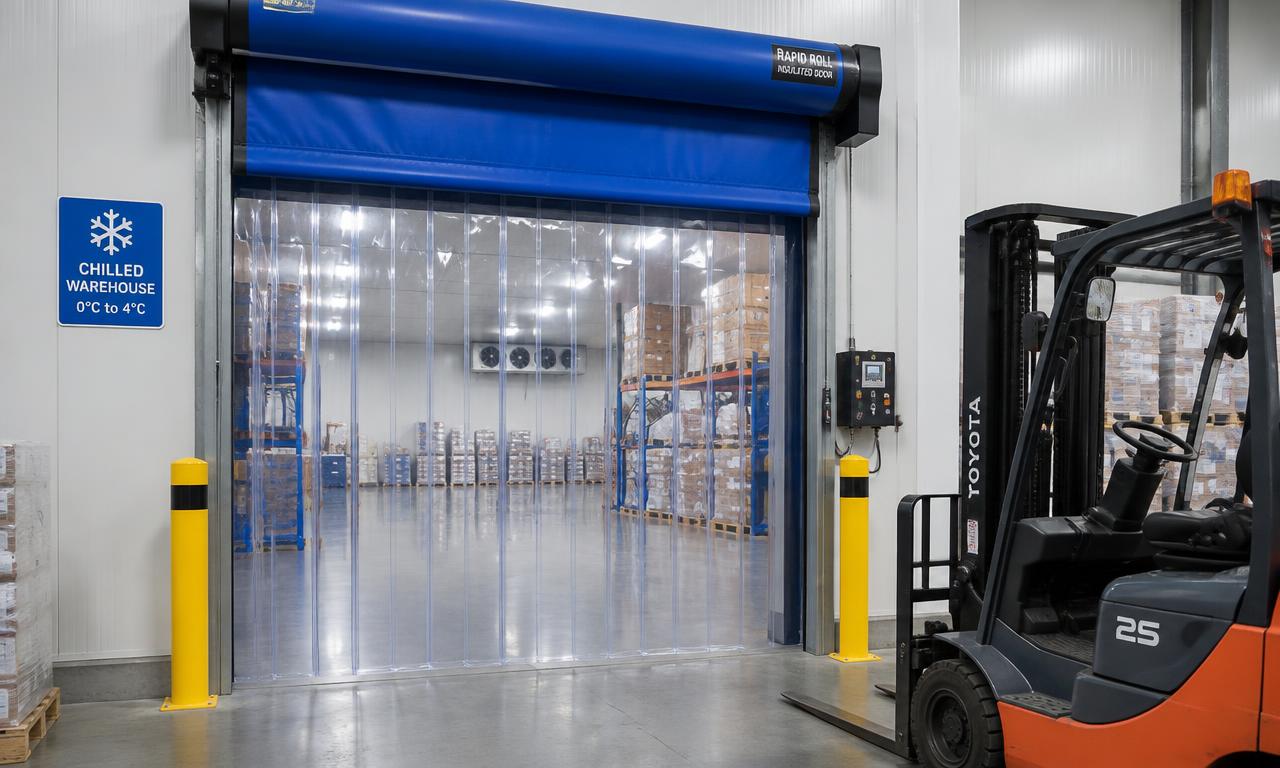
Every door opening exchanges cold room air for warm outside air. Calculation methods use door size, opening time, temperature difference and whether a strip curtain or air curtain is fitted. For a busy produce room with one frequently used dock door, a reasonable estimate in this example is about 6 kW. A rapid-roll door and strip curtain can cut this sharply. The ColdMatch door infiltration calculator estimates this component on its own if your room has heavy traffic.
Step 5: Internal and equipment loads
Two operators (about 0.3 kW each at chilled temperatures), LED lighting around 1.5 kW, one electric forklift for part of the day around 1.5 kW averaged, and evaporator fans around 2 kW give roughly 5.5 kW. Defrost heat is small in a +2 °C room but becomes significant in freezer rooms.
Step 6: Add up and apply a safety factor
- Transmission: about 6.1 kW
- Product and respiration: about 21.5 kW
- Infiltration: about 6 kW
- Internal and equipment: about 5.5 kW
- Subtotal: about 39 kW
Designers commonly add 10–20% as a safety margin for uncertainty and future changes, giving a design capacity of roughly 43–47 kW. The refrigeration plant is then selected at this capacity, at the design evaporating temperature, often split across two or more compressors or units for redundancy.
What changes in a freezer room
In a −25 °C store the temperature difference to outside is much larger, so transmission grows; insulation is typically 150–200 mm and floors need heating to prevent frost heave. If products arrive unfrozen, the latent heat of freezing makes product load very large — at that point a dedicated blast freezer is usually more efficient than a storage room. See our blast freezer selection and sizing guide.
Checking a supplier's load calculation
When proposals arrive, ask each supplier for its load breakdown, not only the final kW figure. Compare the assumptions line by line: outdoor design temperature, panel U-values, daily intake and arrival temperature, door openings and running hours. Differences of a few kilowatts usually come from one of these inputs. If one supplier's capacity is far lower than the others, check whether it has assumed pre-cooled products or fewer door openings than you actually expect.
Common mistakes
- Using average daily intake instead of peak-season intake.
- Assuming products arrive at storage temperature when they do not.
- Ignoring door traffic, which often doubles the load in distribution rooms.
- Forgetting evaporator fans and defrost heat.
- Applying a large safety factor on top of already conservative inputs, leading to oversizing.
From load to running cost
Once the load is known, the next question is energy. The cold storage OPEX estimator converts capacity and running hours into annual electricity use, and the energy savings tool compares improvements such as better doors, variable-speed fans or heat recovery. Cost estimates follow the published baseline in the cold storage cost guide.
Using the result in your RFQ
Do not send suppliers a capacity figure alone. Send the inputs — dimensions, temperatures, intake mass and arrival temperature, door use, climate and running hours — so each supplier calculates on the same basis and you can see whose assumptions differ. The RFQ builder accepts calculator results directly. For projects above USD 250K, a ColdMatch specialist reviews the brief before any supplier is approached. When you are ready, start your project.
Run the numbers
Calculators for this project type
Indicative planning figures only — final sizing belongs to the supplier's or consultant's detailed design.
Blast freezer cost calculator
Size freezing capacity and indicative cost from daily tonnage, entry and target core temperature.
Energy & backup powerEnergy & backup power cost calculator
Annual energy spend from load and running hours, plus the cost of generator hours during outages.
Frequently asked questions
Plan the numbers before you send an RFQ
The reference pages buyers use most before requesting quotes.