Pull to refresh
ColdMatch Group — industrial cooling and cold chain procurement platform
ColdMatchGroupMulti-Bid Cold Chain Sourcing
SolutionsIndustriesKnowledge CenterMarketsToolsFinancingLogistics
ColdMatch Group — industrial cooling and cold chain procurement platform
ColdMatchGroup
SolutionsIndustriesKnowledge CenterIntelligence Center & CalculatorsIndustry IntelligenceExecutive Knowledge CenterPlanning CenterEquipment IntelligenceInnovation & TechnologyProcurement AcademyCase StudiesMarkets by CountryTools & CalculatorsCertificationsFind SuppliersFinancingLogisticsGet Free Quotes
DashboardPrepare a Professional RFQ
DashboardSign inPrepare a Professional RFQ
Cold-chain project financing.Financing for qualified cold-chain projects — introduced to independent financing partners.FinancingFinancing Center
Home

Offline — reconnect before saving or submitting. Changes on this page have not been sent.

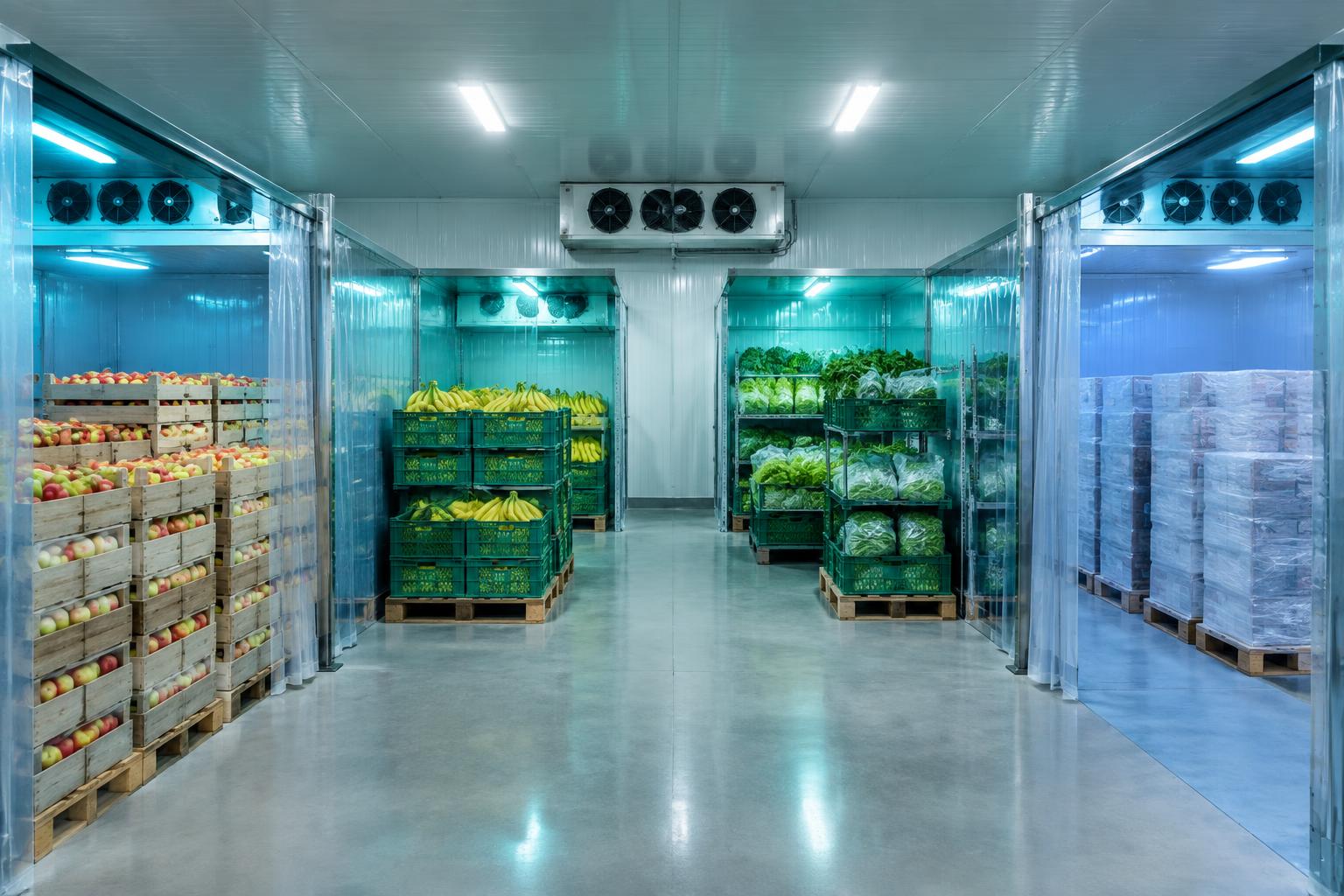
Cold-room planning diagram showing separate chilled produce, tropical produce and frozen storage zones
← Insights
Tools Oct 2026·7 min read

How to Use a Cold Storage Temperature Chart

Turn product temperature, humidity and storage-life requirements into compatible cold-room zones, cooling loads and a supplier-ready RFQ.

EnglishالعربيةPortuguês (Brasil)עבריתРусскийfi

Quick answer

Turn product temperature, humidity and storage-life requirements into compatible cold-room zones, cooling loads and a supplier-ready RFQ. Not necessarily. Compare RH requirements, ethylene production and sensitivity, odours, hygiene needs and operating schedules as well as temperature. Products may need separate rooms or independent air systems despite overlapping temperature bands. Confirm compatibility for the actual variety, maturity, packaging and intended storage duration before approving mixed storage.

Key takeaways

  • ▸Can products with the same storage temperature share a cold room? Not necessarily.
  • ▸Does the storage life in a temperature chart guarantee shelf life? No.
  • ▸Why can bananas be damaged in a colder produce room? Bananas and other tropical products can suffer chilling injury below their suitable temperature range without actually freezing.
  • ▸Can a produce cold room also store pharmaceuticals at 2–8 °C? Do not assume suitability merely because the thermostat can reach that range.

In this article

  1. 01. What does a product storage temperature chart tell buyers?
  2. 02. How should buyers group compatible products?
  3. 03. Why separate chilled, frozen and pharmaceutical storage?
  4. 04. What does a worked cold-room zoning example look like?
  5. 05. How does the chart feed a cooling-load calculation?
  6. 06. What should the cold-room RFQ include?
  7. 07. What are the common mistakes?
  8. 08. How does ColdMatch turn these requirements into procurement?

Reviewed: Oct 2026 · ColdMatch Group

A product storage temperature chart is a design input, not simply a list of thermostat settings. For project owners and procurement managers, its value is connecting product quality requirements with room layout, refrigeration capacity and supplier scope. Temperature alone cannot tell you whether products can share a room, how quickly incoming stock must cool, or how long saleable quality will last. Relative humidity, product condition, packaging, airflow and handling history also matter. Use the ColdMatch storage temperature chart to establish preliminary requirements, then verify them against product specifications and operating conditions. This article explains how to turn those requirements into compatible storage zones, cooling-load inputs and an RFQ that cold-room suppliers can price on a comparable basis.

Short answer: Use a product storage temperature chart to read temperature, relative humidity and indicative storage life together, then group only compatible products into shared rooms. Translate those groups into operating zones, calculate each zone’s cooling load, and put the assumptions and acceptance requirements into your cold-storage RFQ.

What does a product storage temperature chart tell buyers?

A storage temperature chart summarises recommended conditions for holding particular products. Temperature describes the thermal environment; relative humidity, or RH, describes how much water vapour the air contains relative to saturation at that temperature. Storage life is an indicative holding period under stated conditions, not a guaranteed shelf life. These fields must be interpreted together: a suitable temperature does not compensate for moisture loss, poor incoming quality or incompatible mixed storage.

Distinguish room-air temperature from product temperature. A pallet arriving warm may take substantial time to reach its target core temperature. Likewise, high RH does not mean wet surfaces are acceptable: condensation can encourage deterioration and create hygiene problems.

How should buyers group compatible products?

  1. Compare the acceptable temperature and RH bands. Apples are commonly stored near 0 °C, while bananas generally need warmer conditions, around 13 °C depending on maturity and intended handling. Their requirements should not be averaged into one compromise setpoint.

2. Check ethylene compatibility. Ethylene is a plant hormone that affects ripening and senescence. Apples and ripening bananas can produce ethylene; sensitive products, including many leafy vegetables, may deteriorate faster when exposed. Separate incompatible streams rather than assuming refrigeration removes the risk.

3. Check non-temperature conflicts. Odour transfer, allergens, raw-versus-ready-to-eat hygiene, packaging, cleaning routines and access patterns may require separation. Shared airflow can transfer contaminants or ethylene even where partitions appear to create separate rooms.

Why separate chilled, frozen and pharmaceutical storage?

Chilled storage holds products above their freezing point at product-appropriate conditions. Frozen goods are commonly held at −18 °C or colder, subject to specifications and applicable requirements. These are different duties: holding already-frozen stock is not the same as freezing incoming product. Tropical produce introduces another constraint: chilling injury is physiological damage from exposure below a product’s safe temperature, even without freezing.

A pharmaceutical 2–8 °C requirement applies only where the product label specifies that range. Do not treat a produce chart as pharmaceutical design authority. Such projects need product-specific controls, temperature mapping, monitoring, excursion procedures and documented qualification appropriate to their intended use.

What does a worked cold-room zoning example look like?
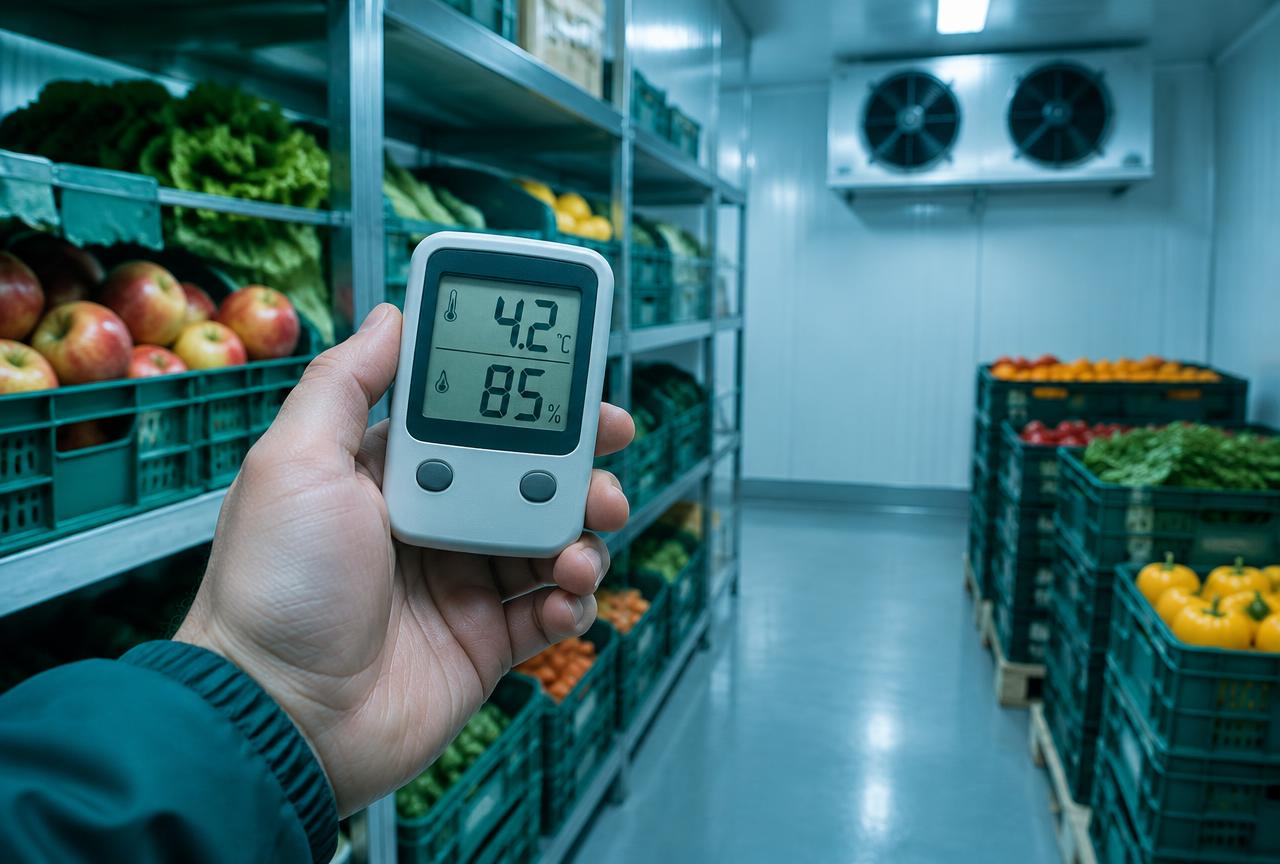
Example zoning diagram separating apples, bananas, leafy vegetables and frozen goods
Product compatibility determines zoning before room dimensions and refrigeration capacity are finalised.

Consider a hypothetical distribution facility receiving apples, bananas, leafy vegetables and packaged frozen goods. Its daily dispatch cycle does not justify putting everything into one chilled room. The buyer first records arrival condition, peak inventory, packaging and intended dwell time for each stream, then proposes four independently controlled zones. These are planning assumptions, not final product specifications.

  • Apple zone: use near 0 °C as an initial reference, then confirm variety, RH and storage method. Keep its air system separate from ethylene-sensitive stock.
  • Banana zone: start around 13 °C, then confirm maturity and handling requirements. Treat deliberate ripening as a separate process duty, not ordinary holding storage.
  • Leafy-vegetable zone: verify species-specific temperature and high-RH needs, protect against ethylene exposure, and select airflow and packaging that limit dehydration.
  • Frozen zone: specify −18 °C or colder according to the goods’ requirements. Confirm whether refrigeration only maintains frozen stock or must also remove incoming product heat.

Next, translate peak stock into pallet positions and usable dimensions with the cold-room size calculator. Include aisles, evaporator clearance and staging needs; product volume alone does not define room size.

How does the chart feed a cooling-load calculation?

  1. Establish each zone’s design conditions. Enter its target temperature, dimensions, insulation assumptions and external design conditions into the cooling load calculator. The chart supplies product requirements; it does not supply the complete refrigeration duty.

2. Define product load separately. Record incoming mass, arrival temperature, target product temperature and required pull-down time. A room sized only for steady holding may not cool warm deliveries within the operating window.

3. Add operating loads. Account for doors, infiltration, people, lighting, fans and defrost as applicable. State loading schedules and coincident peaks. Ask suppliers to explain selections, control strategy and how evaporator operation will support the required RH.

What should the cold-room RFQ include?

Create a zone schedule listing products, temperature bands, RH expectations, peak stock, throughput, arrival temperatures and intended dwell times. Add packaging, ethylene restrictions, hygiene separation and permitted shared services. State whether each room provides holding, pull-down, freezing or ripening. Use the RFQ readiness check to identify missing inputs before requesting proposals.

Specify measurable acceptance criteria: agreed sensor locations, temperature distribution, recovery after defined door-opening events, alarms and product pull-down performance where relevant. State test conditions and responsibilities. Ask suppliers to identify exclusions and provide comparable energy assumptions. For budget context, consult the cold-storage cost guide rather than deriving costs from storage-chart entries.

What are the common mistakes?

  • Treating indicative storage life as a warranty, regardless of harvest condition, prior handling or packaging.
  • Mixing products because their temperature ranges overlap while ignoring RH, ethylene or hygiene conflicts.
  • Choosing the coldest possible setpoint for tropical produce and inadvertently causing chilling injury.
  • Confusing storage capacity with cooling capacity, or frozen holding with a freezing process.
  • Requesting precise humidity control without defining measurement locations, tolerances, operating conditions or verification methods.

How does ColdMatch turn these requirements into procurement?

ColdMatch Group, Global B2B Group’s industrial refrigeration and cold-chain procurement platform, supports projects USD 250K+ through a vendor-neutral process and a network of 100+ qualified suppliers. It is not an automatic marketplace: a buyer submits a request, a specialist reviews it and prepares a brief, and suppliers are introduced manually. The chart helps establish requirements; it does not replace engineering review.

Bring your product list, zone assumptions and operating schedule to start your project.

Turn this guidance into comparable supplier quotes for your warehouse or cold store project. ColdMatch is supplier-neutral and free for buyers. For industrial projects from USD 250,000, the team qualifies the brief, contacts suitable suppliers on your behalf and presents organised responses; no automatic supplier connection.

Start a structured cold storage RFQ

Run the numbers

Calculators for this project type

Indicative planning figures only — final sizing belongs to the supplier's or consultant's detailed design.

Refrigeration sizing

Fruit & vegetable cold storage ROI calculator

Pre-cooling and storage capacity plus indicative payback from spoilage reduction.

Energy & backup power

Energy & backup power cost calculator

Annual energy spend from load and running hours, plus the cost of generator hours during outages.

Related solutions
Industrial Refrigeration Systems Cold Rooms Generators & Backup Power All solutions
Turn these numbers into a packhouse cold storage RFQ Free for buyers · Supplier-neutral · One scope to several suppliers
Request a quote

Frequently asked questions

Plan the numbers before you send an RFQ

The reference pages buyers use most before requesting quotes.

Cold room cost guideUSD/m³ and USD/pallet benchmarks by temperature class.Cold storage construction cost guideCAPEX breakdown: envelope, refrigeration, racking, civil works.Refrigerant phase-out guideF-gas / Kigali timelines and NH3, CO2 and HFO options.Cold storage calculatorSize the room, load and energy spend in under two minutes.Project financingLease, term and export-credit structures for cold chain CAPEX.RFQ BuilderOne structured RFQ to qualified suppliers and EPCs.

In this article

  1. What does a product storage temperature chart tell buyers?
  2. How should buyers group compatible products?
  3. Why separate chilled, frozen and pharmaceutical storage?
  4. What does a worked cold-room zoning example look like?
  5. How does the chart feed a cooling-load calculation?
  6. What should the cold-room RFQ include?
  7. What are the common mistakes?
  8. How does ColdMatch turn these requirements into procurement?

Planning a project?

One brief, reviewed by a specialist, compared across qualified suppliers.

Start your project

Related insights

Tools

Cold Room Problems: Troubleshooting & Health Checks

How to diagnose warm cold rooms, ice build-up, high energy bills and door problems — and when to use ColdMatch's troubleshooting and health-check tools.

Tools & RFP

Free Cold Storage Calculators — Size, Load, Cost & RFP in 6 Languages

ColdMatch's free multilingual calculators size cold rooms, cooling capacity, refrigeration load, electricity cost, compressors and financing — and turn every result into a supplier-ready RFP in one click.

Calculators

Cold Storage Cost Calculator: Worked Buyer Example

Work through frozen cold storage build and operating costs, understand exclusions, and turn calculator ranges into a supplier-ready RFQ.

Agriculture & Post-Harvest

Post-Harvest Cold Storage for Fruit & Vegetables: 2026 Guide

How growers, packhouses and exporters plan post-harvest cold storage: pre-cooling, temperature and humidity by crop, sizing, energy and supplier RFQs.

Risk & Compliance

The Cold Storage Risk Management Checklist Every Buyer Should Answer Before Going to Market

Twelve risk categories every industrial refrigeration buyer should design against — from temperature instability and product loss to supplier dependency, expansion limitations and poor project coordination — and where each mitigation belongs in the requirements document.

Cost & Procurement

Temperature Monitoring and Mapping Upgrade: Cost Drivers, ROI Method and Procurement Checklist

How to budget, justify and procure a cold storage temperature monitoring and mapping upgrade for food or pharma: cost drivers, a transparent ROI method and a supplier-ready checklist.

Project request

Submit your project for expert review

Send your requirements. A ColdMatch specialist reviews every request, prepares a brief and introduces qualified suppliers — free for qualified buyers.

ColdMatch Group — industrial cooling and cold chain procurement platform
ColdMatchGroup

Because we care more.

ColdMatch Group is the industrial refrigeration and cold-chain procurement platform of Global B2B Group, where commercial and industrial buyers build a project and submit an RFQ; the ColdMatch team validates and organizes it, contacts suitable refrigeration technology and equipment suppliers on the buyer's behalf, and presents organized responses through ColdMatch.

support@coldmatchgroup.com
Follow on LinkedIn
Language
Sourcing & Financing
  • Get Free Quotes
  • RFQ Builder
  • Urgent Procurement
  • Solutions
  • Suppliers
  • Refrigeration Marketplace
  • Global Coverage
  • Project Financing
  • Financing Center
Tools & Knowledge
  • Planning Center
  • Calculators
  • Innovation & Technology
  • Projects Hub
  • Knowledge Hub
  • Cold Chain Answers
  • Cost Benchmarks 2026
  • AI Agents (MCP)
Markets
  • All Country Markets
  • Zambia
  • Ghana
  • Malawi
  • Kenya
  • Nigeria
  • Mauritius
  • Israel
  • Finland
  • Hungary
Company
  • About ColdMatch
  • How ColdMatch Works
  • Solutions by Buyer Type
  • Consultant Partner Program
  • Supplier Qualification
  • Trust Center
  • Case Studies
  • Blog
  • Contact
Business and supplier disclaimer

ColdMatch Group is the industrial refrigeration and cold-chain procurement platform of Global B2B Group, where commercial and industrial buyers build a project and submit an RFQ; the ColdMatch team validates and organizes it, contacts suitable refrigeration technology and equipment suppliers on the buyer's behalf, and presents organized responses through ColdMatch. It helps buyers prepare technical requirements and structured RFQs before suitable third-party suppliers, manufacturers, EPC contractors and turnkey providers are introduced manually. ColdMatch is not an equipment manufacturer, reseller, distributor, EPC contractor, installer, insurer, lender, bank or financial advisor, and is not a party to any supply, construction or finance contract. Quotes, equipment and services are provided solely by the matched third-party supplier, who is solely responsible for quality, delivery, installation, safety and performance. ColdMatch makes no guarantee of availability, price, quality or approval and disclaims all liability for any service provided by a supplier or other third party. See Terms and How ColdMatch Works.

Financing disclaimer: ColdMatch does not provide or guarantee finance. Any financing pathway is evaluated and supplied solely by independent third-party providers under their own checks and terms. See Terms.

ColdMatch Group is the industrial refrigeration and cold-chain procurement platform of Global B2B Group, where commercial and industrial buyers build a project and submit an RFQ; the ColdMatch team validates and organizes it, contacts suitable refrigeration technology and equipment suppliers on the buyer's behalf, and presents organized responses through ColdMatch. It helps buyers prepare technical requirements and structured RFQs before suitable third-party suppliers, manufacturers, EPC contractors and turnkey providers are introduced manually. ColdMatch is not an equipment manufacturer, reseller, distributor, EPC contractor, installer, insurer, lender, bank or financial advisor, and is not a party to any supply, construction or finance contract. Quotes, equipment and services are provided solely by the matched third-party supplier, who is solely responsible for quality, delivery, installation, safety and performance. ColdMatch makes no guarantee of availability, price, quality or approval and disclaims all liability for any service provided by a supplier or other third party. See Terms and How ColdMatch Works.

Disclaimer: ColdMatch Group is the specialized industrial refrigeration and cold-chain procurement platform of Global B2B Group. ColdMatch Group is not a manufacturer, reseller, distributor, EPC contractor, installer, insurer, lender, bank, credit provider, financial advisor, investment advisor, underwriter or regulated financial services provider. Any financing, leasing, trade finance, working capital or project-finance option mentioned on this website is provided solely by independent third-party financing providers, subject to their own eligibility checks, KYC, due diligence, compliance review, approval, terms and documentation. ColdMatch Group does not provide financial advice, does not arrange regulated financial products, does not guarantee financing approval, and is not responsible for any financing decision, offer, rejection, delay, cost, term or outcome. Quotes, equipment, services, delivery, installation, commissioning, warranties and project performance are provided solely by independent third-party suppliers, EPC contractors or service providers. See Terms.

ColdMatch Group · Global Refrigeration & Cold-Chain Sourcing
How ColdMatch Works·Cold Chain Project Markets·Project Guide·RFQ Process·AI Agent Brief·For AI Cold Chain & Refrigeration Procurement Agents·Supplier Qualification·Trust Center·Legal Center·Terms of Service·Privacy Policy·Agency Policy·Contact·Client Login (Buyer Portal)·Accessibility·Accessibility Support
Legal Documents
Terms of Service·Privacy Policy·Agency Policy·Cookie Policy·General Disclaimer·Legal Notice·RFQ Terms·Buyer Terms·Supplier Terms·Financing Disclaimer·Acceptable Use Policy·Marketplace Rules·Intellectual Property & Copyright Policy·Data Protection & GDPR·AML, Sanctions, Export & Anti-Bribery Policy·Cyber Security & Responsible Disclosure·AI & Third-Party Content Disclaimer
EnglishالعربيةעבריתPortuguêsPortuguês (Brasil)РусскийSuomiMagyarTürkçe
Operated from the Republic of Cyprus · We are committed to WCAG 2.1 AA accessibility — report barriers to accessibility@coldmatchgroup.com.© 2026 ColdMatch Group · All rights reserved.ColdMatch Group is the specialized commercial cold-chain platform of Global B2B Group — a global B2B procurement & project development ecosystem. Sister platforms: FishMatch Group, HatchMatch Group, FeedMatch Group, SeedMatch Group. About ColdMatch Group.ColdMatch helps buyers prepare cold chain RFQs and source suitable suppliers. Supplier matching and introductions are managed manually by ColdMatch — not an automatic marketplace. How it works.
CalculatorsGuidesFinancingGet a Quote

Get updates

Cold-chain reading, project resources and technology evidence.

Email subscriptions are not active. Your details will not be sent or saved.

Get updates

Separate from project enquiries. You can unsubscribe or change preferences in every update email once the service is active. Privacy notice