
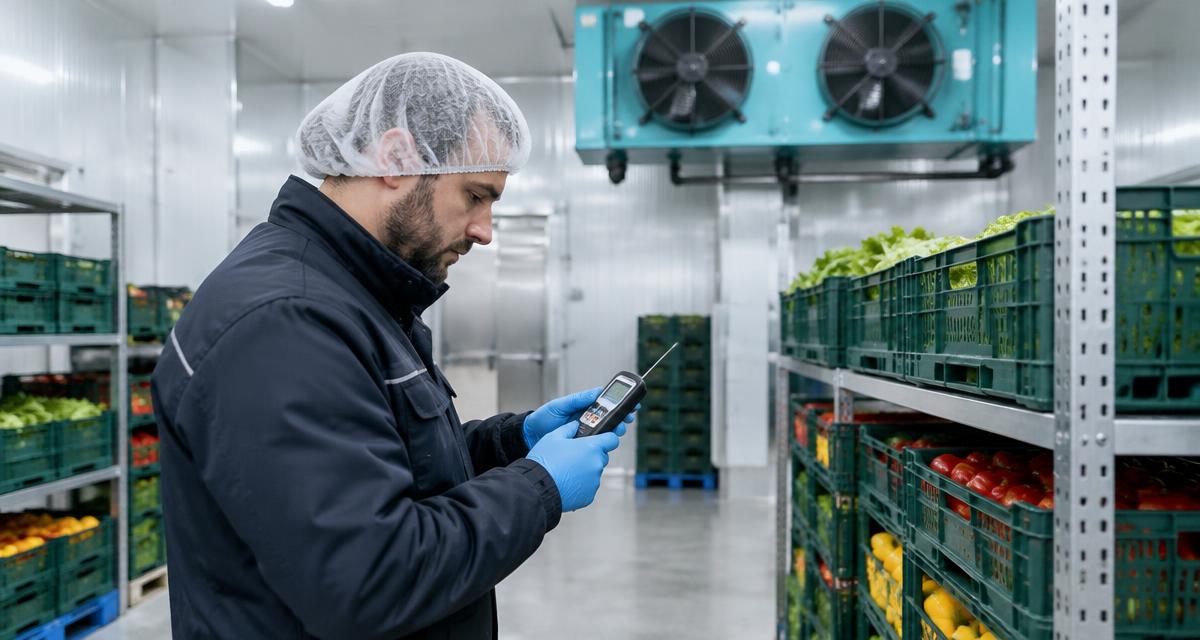
Quick answer
Investigate cold-room temperature excursions with product, load, airflow, defrost and alarm records; separate food-safety decisions from equipment diagnosis. No. Product, maturity, packaging, processing state and duration determine suitable conditions. Use the documented product specification and qualified food-safety guidance.
Key takeaways
- Is there one correct temperature for the entire cold chain? No.
- Can a temperature alarm decide whether food is safe? No.
- Should physical losses and quality discounts be added together? Only with non-overlapping definitions.
- Does the estimate promise a saving or return on investment? No.
Reviewed: Oct 2026 · ColdMatch Group
Direct answer: first define the product's required condition and locate when and where the deviation began. Match product-temperature evidence with intake, load, doors, airflow, defrost, controls and power events before blaming equipment or comparing manufacturers. Hold questionable lots under local food-safety procedures; recovered room air alone does not justify release.
Which evidence distinguishes a load problem from a control or equipment fault?
Build a timestamped event record for the affected lot and a comparable unaffected period. Record product and packaging, approved temperature/humidity requirements, incoming product temperature, quantity per delivery, tonnes/day, peak loading, residence time and the required pull-down time. Separate holding duty from cooling warm incoming stock. Record local ambient conditions, door opening duration and frequency, staging exposure and blocked air paths. Compare air and product measurements without treating them as interchangeable.
| Evidence to collect | Question it can test | Responsibility |
|---|---|---|
| Lot ID, intake mass and product-temperature readings | Did the deviation begin before receipt or during pull-down? | Receiving and quality team |
| Logger positions, calibration records and synchronised timestamps | Is the reading representative and trustworthy? | Monitoring owner |
| Door events, loading cycle, stacking and airflow observations | Did infiltration or blocked circulation coincide with the excursion? | Warehouse operator |
| Seals, insulation condition, frost, defrost times and drain observations | Is heat gain or defrost behaviour involved? | Refrigeration specialist |
| Setpoints, differential, alarm delays and acknowledgement history | Did control or escalation behaviour contribute? | Qualified controls specialist |
| Outage, generator start, restart and equipment fault records | Was cooling interrupted and for how long? | Maintenance team |
When should refrigeration and food-safety specialists intervene?
Quality personnel should manage holds, segregation and release under applicable local rules and product/customer specifications. Consult a refrigeration specialist for repeated or unexplained deviations, failure to meet the documented pull-down duty, abnormal frost/defrost, sensor discrepancies, control faults or outage/restart failures. Do not bypass alarms, change safety settings or handle refrigerant yourself. Preserve logs and settings before intervention; ask the specialist to document the diagnosis, changes and verification under representative loading. First correct the evidenced cause; if a retrofit or new system is justified, use those findings to define the RFQ and compare documented options—not brochure claims.
Source scope: FAO's 2026 news article explains cold-chain policy; the 2022 FAO/UNEP report and 2015 regional agriculture brief provide strategic context, not a universal design manual. They do not establish a loss rate, equipment saving or temperature for your product. ASHRAE's official resource page identifies a commissioning framework; detailed procedures require the guide and qualified review. FAO 2026; FAO/UNEP 2022; FAO 2015.
Where does a product lot face risk along the chain?
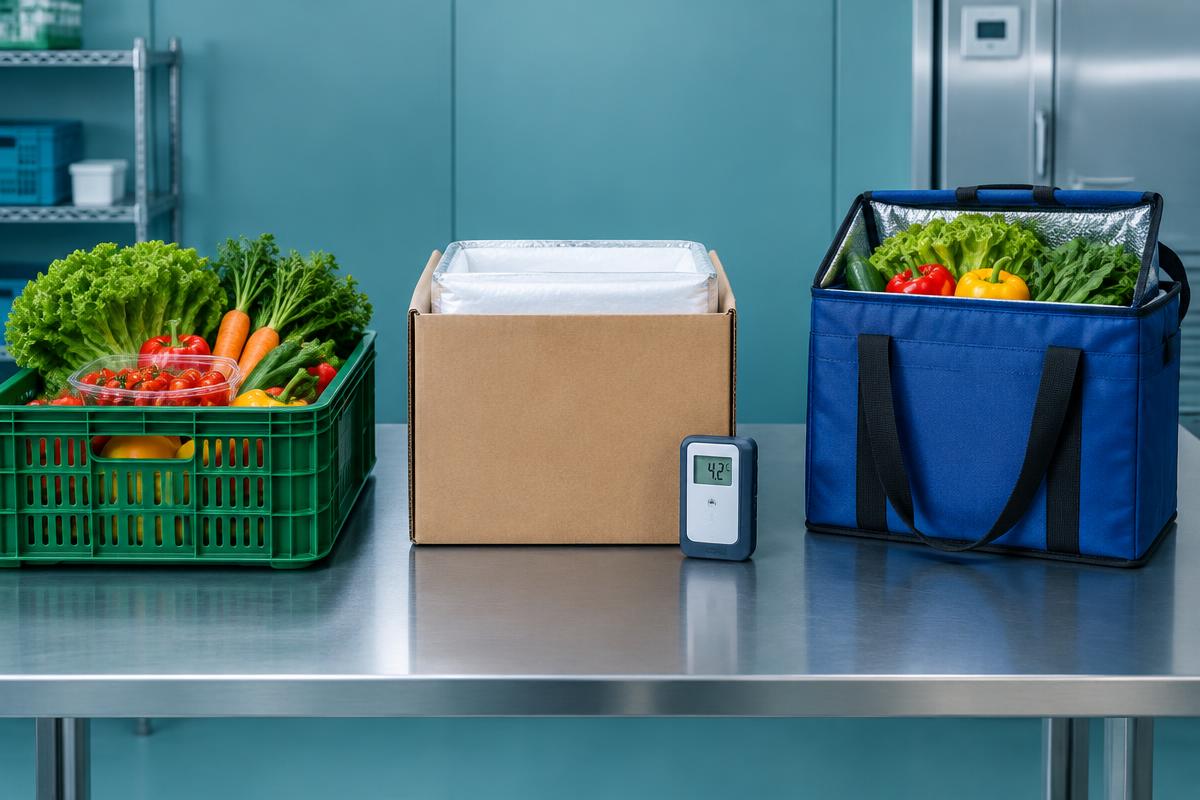
For cold-chain managers, food processors, exporters and distributors, start with one product lot and follow receipt or harvest, processing, pre-cooling, storage, picking, loading, transport and customer acceptance. At each stage record dwell time, incoming product condition, packaging, ambient exposure, equipment failure and ownership. Rank risks using observed frequency, severity and detectability—not an invented industry loss rate. Identify the evidence needed to confirm each suspected cause. The FAO post-harvest manual describes handling, cooling and storage practices; produce examples must not be treated as specifications for fish, meat or dairy.
How do temperature and time affect product quality?
There is no universal storage temperature. Commodity, maturity, packaging, processing state and intended duration change the requirements; some produce is chilling-sensitive. Use a documented product specification and applicable food-safety requirements, supported by sources such as the UC Davis commodity fact sheets for produce. Record both duration and magnitude of exposure. Room or trailer air is not the same as product core temperature, and acceptable quality does not establish food safety.
When is pre-cooling needed rather than storage alone?
When incoming product contains field or process heat, calculate the cooling duty from product mass, arrival temperature, required product condition and available cooling time. FAO describes forced-air, water-based and other cooling methods: select a compatible method for the commodity, hygiene controls and packaging. A holding room is not automatically a pre-cooler. Record the time to verified product condition before storage or dispatch; use the refrigeration load calculator as a planning estimate, followed by engineering review.
How should cold rooms protect airflow and storage quality?
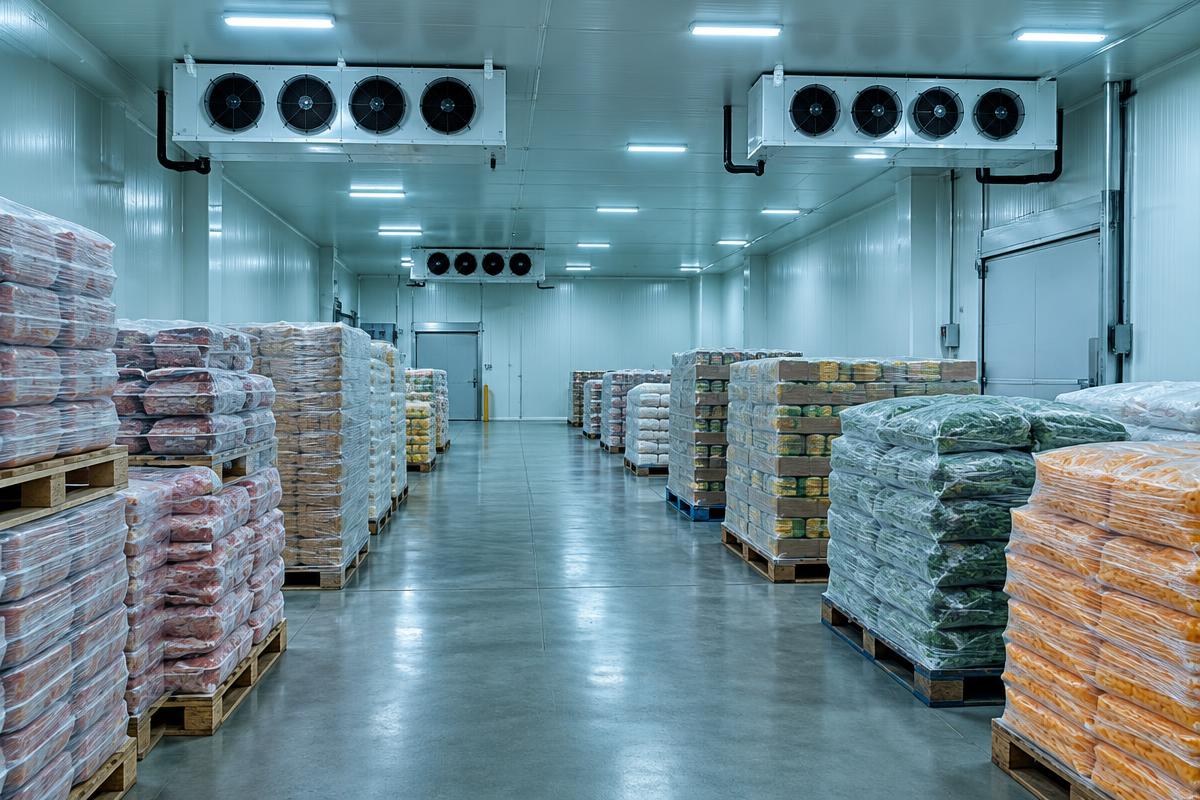
Use compatible product zones, clear supply and return-air paths, appropriate stacking and unobstructed carton vents. Inspect door seals, insulation, condensation and defrost operation; log door activity and loading changes. Stock rotation should follow product life and customer specifications, not a universal residence time. Confirm peak intake and usable pallet positions with the cold-room sizing tool, then check airflow and product-temperature distribution under representative loading. Oversizing equipment alone does not correct poor handling.
What should be checked before loading and transport?
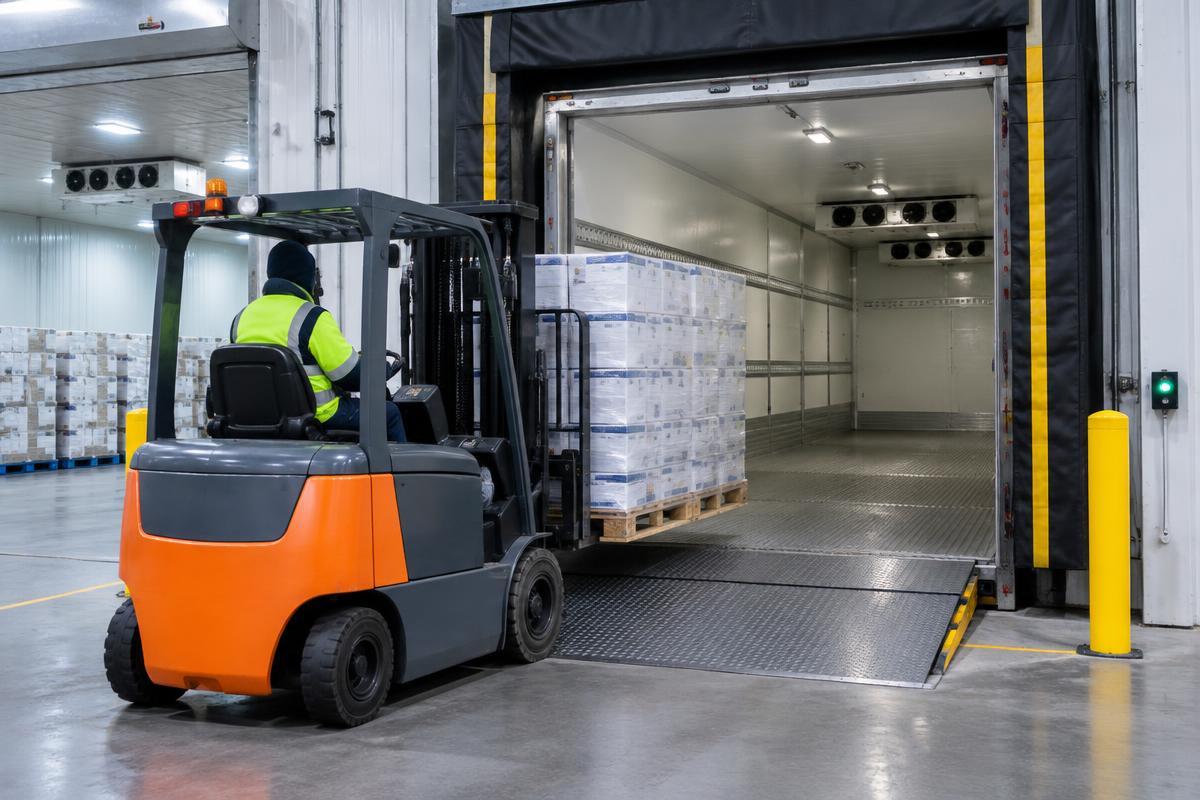
Before loading, verify the product’s documented condition, trailer cleanliness, unit operation, packaging, air channels and door/dock protection. Agree who records departure temperature, seal or lot identifiers, delivery time and acceptance evidence. Do not assume transport refrigeration can remove the incoming product heat within the trip: require a documented pull-down capability if that is part of the duty. During transport record stops, door events, outages and trans-shipment; reconcile receiving evidence with dispatch records.
How should temperature excursions be monitored and handled?
Map representative operating conditions to identify monitoring positions; select air and, where appropriate, product measurements with qualified guidance. Keep calibration and sensor-location records, time synchronisation and a documented sampling plan. Specify alarms from product requirements, not a generic threshold. Each alert needs a recipient, acknowledgement, escalation and corrective-action record. For questionable lots, hold and segregate them pending qualified food-safety guidance and applicable procedures; do not release a lot merely because the air temperature recovered. See cold-chain monitoring.
Who owns traceability and each handover?
Maintain a lot identifier linking receipt, processing, cooling, dispatch and customer receipt. Record quantity, time, condition, sensor identity, deviations, decisions and the person accepting each handover. Define responsibilities between production, warehouse, carrier, customer and quality team, including who can hold or release a lot. Distinguish a commercial claim from the operational cause; a returned consignment is evidence to investigate, not automatic proof that refrigeration failed.
How do you measure physical loss, quality and returns?
Use a consistent reporting boundary, unit and denominator. Physical loss rate = quantity discarded or rejected within that boundary ÷ incoming quantity × 100; identify sampling and measurement uncertainty. Record quality grade changes, shelf-life observations or agreed inspection scores separately—do not translate every grade change into a price loss without sales evidence. Price depreciation = full-quality reference value minus actual comparable realisation on surviving product. Track returned quantity, reason, disposition, credit and handling cost. Count a rejected returned unit once, and avoid counting its full value again as a quality discount. The FAO measurement resources support explicit definitions and measurement methods; the estimator below is not an official FAO index.
How can you compare loss and cooling-cost scenarios?
Use actual lot or period records to enter baseline physical loss, weighted quality discount and cooling/operating cost. Enter an alternative as your own assumption, not a promised improvement. The blank-input estimator below compares equal potential value and reporting boundaries; it separates recovered product value from extra operating cost. Simple break-even requires a positive additional investment and positive repeated-period net difference. Use the existing landed-cost calculator for freight, duty and cost per sellable unit—a different question. Validate any alternative with operational trials and a qualified technical assessment.
What belongs in a refrigeration project checklist?
Mark unknown inputs as to be confirmed. Use this project brief to describe the required outcome and the evidence behind it, rather than choosing a compressor or approaching a bank first.
- Product, processing state, packaging and documented temperature/humidity requirements
- Incoming temperature, lot size, peak throughput and required cooling time
- Storage volume, pallet positions, residence time and distribution points
- Site, design ambient conditions, doors, loading and transport handovers
- Refrigeration duty, insulation, airflow and hygiene constraints
- Energy supply, measured operating cost, outages and backup requirements
- Sensor placement, calibration, alarms, escalation and record retention
- Loss/quality measurement boundary, returns and acceptance criteria
- Accountable operators, qualified food-safety authority and commissioning evidence
- Budget if known, schedule, alternatives and assumptions needing confirmation
What is the next step after defining the need?
After defining the product, route, capacity, temperatures, site and operating outcome, you may optionally prepare an RFQ. ColdMatch reviews the request, coordinates suitable supplier outreach and organises responses for comparison; there is no direct buyer-to-supplier handoff. Buyer procurement is free, with typical USD 250K+ commercial B2B scope. ColdMatch does not manufacture, install or lend and guarantees no savings, performance, availability or approval. Any later exploration of independent external financing is optional and requires consent; no request is automatically sent to a bank or supplier. You can use this checklist without submitting anything.
Sources: FAO: Small-scale postharvest handling practices; FAO: food-loss measurement resources; UC Davis: produce fact sheets. Commodity-specific examples require validation for the product and local regulations.
*Prepared 13 October 2026 from the cited sources. Educational planning guidance, not engineering, food-safety or financial advice. Illustrations are original AI-generated editorial scenes, not ColdMatch facilities or supplier evidence. Local-language versions require independent fluent review before publication.*
Loss and quality scenario estimate
Use one currency and the same lot or reporting period for both scenarios. Enter all required fields; enter 0 only when you intend zero. These are your assumptions, not market benchmarks.
Complete the seven required inputs with valid non-negative amounts and percentages from 0 to 100. Shipment value must exceed zero.
Formulas and assumptions
- Physical loss = V × L / 100.
- Quality discount = V × (1 − L / 100) × Q / 100.
- Burden = physical loss + quality discount + cooling/operating cost.
- Net difference = baseline burden − alternative burden.
- Break-even periods = additional investment ÷ positive net difference.
V is the same potential full-quality value in both scenarios. Q is the weighted average price discount over all surviving product. Count rejected returns in physical loss once; include return-handling cost in operating cost, not again as lost product. No salvage, tax, price growth, finance, discounting or causation is modelled. Repeated-period break-even assumes identical throughput, prices, performance and costs; it is not a savings promise.
Optional: define the need before requesting proposals. Buyer procurement is free; typical B2B scope is USD 250K+. ColdMatch reviews the RFQ, contacts suitable suppliers on your behalf and organises responses. No direct supplier handoff.
Prepare a project RFQFrequently asked questions
Plan the numbers before you send an RFQ
The reference pages buyers use most before requesting quotes.