Pull to refresh
ColdMatch Group — industrial cooling and cold chain procurement platform
ColdMatchGroupMulti-Bid Cold Chain Sourcing
SolutionsIndustriesKnowledge CenterMarketsToolsFinancingLogistics
ColdMatch Group — industrial cooling and cold chain procurement platform
ColdMatchGroup
SolutionsIndustriesKnowledge CenterIntelligence Center & CalculatorsIndustry IntelligenceExecutive Knowledge CenterPlanning CenterEquipment IntelligenceInnovation & TechnologyProcurement AcademyCase StudiesMarkets by CountryTools & CalculatorsCertificationsFind SuppliersFinancingLogisticsGet Free Quotes
DashboardPrepare a Professional RFQ
DashboardSign inPrepare a Professional RFQ
Cold-chain project financing.Financing for qualified cold-chain projects — introduced to independent financing partners.FinancingFinancing Center
Home

Offline — reconnect before saving or submitting. Changes on this page have not been sent.

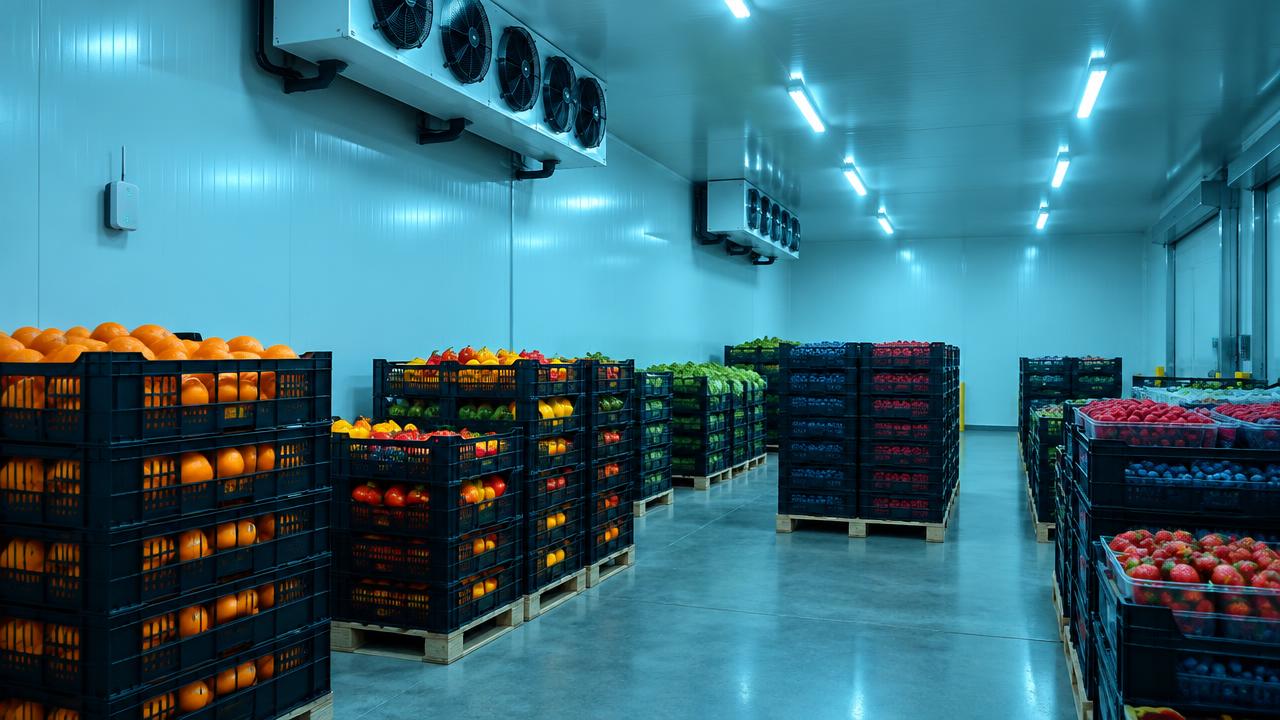
Produce cold room with crates of oranges, peppers and berries on pallets, ceiling evaporators and a wall temperature sensor
← Insights
Planning & Procurement Oct 2026·18 min read

Designing a Reliable Produce Cold Chain

Commodity-specific temperature management, pre-cooling, airflow, monitoring and backup for produce — with a transparent cold-room requirement checklist.

EnglishEspañolPortuguês (Brasil)FrançaisDeutsch

Airflow gaps, evaporator placement and sensor position all shape product temperature.

Quick answer

A cold-chain investment brief starts with the product outcome and peak operating duty, then compares operational fixes, phased expansion, replacement and outsourced capacity where feasible. Record utility limits, handover responsibilities and acceptance evidence before comparing CAPEX or ROI. FAO/UNEP supports systems planning, not universal capacity rules. For projects from USD 250,000, ColdMatch reviews the RFQ and organises supplier responses for human comparison.

Key takeaways

  • ▸What temperature should a produce cold room be? There is no single answer.
  • ▸Can one room store all produce? Only if the products share compatible temperature, humidity and ethylene requirements.
  • ▸Why is pre-cooling separate from storage? Removing field heat quickly needs more capacity and airflow than holding product at temperature.
  • ▸Will a new system reduce losses by a set percentage? No guarantee is possible; outcomes depend on product, operation and practices.

In this article

  1. 01. Why there is no universal cold-room setpoint
  2. 02. Pre-cooling: reduce the delay after harvest
  3. 03. Room capacity and refrigeration duty
  4. 04. Airflow and loading practices
  5. 05. Doors, humidity and condensation
  6. 06. Sensor placement, calibration and records
  7. 07. Alarm escalation and backup power
  8. 08. Cold-room requirement checklist / project brief
  9. 09. From brief to RFQ
  10. 10. Which interfaces matter when a food processor expands?
  11. 11. Three steps to a reviewed refrigeration RFQ
  12. 12. When is this method useful?
  13. 13. Decision gates before committing CAPEX
  14. 14. Evidence and planning worksheet
  15. 15. From evidence to a reviewed RFQ

Reviewed: 2026-10-15 · ColdMatch Group

Why there is no universal cold-room setpoint

Produce differs in respiration, chilling sensitivity, ethylene production and sensitivity, and water-loss behaviour. The UC Davis temperature-management resources show that suitable conditions depend on the commodity and its maturity. Storing incompatible products together is a common cause of avoidable loss.

Pre-cooling: reduce the delay after harvest

Field heat accelerates deterioration, so the time from harvest to cooling matters. The FAO post-harvest and cold-chain guidance describes pre-cooling methods such as forced-air, hydro-cooling and room cooling; the right method depends on the commodity and packaging. Holding rooms are usually not designed to remove field heat quickly.

Room capacity and refrigeration duty

Size refrigeration for peak daily intake, incoming product temperature, required pull-down time, door traffic and design ambient — not floor area. Test assumptions with the cold room size calculator and the refrigeration load calculator; results are estimates for engineering review.

Airflow and loading practices

Leave clear paths for supply and return air, keep pallets off walls, align carton vents and avoid overfilling. The UC Davis cold-chain documents note that product temperature inside stacks can differ from room air.

Doors, humidity and condensation

Every door opening admits warm, moist air. Plan dock seals, fast doors or strip curtains, and loading procedures. Target humidity depends on the commodity: too low causes water loss, while condensation on cold product can encourage decay.

Sensor placement, calibration and records

Place sensors where risk is highest — warmest pallet positions, return air and, where practical, product pulp — and calibrate them on a schedule. Keep time-temperature records long enough for customer, insurer and regulatory needs. See cold-chain monitoring.

Alarm escalation and backup power

Define who receives alarms, response times and the escalation path out of hours. Estimate standby power with the backup generator calculator and decide which compressors or circuits need redundancy.

Cold-room requirement checklist / project brief

Use this checklist to brief engineers and suppliers. Mark any unknown value as *to be confirmed* rather than guessing.

  • Commodities, varieties and maturity at arrival; source of recommended conditions for each
  • Compatibility groups (temperature, humidity, ethylene)
  • Peak daily intake, arrival temperature, maximum harvest-to-cooling time
  • Pre-cooling method and required cooling time
  • Storage duration and stock rotation
  • Room dimensions, pallet positions, airflow pattern
  • Door count, traffic and dock protection
  • Design ambient conditions and site constraints
  • Sensor points, calibration interval, record retention
  • Alarm recipients, response times, escalation
  • Backup power and redundancy requirement
  • Applicable food-safety, building and refrigerant regulations (to confirm locally)

From brief to RFQ

Turn the brief into a structured request in the RFQ builder. For commercial projects from USD 250,000, the ColdMatch team reviews it, approaches suitable suppliers on your behalf and organises comparable proposals. Estimate the cost of loss scenarios with the landed cost and spoilage calculator. No equipment guarantees a lower loss rate.

*Educational content by the ColdMatch Group editorial team based on the cited UC Davis and FAO sources. Not engineering or food-safety advice; confirm commodity conditions and design with qualified specialists. Last reviewed: 13 October 2026.*

Which interfaces matter when a food processor expands?

Define peak tonnes/hour, incoming product temperature, cooling deadline, pallet dwell and dispatch rhythm. ERP forecasts describe demand; WMS movements describe occupancy and doors; packaging affects pallet geometry and airflow; monitoring records describe conditions. None replaces an engineer’s refrigeration-load assessment. Document power, downtime windows, temporary storage, mapping, tested alarm escalation and commissioning under representative load. A larger room does not establish spare compressor capacity.

Planning education only: ERP, packaging and certification are complementary interfaces, not a new ColdMatch product catalogue. No affiliation, certification, engineering approval, lot release or savings is implied. Codex provides a hygiene/HACCP framework; FAO/UNEP provides system context, not universal temperature or sensor-spacing rules.

Codex CXC 1-1969 · FAO/UNEP 2022

Three steps to a reviewed refrigeration RFQ

  1. Define product, site, peak throughput and evidenced problem.
  2. For industrial projects from USD 250,000, submit one refrigeration brief with logs, assumptions and interface responsibilities.
  3. ColdMatch reviews and organises the request, contacts suitable suppliers on your behalf and presents organised responses for human comparison; no automatic contact or guaranteed outcome.

RFQ · Planning tool

When is this method useful?

Use for defining a food-processing or storage expansion and its interfaces. Do not size compressors from floor area, assume packaging software replaces thermal design, or commit to a build before utility and demand checks.

  1. Define product requirements and peak throughput, not just room volume.
  2. Diagnose handling, cooling and utility bottlenecks.
  3. Compare operating changes, staged construction and external capacity.
  4. Test full-scope CAPEX/OPEX against utilisation and delays.
  5. Assign packaging, controls, civil works and refrigeration interfaces; request evidence-based acceptance tests.

Decision gates before committing CAPEX

Buyer / questionEvidence to collectDecision gate
Operations: what changed?kWh, tonnes, operating hours, weather and meter boundary for the same periodDiagnose before specifying replacement
Quality: why was product rejected?Lot condition, product limits, calibration, raw logs and handover timesQualified hold/release; missing is not zero
Procurement: which option fits?Equal duty, inclusions, exclusions, service and acceptance testsRequest clarification before scoring
Finance: does the investment hold up?Incremental margin, avoided costs, full CAPEX, recurring OPEX, ramp-up and downsideNo double counting or guaranteed return

Evidence and planning worksheet

Sources checked 15 October 2026: FAO/UNEP (2022), system-level food cold chains; Codex CXC 1-1969 (2023 publication), hygiene/HACCP; EVO IPMVP, measurement and verification; World Bank procurement framework, value-for-money principles. These sources do not validate this project, local permits, a specific savings rate or sensor spacing. Confirm applicable local rules with competent professionals.

FAO/UNEP 2022 · Codex · EVO IPMVP · World Bank

Blank planning worksheet (CSV; no email required)

From evidence to a reviewed RFQ

  1. Define product, site, peak duty and evidence gaps.
  2. Submit a supplier-neutral brief for industrial projects from USD 250,000; ColdMatch qualifies and organises it.
  3. The ColdMatch team contacts suitable suppliers on your behalf and presents organised responses for human comparison. No automatic supplier connection, supplier certification, promised quote count or guaranteed result. ColdMatch is the industrial refrigeration vertical of Global B2B Group, not a manufacturer, installer or lender.

Planning calculator (English) · Prepare the three-step RFQ · Global B2B Group procurement framework

Turn this guidance into comparable supplier quotes for your warehouse or cold store project. ColdMatch is supplier-neutral and free for buyers. For industrial projects from USD 250,000, the team qualifies the brief, contacts suitable suppliers on your behalf and presents organised responses; no automatic supplier connection.

Start a structured cold storage RFQ

Run the numbers

Calculators for this project type

Indicative planning figures only — final sizing belongs to the supplier's or consultant's detailed design.

Refrigeration sizing

Fruit & vegetable cold storage ROI calculator

Pre-cooling and storage capacity plus indicative payback from spoilage reduction.

Energy & backup power

Energy & backup power cost calculator

Annual energy spend from load and running hours, plus the cost of generator hours during outages.

Related solutions
Generators & Backup Power Solar Backup Power Industrial Refrigeration Systems All solutions
Turn these numbers into a packhouse cold storage RFQ Free for buyers · Supplier-neutral · One scope to several suppliers
Request a quote

Frequently asked questions

Plan the numbers before you send an RFQ

The reference pages buyers use most before requesting quotes.

Cold room cost guideUSD/m³ and USD/pallet benchmarks by temperature class.Cold storage construction cost guideCAPEX breakdown: envelope, refrigeration, racking, civil works.Refrigerant phase-out guideF-gas / Kigali timelines and NH3, CO2 and HFO options.Cold storage calculatorSize the room, load and energy spend in under two minutes.Project financingLease, term and export-credit structures for cold chain CAPEX.RFQ BuilderOne structured RFQ to qualified suppliers and EPCs.

In this article

  1. Why there is no universal cold-room setpoint
  2. Pre-cooling: reduce the delay after harvest
  3. Room capacity and refrigeration duty
  4. Airflow and loading practices
  5. Doors, humidity and condensation
  6. Sensor placement, calibration and records
  7. Alarm escalation and backup power
  8. Cold-room requirement checklist / project brief
  9. From brief to RFQ
  10. Which interfaces matter when a food processor expands?
  11. Three steps to a reviewed refrigeration RFQ
  12. When is this method useful?
  13. Decision gates before committing CAPEX
  14. Evidence and planning worksheet
  15. From evidence to a reviewed RFQ

Planning a project?

One brief, reviewed by a specialist, compared across qualified suppliers.

Start your project

Related insights

Planning & Procurement

Cold-Room Sizing and Total Operating Cost: Buyer Guide

Size a cold room from product, peak throughput and holding time; compare cooling duty, energy, maintenance and backup at documented design conditions.

Planning & Procurement

How to Reduce Cold-Chain Losses: Plan Around Risk

Plan refrigeration procurement around product needs, load profile, route stages, ambient heat, monitoring and backup power to cut avoidable cold-chain losses.

Planning & Procurement

Free Tools to Size and Compare Cold Storage

Use ColdMatch's free calculators to plan cold room capacity, cooling load, refrigeration energy cost and lifecycle cost, then compare complete proposals.

Planning & Procurement

Choosing Cold-Chain Equipment for Food and Farm Products

Match industrial refrigeration equipment to each food or farm product: pre-cooling, freezing, zones, humidity, ripening and questions to answer before quotes.

Planning & Procurement

Compare Refrigeration Suppliers: Documented RFQ Scorecard

Compare cold-room suppliers using documented capacity, energy basis, scope, commissioning, service, warranty and acceptance tests—not unsupported claims.

Cost & Procurement

Temperature Monitoring and Mapping Upgrade: Cost Drivers, ROI Method and Procurement Checklist

How to budget, justify and procure a cold storage temperature monitoring and mapping upgrade for food or pharma: cost drivers, a transparent ROI method and a supplier-ready checklist.

Project request

Submit your project for expert review

Send your requirements. A ColdMatch specialist reviews every request, prepares a brief and introduces qualified suppliers — free for qualified buyers.

ColdMatch Group — industrial cooling and cold chain procurement platform
ColdMatchGroup

Because we care more.

ColdMatch Group is the industrial refrigeration and cold-chain procurement platform of Global B2B Group, where commercial and industrial buyers build a project and submit an RFQ; the ColdMatch team validates and organizes it, contacts suitable refrigeration technology and equipment suppliers on the buyer's behalf, and presents organized responses through ColdMatch.

support@coldmatchgroup.com
Follow on LinkedIn
Language
Sourcing & Financing
  • Get Free Quotes
  • RFQ Builder
  • Urgent Procurement
  • Solutions
  • Suppliers
  • Refrigeration Marketplace
  • Global Coverage
  • Project Financing
  • Financing Center
Tools & Knowledge
  • Planning Center
  • Calculators
  • Innovation & Technology
  • Projects Hub
  • Knowledge Hub
  • Cold Chain Answers
  • Cost Benchmarks 2026
  • AI Agents (MCP)
Markets
  • All Country Markets
  • Zambia
  • Ghana
  • Malawi
  • Kenya
  • Nigeria
  • Mauritius
  • Israel
  • Finland
  • Hungary
Company
  • About ColdMatch
  • How ColdMatch Works
  • Solutions by Buyer Type
  • Consultant Partner Program
  • Supplier Qualification
  • Trust Center
  • Case Studies
  • Blog
  • Contact
Business and supplier disclaimer

ColdMatch Group is the industrial refrigeration and cold-chain procurement platform of Global B2B Group, where commercial and industrial buyers build a project and submit an RFQ; the ColdMatch team validates and organizes it, contacts suitable refrigeration technology and equipment suppliers on the buyer's behalf, and presents organized responses through ColdMatch. It helps buyers prepare technical requirements and structured RFQs before suitable third-party suppliers, manufacturers, EPC contractors and turnkey providers are introduced manually. ColdMatch is not an equipment manufacturer, reseller, distributor, EPC contractor, installer, insurer, lender, bank or financial advisor, and is not a party to any supply, construction or finance contract. Quotes, equipment and services are provided solely by the matched third-party supplier, who is solely responsible for quality, delivery, installation, safety and performance. ColdMatch makes no guarantee of availability, price, quality or approval and disclaims all liability for any service provided by a supplier or other third party. See Terms and How ColdMatch Works.

Financing disclaimer: ColdMatch does not provide or guarantee finance. Any financing pathway is evaluated and supplied solely by independent third-party providers under their own checks and terms. See Terms.

ColdMatch Group is the industrial refrigeration and cold-chain procurement platform of Global B2B Group, where commercial and industrial buyers build a project and submit an RFQ; the ColdMatch team validates and organizes it, contacts suitable refrigeration technology and equipment suppliers on the buyer's behalf, and presents organized responses through ColdMatch. It helps buyers prepare technical requirements and structured RFQs before suitable third-party suppliers, manufacturers, EPC contractors and turnkey providers are introduced manually. ColdMatch is not an equipment manufacturer, reseller, distributor, EPC contractor, installer, insurer, lender, bank or financial advisor, and is not a party to any supply, construction or finance contract. Quotes, equipment and services are provided solely by the matched third-party supplier, who is solely responsible for quality, delivery, installation, safety and performance. ColdMatch makes no guarantee of availability, price, quality or approval and disclaims all liability for any service provided by a supplier or other third party. See Terms and How ColdMatch Works.

Disclaimer: ColdMatch Group is the specialized industrial refrigeration and cold-chain procurement platform of Global B2B Group. ColdMatch Group is not a manufacturer, reseller, distributor, EPC contractor, installer, insurer, lender, bank, credit provider, financial advisor, investment advisor, underwriter or regulated financial services provider. Any financing, leasing, trade finance, working capital or project-finance option mentioned on this website is provided solely by independent third-party financing providers, subject to their own eligibility checks, KYC, due diligence, compliance review, approval, terms and documentation. ColdMatch Group does not provide financial advice, does not arrange regulated financial products, does not guarantee financing approval, and is not responsible for any financing decision, offer, rejection, delay, cost, term or outcome. Quotes, equipment, services, delivery, installation, commissioning, warranties and project performance are provided solely by independent third-party suppliers, EPC contractors or service providers. See Terms.

ColdMatch Group · Global Refrigeration & Cold-Chain Sourcing
How ColdMatch Works·Cold Chain Project Markets·Project Guide·RFQ Process·AI Agent Brief·For AI Cold Chain & Refrigeration Procurement Agents·Supplier Qualification·Trust Center·Legal Center·Terms of Service·Privacy Policy·Agency Policy·Contact·Client Login (Buyer Portal)·Accessibility·Accessibility Support
Legal Documents
Terms of Service·Privacy Policy·Agency Policy·Cookie Policy·General Disclaimer·Legal Notice·RFQ Terms·Buyer Terms·Supplier Terms·Financing Disclaimer·Acceptable Use Policy·Marketplace Rules·Intellectual Property & Copyright Policy·Data Protection & GDPR·AML, Sanctions, Export & Anti-Bribery Policy·Cyber Security & Responsible Disclosure·AI & Third-Party Content Disclaimer
EnglishالعربيةעבריתPortuguêsPortuguês (Brasil)РусскийSuomiMagyarTürkçe
Operated from the Republic of Cyprus · We are committed to WCAG 2.1 AA accessibility — report barriers to accessibility@coldmatchgroup.com.© 2026 ColdMatch Group · All rights reserved.ColdMatch Group is the specialized commercial cold-chain platform of Global B2B Group — a global B2B procurement & project development ecosystem. Sister platforms: FishMatch Group, HatchMatch Group, FeedMatch Group, SeedMatch Group. About ColdMatch Group.ColdMatch helps buyers prepare cold chain RFQs and source suitable suppliers. Supplier matching and introductions are managed manually by ColdMatch — not an automatic marketplace. How it works.
CalculatorsGuidesFinancingGet a Quote

Get updates

Cold-chain reading, project resources and technology evidence.

Email subscriptions are not active. Your details will not be sent or saved.

Get updates

Separate from project enquiries. You can unsubscribe or change preferences in every update email once the service is active. Privacy notice