
Quick answer
a produce cold chain is only as strong as its weakest hand-off. Most quality problems arise at delays after harvest, slow removal of field heat, unsuitable mixed storage and temperature breaks at loading and transport. FAO notes that deterioration rates rise two to three-fold for every 10 °C increase in temperature (FAO, accessed 19 Oct 2026). Requirements differ by commodity, variety and maturity — cherries, avocados and leafy greens should never share one generic brief.
Key takeaways
- Where is most quality lost in a fresh produce cold chain? Commonly at delays after harvest, slow pre-cooling, incompatible mixed storage and temperature breaks during loading and transport.
- Do cherries, avocados and leafy greens need the same cold storage? No.
- Why does pre-cooling matter so much? FAO notes deterioration rises two to three-fold for every 10 °C increase, so removing field heat quickly protects quality.
- Does ColdMatch buy or sell produce? No.
Reviewed: 2026-10-19 · ColdMatch Group
Short answer: a produce cold chain is only as strong as its weakest hand-off. Most quality problems arise at delays after harvest, slow removal of field heat, unsuitable mixed storage and temperature breaks at loading and transport. FAO notes that deterioration rates rise two to three-fold for every 10 °C increase in temperature (FAO, accessed 19 Oct 2026). Requirements differ by commodity, variety and maturity — cherries, avocados and leafy greens should never share one generic brief.
Key terms in one line each
Field heat is the heat produce carries from the field at harvest. Chilling injury is damage some crops suffer at temperatures that are too low for them. Maturity is the ripeness stage at harvest, which changes handling needs. A reefer is a refrigerated truck or container. A temperature break is any period when product leaves its required range.
The farm-to-market chain in six stages
- Harvest — timing, field shade and how long crates wait before transport.
- Transport to packhouse — distance, covered vehicles, unloading speed.
- Pre-cooling — removing field heat; FAO describes forced-air cooling as much faster than room cooling (FAO).
- Packing and grading — packaging that protects and still allows airflow (FAO).
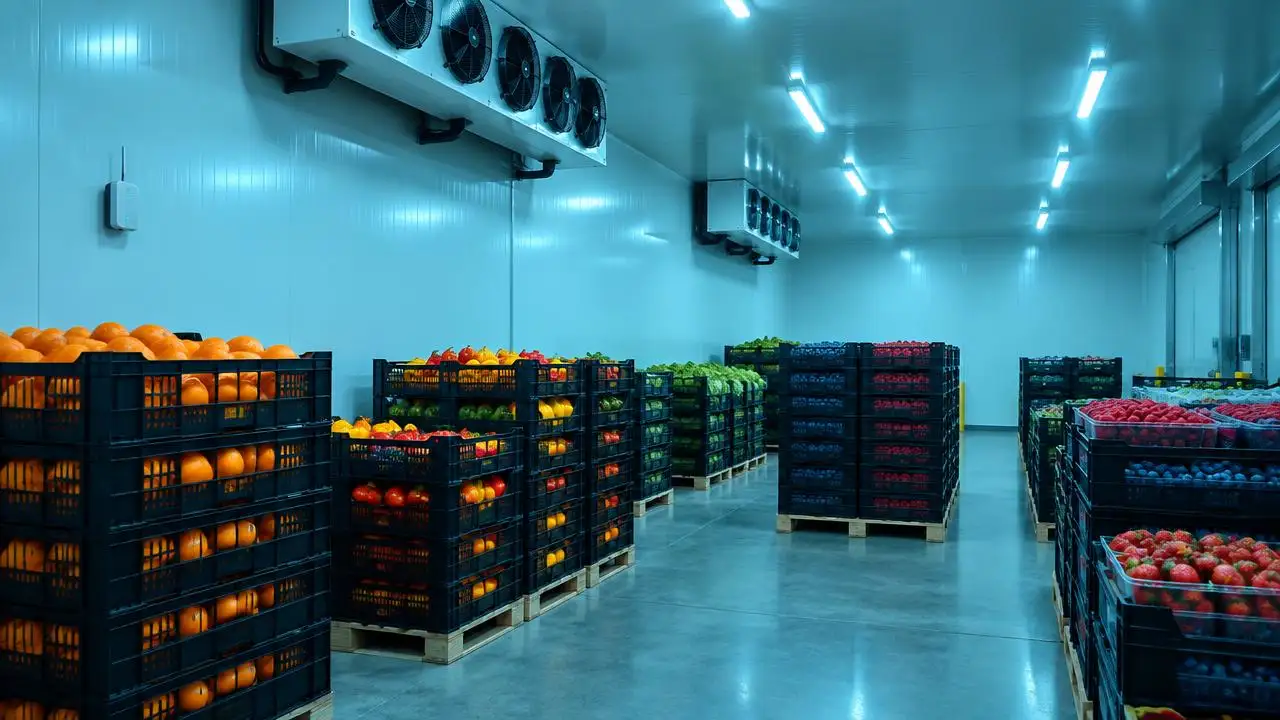
- Cold storage — compatible rooms with controlled temperature and humidity (FAO).
- Refrigerated transport and market — pre-cooled reefers, sealed docks and handover records.
Why commodity and maturity change the requirements
FAO gives the example that leafy vegetables tolerate temperatures close to 0 °C, whereas most tropical fruits cannot tolerate exposure below 10 °C, and warns that mixing incompatible products creates temperature, humidity, ethylene and odour problems (FAO). The table shows the questions to ask — not setpoints, which your quality team or buyer must confirm.
| Commodity | Typical concern to raise | Questions for your quality team or buyer |
|---|---|---|
| Cherries | Delicate fruit; speed from harvest to cooling and moisture loss | Required cooling time, humidity range, packaging and stem condition criteria |
| Avocados | Ripening behaviour depends on maturity; possible chilling sensitivity | Maturity at harvest, storage range per variety, ethylene management, ripening programme at destination |
| Leafy greens | High water loss and fast deterioration | Cooling method suitable for the product, humidity, hygiene and washing requirements |
| Mixed loads | Compatibility | Which products may share rooms or reefers, and under what conditions |
Common loss points and what to specify
- Waiting in the field → shaded collection points and scheduled pick-ups.
- Slow cooling → pre-cooling capacity sized to peak intake, quoted separately.
- Overfilled rooms → stack spacing and airflow design; FAO recommends gaps of about 2.5 cm and narrow stacks (FAO).
- Dock delays → insulated docks, dock seals and loading procedures.
- Warm reefers → pre-cooled vehicles and temperature recorders.
- Missing data → continuous monitoring with alarms and shared records.
Equipment and system choices along the chain
Ask suppliers to state how each item matches your confirmed product conditions: forced-air pre-coolers or tunnels; cold rooms with humidity control; ripening rooms where relevant; dock levellers and seals; refrigerated vehicles or containers; and temperature monitoring with data access. Compare refrigerant choices and local service availability; see the innovation and technology briefs for evidence-based context.
General guidance versus local requirements
This article gives general planning guidance based on FAO material. Food-safety rules, phytosanitary requirements, import conditions and buyer specifications vary by country, destination market and product. Confirm them with your competent authority, importer and quality advisers before finalising the design.
Next step: prepare a qualified RFQ
For projects of about USD 250,000 or more, use the project RFQ builder to describe the commodities and varieties, daily throughput and storage capacity, origin and destination, confirmed temperature and humidity requirements, timeline, certifications you need and budget range. ColdMatch reviews each request before contacting suitable cold-chain suppliers on your behalf. Related reading: reliable produce cold-chain design and the food cold chain overview.
Run the numbers
Calculators for this project type
Indicative planning figures only — final sizing belongs to the supplier's or consultant's detailed design.
Fruit & vegetable cold storage ROI calculator
Pre-cooling and storage capacity plus indicative payback from spoilage reduction.
Energy & backup powerEnergy & backup power cost calculator
Annual energy spend from load and running hours, plus the cost of generator hours during outages.
Frequently asked questions
Plan the numbers before you send an RFQ
The reference pages buyers use most before requesting quotes.