
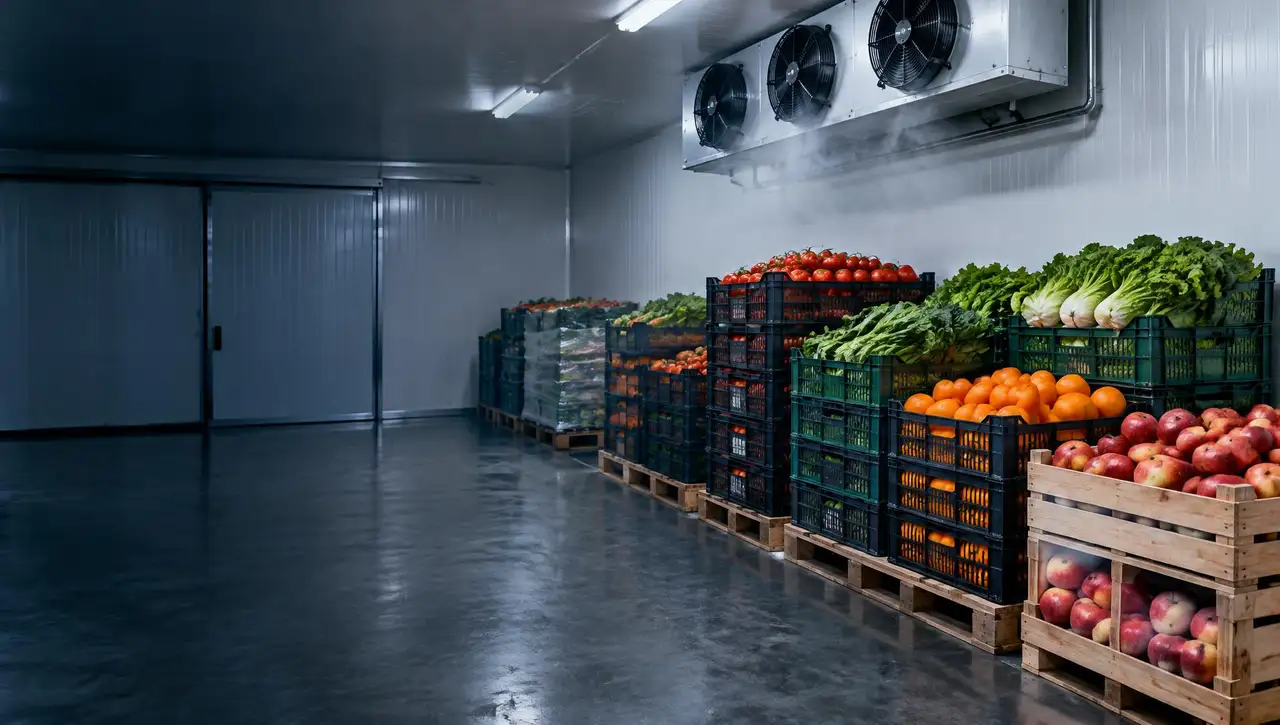
Quick answer
size a fruit and vegetable cold room from your peak daily intake, the pull-down (cooling) duty needed to remove field heat, the holding volume and the compatibility of the products you will store together — not from floor area alone. FAO identifies temperature as the most important factor in keeping produce quality (FAO, accessed 19 Oct 2026), and notes that crops differ in temperature, humidity, chilling and ethylene sensitivity (FAO). Your agronomist, buyer specification or a qualified operator confirms the conditions; the cold room supplier designs to them.
Key takeaways
- How big should a cold room for fruit and vegetables be? Base it on peak daily intake, holding days, pallet pattern and the cooling time your products need.
- Can I store all my fruit and vegetables in one cold room? Only when temperature, humidity, ethylene and odour needs are compatible.
- Do I need a separate pre-cooling room? Often, where warm produce arrives in volume.
- Will ColdMatch tell me the storage temperature for my crop? No.
Reviewed: 2026-10-19 · ColdMatch Group
Short answer: size a fruit and vegetable cold room from your peak daily intake, the pull-down (cooling) duty needed to remove field heat, the holding volume and the compatibility of the products you will store together — not from floor area alone. FAO identifies temperature as the most important factor in keeping produce quality (FAO, accessed 19 Oct 2026), and notes that crops differ in temperature, humidity, chilling and ethylene sensitivity (FAO). Your agronomist, buyer specification or a qualified operator confirms the conditions; the cold room supplier designs to them.
Key terms in one line each
Pull-down is the refrigeration capacity needed to cool warm, freshly harvested produce to its storage temperature. Holding is the smaller duty that keeps already-cooled produce stable. Pre-cooling removes field heat soon after harvest, often in a dedicated room or tunnel. Relative humidity (RH) is the moisture level of the air; low RH draws water out of produce. An RFQ is the written specification suppliers price against.
Step 1: Group your products by compatible conditions
FAO warns that storing incompatible crops in one room can create problems from different temperature and humidity needs, chilling and ethylene sensitivity, and odour transfer (FAO). It gives the example that leafy vegetables tolerate temperatures close to 0 °C, while most tropical fruits cannot tolerate exposure below 10 °C. In practice this decides whether you need one room or several zones.
- List every product, variety and maturity stage you expect to store.
- Ask your quality lead or buyer to confirm temperature and RH for each one in writing.
- Flag ethylene producers, ethylene-sensitive products and odour-sensitive products.
- Group products into rooms or zones only where conditions are genuinely compatible.
Step 2: Calculate capacity from intake, not area
Suppliers need numbers they can design against. Give them:
| Input | What to state | Why it matters |
|---|---|---|
| Peak daily intake | tonnes or pallets per day in the busiest week | Sets the pull-down duty |
| Product entry temperature | measured field or packhouse temperature | Heat to remove |
| Target cooling time | time window your buyer or quality team requires | Drives refrigeration and airflow size |
| Holding stock | maximum pallets stored at once and days held | Sets room volume |
| Packaging and pallet pattern | crate/carton type, vents, pallet height | Affects airflow and stacking |
| Door openings | loading pattern and hours | Adds warm-air load |
The free refrigeration load calculator helps you test an early estimate before you speak to suppliers; it does not replace engineering design.
Step 3: Decide where field heat is removed
FAO describes room cooling as relatively low cost but very slow, and forced-air cooling as much faster because air is pulled or pushed through the packages themselves (FAO). If produce arrives warm in large volumes, a holding room alone may struggle; ask suppliers to quote pre-cooling as a separate line so you can compare options.
- Room cooling: simpler, slower; suited to lower daily intake or already-cool product.
- Forced-air cooling: faster; needs vented packaging and a defined stacking arrangement.
- Hydro-cooling or other methods: only where suitable for the product and your water quality.
Step 4: Specify airflow, stacking and humidity
FAO recommends leaving space between stacks (about 2.5 cm) so cold air can circulate, keeping stacks narrow and installing fans to move air through the room (FAO). It also notes that water loss lowers quality and that raising storage humidity slows it. Put these expectations into the RFQ so suppliers design evaporators, air throw and humidity control for your real loading pattern.
- Required RH range per room, as confirmed by your quality team.
- Evaporator type and air velocity limits for delicate products.
- Pallet layout drawing with aisles, stack gaps and wall clearances.
- Condensation control at doors and dock interfaces.
Step 5: Packaging, loading and hygiene
Packaging protects produce but also affects airflow and humidity (FAO). State container types and vent area, whether forklifts or pallet jacks operate inside, door type (strip curtain, high-speed, air curtain), dock levellers and floor finish. Ask how the design supports cleaning and drainage.
Commercial cold room RFQ checklist
- Site location, climate and available electrical supply.
- Product list with confirmed temperature/RH per room or zone.
- Peak daily intake, entry temperature and required cooling time.
- Holding capacity in pallets, pallet height and storage duration.
- Pre-cooling method to be quoted separately.
- Panel thickness/insulation, floor insulation and door specification.
- Refrigeration system type, refrigerant preference and local refrigerant rules.
- Temperature and RH monitoring, alarms and data access.
- Backup power and service availability near site.
- Scope: design, supply, installation, commissioning, training, warranty and service.
Risks and trade-offs to discuss with suppliers
- Oversizing raises capital and energy cost; undersizing extends cooling time in peak season.
- Mixing products saves space but can harm quality if conditions are incompatible.
- Lowest price quotes often exclude pre-cooling, controls, electrical works or commissioning — compare scope line by line.
- Future expansion: ask whether panels, refrigeration and electrical supply can be extended later.
Next step: prepare a qualified RFQ
When your project is in the range of about USD 250,000 or more, use the project RFQ builder to state products, throughput and capacity, origin and destination markets, required conditions, timeline, certifications you need and an indicative budget. The ColdMatch team reviews each request before contacting suitable refrigeration suppliers on your behalf. For background, see the post-harvest cold storage guide and cold room cost guide.
Run the numbers
Calculators for this project type
Indicative planning figures only — final sizing belongs to the supplier's or consultant's detailed design.
Fruit & vegetable cold storage ROI calculator
Pre-cooling and storage capacity plus indicative payback from spoilage reduction.
Energy & backup powerEnergy & backup power cost calculator
Annual energy spend from load and running hours, plus the cost of generator hours during outages.
Frequently asked questions
Plan the numbers before you send an RFQ
The reference pages buyers use most before requesting quotes.