Pull to refresh
ColdMatch Group — industrial cooling and cold chain procurement platform
ColdMatchGroupMulti-Bid Cold Chain Sourcing
SolutionsIndustriesKnowledge CenterMarketsToolsFinancingLogistics
ColdMatch Group — industrial cooling and cold chain procurement platform
ColdMatchGroup
SolutionsIndustriesKnowledge CenterIntelligence Center & CalculatorsIndustry IntelligenceExecutive Knowledge CenterPlanning CenterEquipment IntelligenceInnovation & TechnologyProcurement AcademyCase StudiesMarkets by CountryTools & CalculatorsCertificationsFind SuppliersFinancingLogisticsGet Free Quotes
DashboardPrepare a Professional RFQ
DashboardSign inPrepare a Professional RFQ
Cold-chain project financing.Financing for qualified cold-chain projects — introduced to independent financing partners.FinancingFinancing Center
Home

Offline — reconnect before saving or submitting. Changes on this page have not been sent.

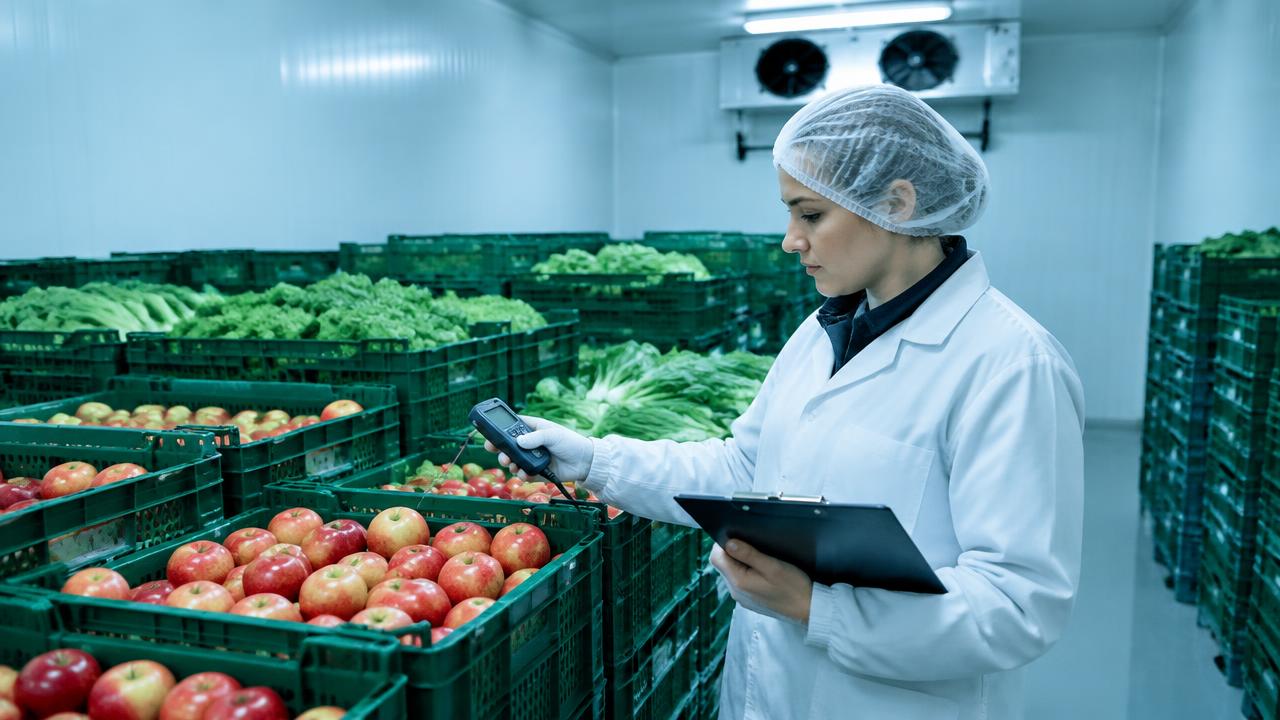
Quality inspector checking apples and leafy greens in a cold room with a handheld temperature logger
← Insights
Operations & Quality Oct 2026·17 min read

Produce Spoilage in Cold Storage: How to Investigate

A safe diagnostic framework for temperature breaks, moisture, handling damage and decay in stored produce — with a printable excursion log and contact workflow.

EnglishEspañolPortuguês (Brasil)FrançaisDeutsch

Collect product temperatures and lot records before moving or discarding anything.

Quick answer

Investigate produce spoilage by aligning affected and unaffected lots with product requirements, receiving condition, cooling history, calibrated readings, packaging and handovers. Codex supplies a hygiene and HACCP framework, not a diagnosis or universal storage setting. Record missing evidence before choosing equipment. Air-temperature recovery does not prove product safety; qualified quality personnel decide hold or release, while engineers assess refrigeration changes.

Key takeaways

  • ▸Can I tell from this guide whether a lot is safe to sell? No.
  • ▸What is the right cold-room temperature for produce? There is no single setting.
  • ▸Is postharvest decay the same as a food-safety hazard? Not necessarily.
  • ▸What records matter most? Time-temperature data (air and product), logger positions and calibration, door/defrost/power events, humidity observations, lot details and handling history.

In this article

  1. 01. Why spoilage investigations go wrong
  2. 02. Step 1: hold the lot and protect the evidence
  3. 03. Step 2: gather time-temperature records
  4. 04. Step 3: record commodity, lot and maturity details
  5. 05. Step 4: check airflow, loading, doors and moisture
  6. 06. Step 5: review packaging and handling history (printable log below)
  7. 07. Step 6: separate quality causes from food-safety decisions (who to contact)
  8. 08. What to change after the investigation
  9. 09. How ColdMatch fits in
  10. 10. How do ERP, monitoring and packaging records isolate an incident?
  11. 11. Three steps to a reviewed refrigeration RFQ
  12. 12. When is this method useful?
  13. 13. Decision gates before committing CAPEX
  14. 14. Evidence and planning worksheet
  15. 15. From evidence to a reviewed RFQ

Reviewed: 2026-10-15 · ColdMatch Group

Why spoilage investigations go wrong

Spoilage usually has more than one cause. A short temperature break, a crowded room that blocks airflow and bruising at harvest can all show up as the same soft or decayed product. Teams that act on the first visible symptom often fix the wrong thing. The UC Davis Postharvest Center explains in its cold-chain resources that losses accumulate across every handling step, not only in the store.

Step 1: hold the lot and protect the evidence

Mark affected pallets as HOLD, keep them physically separate and stop dispatch until a qualified person decides their status. Photograph the room, stacking pattern and product before moving anything. Do not reset loggers or controllers until data has been downloaded.

Step 2: gather time-temperature records

Download every relevant logger and controller record for the period from receiving to discovery. Compare air temperature with product (pulp) temperature where available, and note logger positions — a sensor near the evaporator can read very differently from the warmest pallet. The UC Davis temperature-management documents stress that product temperature, not room setpoint, is what governs deterioration.

Step 3: record commodity, lot and maturity details

Record commodity, variety, maturity, harvest date, grower or supplier, arrival temperature and time from harvest to cooling. Recommended storage conditions differ by commodity and maturity; check the relevant UC Davis produce fact sheet rather than assuming one room setting suits everything. Mixed loads can expose chilling-sensitive or ethylene-sensitive products to unsuitable conditions.

Step 4: check airflow, loading, doors and moisture

Look for blocked return-air paths, pallets stacked against walls, overfilled rooms, frequent or long door openings, defrost problems, and condensation or ice. Wet surfaces and condensation can encourage decay, while dry air can cause shrivelling. The FAO post-harvest and cold-chain guidance describes how poor air circulation and inadequate cooling capacity create warm spots inside stacks.

Step 5: review packaging and handling history (printable log below)

Packaging that restricts ventilation, damaged cartons, rough handling and delays before pre-cooling all leave signs: bruising patterns, wounds that start decay, and warm cores in tight stacks. Use the log below to keep the evidence in one place.

FieldRecord
Lot / commodity / variety / maturity
Room and position in room
Excursion start and end (date, time)
Logger IDs and calibration date
Air vs product (pulp) readings
Door, defrost, power and alarm events
Humidity / condensation / ice observed
Packaging, stacking and handling notes
Lot status (HOLD / released by whom)
Person recording, date

Step 6: separate quality causes from food-safety decisions (who to contact)

Quality causes — chilling injury, water loss, bruising, over-ripening, postharvest decay — explain why product lost value. Whether any lot can be sold, reworked or must be destroyed is a food-safety and regulatory decision. Hold the lot and follow your HACCP or food-safety plan.

  1. Shift lead / store manager — places HOLD, downloads data.
  2. Food-safety or QA lead — owns the decision on lot status under your food-safety plan.
  3. Refrigeration service provider — checks equipment, defrost, sensors and calibration.
  4. Supplier / grower and customer — as required by contract.
  5. Competent food authority — where law or your plan requires notification.

What to change after the investigation

Typical outcomes are revised receiving checks, faster pre-cooling, better stacking patterns, sensor relocation or calibration, alarm escalation rules and, sometimes, more refrigeration or airflow capacity. Estimate the effect of loss on your costs with the landed cost and spoilage calculator and check room duty with the refrigeration load calculator.

How ColdMatch fits in

If the investigation shows your facility needs new capacity, pre-cooling or monitoring, you can scope it in the RFQ builder. For commercial projects from USD 250,000, the ColdMatch team reviews the request, approaches suitable suppliers on your behalf and organises comparable responses. ColdMatch does not judge food safety or the status of any lot.

*Educational content only, prepared by the ColdMatch Group editorial team from the cited UC Davis and FAO sources. It is not food-safety, legal or engineering advice and cannot determine whether any product is safe to sell or eat. Last reviewed: 13 October 2026.*

How do ERP, monitoring and packaging records isolate an incident?

Join ERP/WMS lot IDs to receipt, dispatch and calibrated logger timestamps. Preserve timezone, pallet position, package condition, loading and alarm acknowledgement. ERP/WMS establishes movements and FEFO; monitoring provides raw readings, calibration and gaps; packaging specialists assess actual configuration and damage; quality personnel own approved limits and hold/release decisions. Product and air temperatures are not interchangeable.

Worked method, not a customer case: align receiving, cooling, storage and dispatch for comparable affected/unaffected lots of the same product and package. Mark missing evidence. A deviation near a door event is a hypothesis, not proven causation. Obtain qualified diagnosis; recovered air temperature alone never justifies lot release.

Planning education only: ERP, packaging and certification are complementary interfaces, not a new ColdMatch product catalogue. No affiliation, certification, engineering approval, lot release or savings is implied. Codex provides a hygiene/HACCP framework; FAO/UNEP provides system context, not universal temperature or sensor-spacing rules.

Codex CXC 1-1969 · FAO/UNEP 2022

Three steps to a reviewed refrigeration RFQ

  1. Define product, site, peak throughput and evidenced problem.
  2. For industrial projects from USD 250,000, submit one refrigeration brief with logs, assumptions and interface responsibilities.
  3. ColdMatch reviews and organises the request, contacts suitable suppliers on your behalf and presents organised responses for human comparison; no automatic contact or guaranteed outcome.

RFQ · Planning tool

When is this method useful?

Use when investigating documented quality incidents before requesting a refrigeration change. Do not use logger readings alone to diagnose pathogens, release a lot or prescribe a product temperature.

  1. Select comparable lots of the same product and packaging.
  2. Align timestamps, timezone, pallet position and receiving condition.
  3. Separate air and product readings; flag calibration gaps and missing intervals.
  4. Compare cooling, doors, dwell and handling before inferring causes.
  5. Have quality and engineering reviewers define corrective options and acceptance evidence.

Decision gates before committing CAPEX

Buyer / questionEvidence to collectDecision gate
Operations: what changed?kWh, tonnes, operating hours, weather and meter boundary for the same periodDiagnose before specifying replacement
Quality: why was product rejected?Lot condition, product limits, calibration, raw logs and handover timesQualified hold/release; missing is not zero
Procurement: which option fits?Equal duty, inclusions, exclusions, service and acceptance testsRequest clarification before scoring
Finance: does the investment hold up?Incremental margin, avoided costs, full CAPEX, recurring OPEX, ramp-up and downsideNo double counting or guaranteed return

Evidence and planning worksheet

Sources checked 15 October 2026: FAO/UNEP (2022), system-level food cold chains; Codex CXC 1-1969 (2023 publication), hygiene/HACCP; EVO IPMVP, measurement and verification; World Bank procurement framework, value-for-money principles. These sources do not validate this project, local permits, a specific savings rate or sensor spacing. Confirm applicable local rules with competent professionals.

FAO/UNEP 2022 · Codex · EVO IPMVP · World Bank

Blank planning worksheet (CSV; no email required)

From evidence to a reviewed RFQ

  1. Define product, site, peak duty and evidence gaps.
  2. Submit a supplier-neutral brief for industrial projects from USD 250,000; ColdMatch qualifies and organises it.
  3. The ColdMatch team contacts suitable suppliers on your behalf and presents organised responses for human comparison. No automatic supplier connection, supplier certification, promised quote count or guaranteed result. ColdMatch is the industrial refrigeration vertical of Global B2B Group, not a manufacturer, installer or lender.

Planning calculator (English) · Prepare the three-step RFQ · Global B2B Group procurement framework

Turn this guidance into comparable supplier quotes for your warehouse or cold store project. ColdMatch is supplier-neutral and free for buyers. For industrial projects from USD 250,000, the team qualifies the brief, contacts suitable suppliers on your behalf and presents organised responses; no automatic supplier connection.

Start a structured cold storage RFQ

Run the numbers

Calculators for this project type

Indicative planning figures only — final sizing belongs to the supplier's or consultant's detailed design.

Refrigeration sizing

Fruit & vegetable cold storage ROI calculator

Pre-cooling and storage capacity plus indicative payback from spoilage reduction.

Energy & backup power

Energy & backup power cost calculator

Annual energy spend from load and running hours, plus the cost of generator hours during outages.

Related solutions
Industrial Pumps Industrial Refrigeration Systems Cold Rooms All solutions
Turn these numbers into a packhouse cold storage RFQ Free for buyers · Supplier-neutral · One scope to several suppliers
Request a quote

Frequently asked questions

Plan the numbers before you send an RFQ

The reference pages buyers use most before requesting quotes.

Cold room cost guideUSD/m³ and USD/pallet benchmarks by temperature class.Cold storage construction cost guideCAPEX breakdown: envelope, refrigeration, racking, civil works.Refrigerant phase-out guideF-gas / Kigali timelines and NH3, CO2 and HFO options.Cold storage calculatorSize the room, load and energy spend in under two minutes.Project financingLease, term and export-credit structures for cold chain CAPEX.RFQ BuilderOne structured RFQ to qualified suppliers and EPCs.

In this article

  1. Why spoilage investigations go wrong
  2. Step 1: hold the lot and protect the evidence
  3. Step 2: gather time-temperature records
  4. Step 3: record commodity, lot and maturity details
  5. Step 4: check airflow, loading, doors and moisture
  6. Step 5: review packaging and handling history (printable log below)
  7. Step 6: separate quality causes from food-safety decisions (who to contact)
  8. What to change after the investigation
  9. How ColdMatch fits in
  10. How do ERP, monitoring and packaging records isolate an incident?
  11. Three steps to a reviewed refrigeration RFQ
  12. When is this method useful?
  13. Decision gates before committing CAPEX
  14. Evidence and planning worksheet
  15. From evidence to a reviewed RFQ

Planning a project?

One brief, reviewed by a specialist, compared across qualified suppliers.

Start your project

Related insights

Cold-chain operations

Cold-Storage Temperature Excursions: Diagnose Product Loss

Investigate cold-room temperature excursions with product, load, airflow, defrost and alarm records; separate food-safety decisions from equipment diagnosis.

Planning & Procurement

Designing a Reliable Produce Cold Chain

Commodity-specific temperature management, pre-cooling, airflow, monitoring and backup for produce — with a transparent cold-room requirement checklist.

Procurement & Sourcing

How to Prepare a Cold Storage RFQ with AI and ColdMatch

The exact inputs a cold room RFQ needs to return comparable quotes — temperature class, capacity, ambient, refrigeration type, backup power, solar, pumps, budget and timeline — plus how an AI assistant should interview the buyer before anything is sent to suppliers.

UAE & GCC

Cold Storage Trends UAE 2026: capacity, automation and financing

Themes buyers weigh for cold storage projects in Dubai, Abu Dhabi and Sharjah — food security, automation, solar PV, pharma temperature control and financing — with unsupported market figures removed.

Procurement

Cold Storage Projects: Engineering & Lifetime Cost First

Why cold storage buyers should fix heat load, temperature, energy and OPEX before comparing supplier prices: formulas, worksheets and a staged roadmap.

Diagnostics

Temperature Excursions in Cold Storage: A Root-Cause Investigation Method

A stepwise method for food and pharma cold stores to trace temperature excursions to their cause (doors, defrost, airflow, load, capacity or sensors) before spending on new equipment.

Project request

Submit your project for expert review

Send your requirements. A ColdMatch specialist reviews every request, prepares a brief and introduces qualified suppliers — free for qualified buyers.

ColdMatch Group — industrial cooling and cold chain procurement platform
ColdMatchGroup

Because we care more.

ColdMatch Group is the industrial refrigeration and cold-chain procurement platform of Global B2B Group, where commercial and industrial buyers build a project and submit an RFQ; the ColdMatch team validates and organizes it, contacts suitable refrigeration technology and equipment suppliers on the buyer's behalf, and presents organized responses through ColdMatch.

support@coldmatchgroup.com
Follow on LinkedIn
Language
Sourcing & Financing
  • Get Free Quotes
  • RFQ Builder
  • Urgent Procurement
  • Solutions
  • Suppliers
  • Refrigeration Marketplace
  • Global Coverage
  • Project Financing
  • Financing Center
Tools & Knowledge
  • Planning Center
  • Calculators
  • Innovation & Technology
  • Projects Hub
  • Knowledge Hub
  • Cold Chain Answers
  • Cost Benchmarks 2026
  • AI Agents (MCP)
Markets
  • All Country Markets
  • Zambia
  • Ghana
  • Malawi
  • Kenya
  • Nigeria
  • Mauritius
  • Israel
  • Finland
  • Hungary
Company
  • About ColdMatch
  • How ColdMatch Works
  • Solutions by Buyer Type
  • Consultant Partner Program
  • Supplier Qualification
  • Trust Center
  • Case Studies
  • Blog
  • Contact
Business and supplier disclaimer

ColdMatch Group is the industrial refrigeration and cold-chain procurement platform of Global B2B Group, where commercial and industrial buyers build a project and submit an RFQ; the ColdMatch team validates and organizes it, contacts suitable refrigeration technology and equipment suppliers on the buyer's behalf, and presents organized responses through ColdMatch. It helps buyers prepare technical requirements and structured RFQs before suitable third-party suppliers, manufacturers, EPC contractors and turnkey providers are introduced manually. ColdMatch is not an equipment manufacturer, reseller, distributor, EPC contractor, installer, insurer, lender, bank or financial advisor, and is not a party to any supply, construction or finance contract. Quotes, equipment and services are provided solely by the matched third-party supplier, who is solely responsible for quality, delivery, installation, safety and performance. ColdMatch makes no guarantee of availability, price, quality or approval and disclaims all liability for any service provided by a supplier or other third party. See Terms and How ColdMatch Works.

Financing disclaimer: ColdMatch does not provide or guarantee finance. Any financing pathway is evaluated and supplied solely by independent third-party providers under their own checks and terms. See Terms.

ColdMatch Group is the industrial refrigeration and cold-chain procurement platform of Global B2B Group, where commercial and industrial buyers build a project and submit an RFQ; the ColdMatch team validates and organizes it, contacts suitable refrigeration technology and equipment suppliers on the buyer's behalf, and presents organized responses through ColdMatch. It helps buyers prepare technical requirements and structured RFQs before suitable third-party suppliers, manufacturers, EPC contractors and turnkey providers are introduced manually. ColdMatch is not an equipment manufacturer, reseller, distributor, EPC contractor, installer, insurer, lender, bank or financial advisor, and is not a party to any supply, construction or finance contract. Quotes, equipment and services are provided solely by the matched third-party supplier, who is solely responsible for quality, delivery, installation, safety and performance. ColdMatch makes no guarantee of availability, price, quality or approval and disclaims all liability for any service provided by a supplier or other third party. See Terms and How ColdMatch Works.

Disclaimer: ColdMatch Group is the specialized industrial refrigeration and cold-chain procurement platform of Global B2B Group. ColdMatch Group is not a manufacturer, reseller, distributor, EPC contractor, installer, insurer, lender, bank, credit provider, financial advisor, investment advisor, underwriter or regulated financial services provider. Any financing, leasing, trade finance, working capital or project-finance option mentioned on this website is provided solely by independent third-party financing providers, subject to their own eligibility checks, KYC, due diligence, compliance review, approval, terms and documentation. ColdMatch Group does not provide financial advice, does not arrange regulated financial products, does not guarantee financing approval, and is not responsible for any financing decision, offer, rejection, delay, cost, term or outcome. Quotes, equipment, services, delivery, installation, commissioning, warranties and project performance are provided solely by independent third-party suppliers, EPC contractors or service providers. See Terms.

ColdMatch Group · Global Refrigeration & Cold-Chain Sourcing
How ColdMatch Works·Cold Chain Project Markets·Project Guide·RFQ Process·AI Agent Brief·For AI Cold Chain & Refrigeration Procurement Agents·Supplier Qualification·Trust Center·Legal Center·Terms of Service·Privacy Policy·Agency Policy·Contact·Client Login (Buyer Portal)·Accessibility·Accessibility Support
Legal Documents
Terms of Service·Privacy Policy·Agency Policy·Cookie Policy·General Disclaimer·Legal Notice·RFQ Terms·Buyer Terms·Supplier Terms·Financing Disclaimer·Acceptable Use Policy·Marketplace Rules·Intellectual Property & Copyright Policy·Data Protection & GDPR·AML, Sanctions, Export & Anti-Bribery Policy·Cyber Security & Responsible Disclosure·AI & Third-Party Content Disclaimer
EnglishالعربيةעבריתPortuguêsPortuguês (Brasil)РусскийSuomiMagyarTürkçe
Operated from the Republic of Cyprus · We are committed to WCAG 2.1 AA accessibility — report barriers to accessibility@coldmatchgroup.com.© 2026 ColdMatch Group · All rights reserved.ColdMatch Group is the specialized commercial cold-chain platform of Global B2B Group — a global B2B procurement & project development ecosystem. Sister platforms: FishMatch Group, HatchMatch Group, FeedMatch Group, SeedMatch Group. About ColdMatch Group.ColdMatch helps buyers prepare cold chain RFQs and source suitable suppliers. Supplier matching and introductions are managed manually by ColdMatch — not an automatic marketplace. How it works.
CalculatorsGuidesFinancingGet a Quote

Get updates

Cold-chain reading, project resources and technology evidence.

Email subscriptions are not active. Your details will not be sent or saved.

Get updates

Separate from project enquiries. You can unsubscribe or change preferences in every update email once the service is active. Privacy notice