

Quick answer
A practical map of ColdMatch's cold storage calculators — room size, cooling load, compressor, energy, CAPEX, OPEX and ROI — and the order to use them in. Start with size: the cold room size calculator for single rooms or the facility sizing calculator for multi-room sites. Then calculate cooling load, then cost, then running cost and ROI.
Key takeaways
- Which cold storage calculator should I use first? Start with size: the cold room size calculator for single rooms or the facility sizing calculator for multi-room sites.
- Are ColdMatch calculator costs accurate? They are planning ranges drawn from one published cost baseline.
- Do the calculators replace an engineer? No.
- Can I send calculator results to suppliers? Yes.
Reviewed: Oct 2026 · ColdMatch Group
Every cold storage project eventually has to answer four questions: how big, how much cooling, how much will it cost to build and how much will it cost to run. Suppliers will answer them in their proposals, but buyers who arrive with their own estimates negotiate better, spot missing scope faster and write clearer requests. ColdMatch's calculator library exists for that purpose. This guide explains which calculator answers which question, the order in which to use them, how to read the results and where their limits are.
Short answer: start with size (cold room size or facility sizing), then cooling (cooling load, door infiltration, compressor sizing), then cost (CAPEX estimator, cost calculator), then running cost and return (electricity, OPEX, ROI). Send the results into the RFQ builder so suppliers start from your numbers.
Step 1 — How big?
The cold room size calculator converts pallets, crates or tonnes into internal room dimensions, allowing for aisles, stacking height and handling equipment. For larger projects with several rooms, a dispatch area, plant room and offices, the facility sizing calculator builds a full footprint. Growth matters here: the cold storage growth planner tests whether to build capacity now or phase it, and the multi-site expansion planner compares one large site with several smaller ones.
Typical inputs are product type, pallet positions or weekly throughput, storage duration and racking type. The most common error is entering average stock rather than peak stock; size for the busiest weeks.
Step 2 — How much cooling?
The cooling load calculator adds up the heat the refrigeration plant must remove: transmission through walls, roof and floor; product heat from incoming goods; air infiltration through doors; people, lighting, forklifts and evaporator fans; and a safety margin. Door openings are often underestimated, so the door infiltration load calculator isolates that element and shows the effect of strip curtains, rapid doors and anterooms. Once the load is known, the compressor sizing calculator translates it into compressor capacity at your evaporating and condensing conditions, and the insulation panel calculator helps select panel thickness.
For freezing rather than holding, use the IQF freezer sizing calculator or the blast freezer cost calculator, since freezing loads are dominated by product heat and freezing time.
Step 3 — How much to build?
The cold room CAPEX estimator and the cold storage calculator produce budget ranges for construction, refrigeration, electrical works and installation. Every cost figure on ColdMatch comes from one published baseline, so calculators, guides and answers agree with each other — see the cold storage cost guide for the ranges and what drives them. Treat these numbers as planning ranges. Location, scope, specification and market conditions move real quotations, which is exactly why a structured RFQ is still needed.
Step 4 — How much to run, and does it pay?
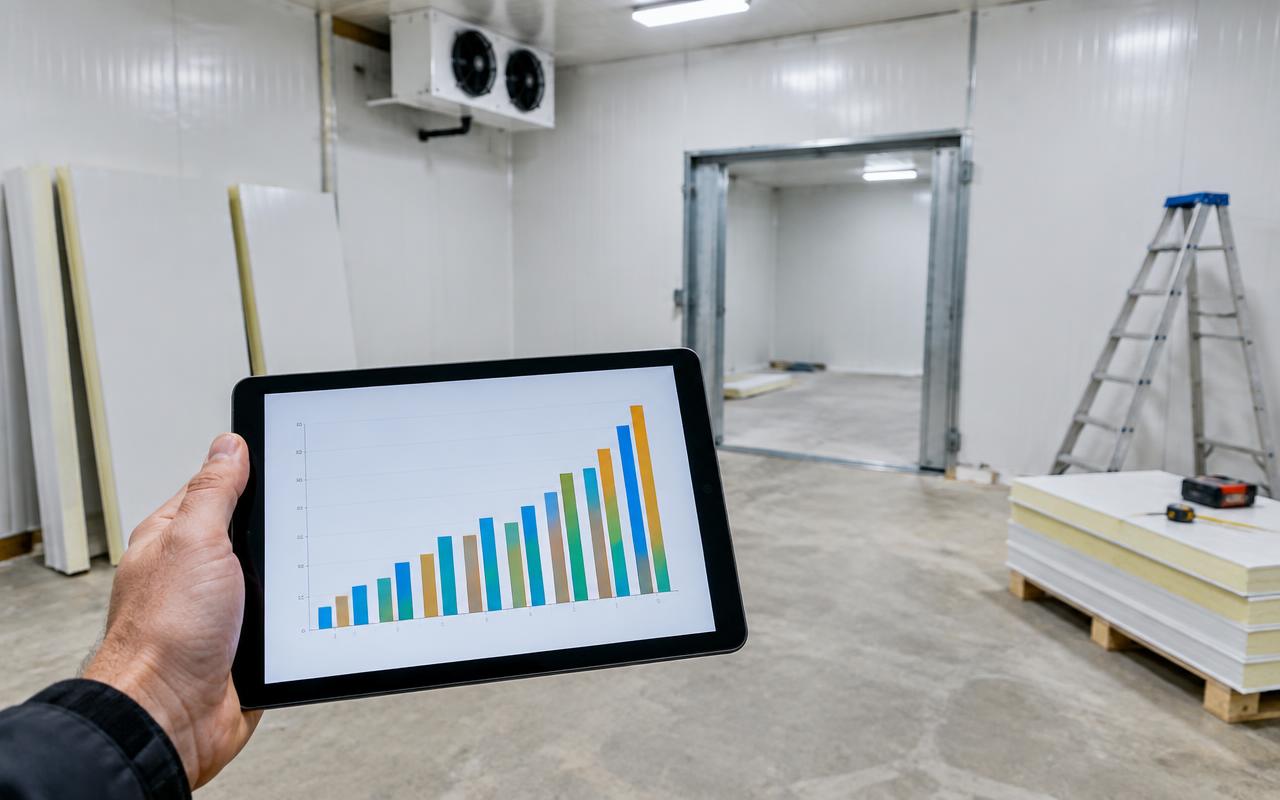
Running costs often exceed construction costs over the life of a facility. The electricity cost calculator estimates annual energy use and cost at your tariff, the cold storage OPEX estimator adds maintenance, staffing, insurance and consumables, and the energy savings tool compares upgrades such as variable-speed drives, better insulation or heat recovery. For agricultural projects, the fruit and vegetable cold storage ROI calculator models payback from lower losses and better selling windows.
Specialist calculators
- Pharma: pharmaceutical cold room calculator, pharma capacity planner and redundancy planner.
- Refrigerant choice: CO₂ vs ammonia comparison calculator.
- Resilience: backup generator calculator.
- Financing scenarios: financing calculator — for planning only; ColdMatch does not lend and may only introduce independent financing partners.
How to read the results
Each calculator shows its method, assumptions and a worked example, and most support metric and imperial units. Read the assumptions before the result: a cooling load built on 25 °C ambient means little for a site that reaches 45 °C. Run a few scenarios rather than one — best case, expected and worst case — and keep the inputs, because suppliers will ask for them. If two calculators disagree, the difference usually points to an input that needs a decision.
Limits
Calculators are planning tools, not engineering design. They do not replace a heat-load calculation by a qualified engineer, local code checks, structural design or supplier selection software. They are most useful early, when a buyer needs to know whether a project is realistic, which options are worth asking about and what a fair proposal should contain.
A worked example
A meat distributor plans a frozen store for 1,200 pallets at −25 °C with daily intake of 60 pallets arriving at −15 °C. The cold room size calculator suggests internal dimensions based on selective racking and stacking height. The cooling load calculator then adds transmission, product heat for warming pallets back down, infiltration from a busy dock door and internal loads; the door infiltration calculator shows that adding an anteroom and rapid doors cuts infiltration load substantially. With the reduced load, the compressor sizing calculator indicates capacity at the expected evaporating and condensing temperatures. The CAPEX estimator gives a budget range from the published baseline, and the electricity cost calculator shows the annual energy bill at the local tariff with and without the door upgrade.
The buyer now arrives at suppliers with a defined room, a load estimate, a clear view on doors and a budget range. Suppliers are asked to confirm or challenge those numbers rather than invent their own — which makes their proposals far easier to compare.
Tips for better inputs
- Use the hottest realistic ambient temperature for your site, not the annual average.
- Enter peak intake per day and the temperature at which product arrives.
- Count real door openings per hour during the busiest shift.
- State whether racking is selective, drive-in or mobile — it changes capacity significantly.
- Keep a record of every scenario so you can explain your assumptions to engineers and financiers.
Calculators in your language
The core calculators are available in several languages, including Arabic, Portuguese, Hebrew, Finnish, Hungarian and Greek, with the same formulas and results as the English versions. The cold chain questions hub also maps everyday questions — "how much cooling do I need?", "how much does a cold room cost?" — to the right calculator, which is often the quickest way to start.
From numbers to a request
Most calculators include a button that carries results directly into the RFQ builder or quote form, so suppliers receive the same capacities, temperatures and assumptions. The RFQ readiness check shows what is still missing. For projects from USD 250K upward, a ColdMatch specialist reviews the request and prepares a structured brief before introducing qualified suppliers. Browse the full calculator library, or start your project now.
Run the numbers
Calculators for this project type
Indicative planning figures only — final sizing belongs to the supplier's or consultant's detailed design.
Blast freezer cost calculator
Size freezing capacity and indicative cost from daily tonnage, entry and target core temperature.
Energy & backup powerEnergy & backup power cost calculator
Annual energy spend from load and running hours, plus the cost of generator hours during outages.
Frequently asked questions
Plan the numbers before you send an RFQ
The reference pages buyers use most before requesting quotes.