Pull to refresh
ColdMatch Group — industrial cooling and cold chain procurement platform
ColdMatchGroupMulti-Bid Cold Chain Sourcing
SolutionsIndustriesKnowledge CenterMarketsToolsFinancingLogistics
ColdMatch Group — industrial cooling and cold chain procurement platform
ColdMatchGroup
SolutionsIndustriesKnowledge CenterIntelligence Center & CalculatorsIndustry IntelligenceExecutive Knowledge CenterPlanning CenterEquipment IntelligenceInnovation & TechnologyProcurement AcademyCase StudiesMarkets by CountryTools & CalculatorsCertificationsFind SuppliersFinancingLogisticsGet Free Quotes
DashboardPrepare a Professional RFQ
DashboardSign inPrepare a Professional RFQ
Cold-chain project financing.Financing for qualified cold-chain projects — introduced to independent financing partners.FinancingFinancing Center
Home

Offline — reconnect before saving or submitting. Changes on this page have not been sent.

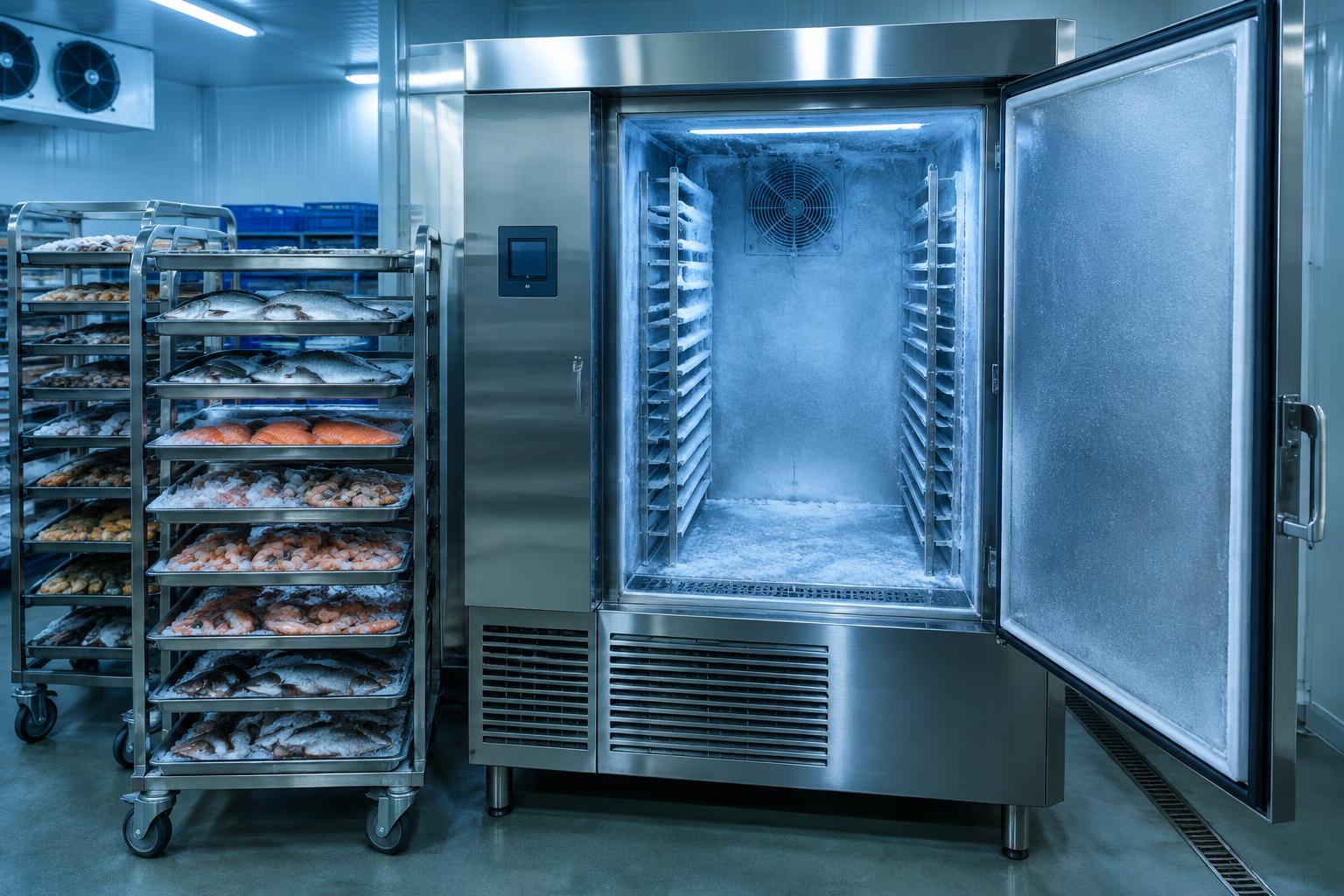
Blast freezer cabinet installed inside an existing cold storage facility with trolleys of product
← Insights
Freezing Technology Oct 2026·6 min read

Adding a Blast Freezer: Sizing, Space and Power Guide

How to add a blast freezer to an existing cold facility: sizing from batch weight, space and power checks, refrigeration options and integration steps.

EnglishالعربيةPortuguês (Brasil)עבריתРусскийfi

Quick answer

How to add a blast freezer to an existing cold facility: sizing from batch weight, space and power checks, refrigeration options and integration steps. Start from the batch: kilograms per cycle, product entry temperature, target core temperature (usually −18 °C) and the freezing time your quality standard allows. Capacity in kg per cycle, not chamber volume, is the number suppliers quote against.

Key takeaways

  • ▸How do I size a blast freezer? Start from the batch: kilograms per cycle, product entry temperature, target core temperature (usually −18 °C) and the freezing time your quality standard allows.
  • ▸Can a blast freezer share refrigeration with my cold room? Sometimes, but it is rarely the best option.
  • ▸How much space does a blast freezer need? Beyond the cabinet or room itself, allow trolley circulation space in front, service access at the machinery side, and a condenser location with airflow.
  • ▸What is the difference between a blast freezer and a cold room? A cold room holds already-frozen or chilled product at temperature; a blast freezer removes heat fast, with high air velocity and much larger refrigeration per cubic metre.

In this article

  1. 01. Step 1: size from the batch, not the room
  2. 02. Step 2: check space, power and drainage
  3. 03. Step 3: choose the refrigeration arrangement
  4. 04. Step 4: plan the workflow around it
  5. 05. Step 5: commission it like a new plant
  6. 06. Blast chiller, blast freezer or both?
  7. 07. Energy and running costs
  8. 08. Common mistakes
  9. 09. What to put in the RFQ
  10. 10. Plan it with ColdMatch tools
  11. 11. Sources and how to read this guide

Reviewed: Oct 2026 · ColdMatch Group

Short answer: adding a blast freezer to an existing facility is usually straightforward if you size it from the batch (kg per cycle, entry temperature, target core temperature, allowed freezing time) and check three building constraints first: electrical supply, floor strength and condenser location. Give it dedicated or properly separated refrigeration so your holding rooms stay stable. For selection basics see the blast freezer selection and sizing guide; for cost context use the 2026 cost benchmarks.

Many cold businesses grow into freezing: a fish trader wants to freeze at landing, a bakery wants to freeze part-baked goods, a meal producer needs to pass the freezing zone fast for quality and safety. The good news is that a blast freezer is one of the easiest upgrades to add to an existing facility — if you respect what it demands from the building and the refrigeration plant.

Step 1: size from the batch, not the room

Blast freezers are specified by throughput: kilograms per cycle and cycles per day. Write down the product, its packaging, the trolley or tray format, entry temperature, the core temperature you must reach (usually −18 °C) and the maximum freezing time your quality standard allows. Freezing time is a quality decision, not just a capacity one: slow freezing forms large ice crystals that damage texture and drip loss.

With those numbers, suppliers can calculate the heat to remove per cycle and propose a cabinet, a trolley room or a small tunnel. If you want to check the arithmetic yourself first, the IQF and freezer sizing calculator walks through the same inputs.

Step 2: check space, power and drainage
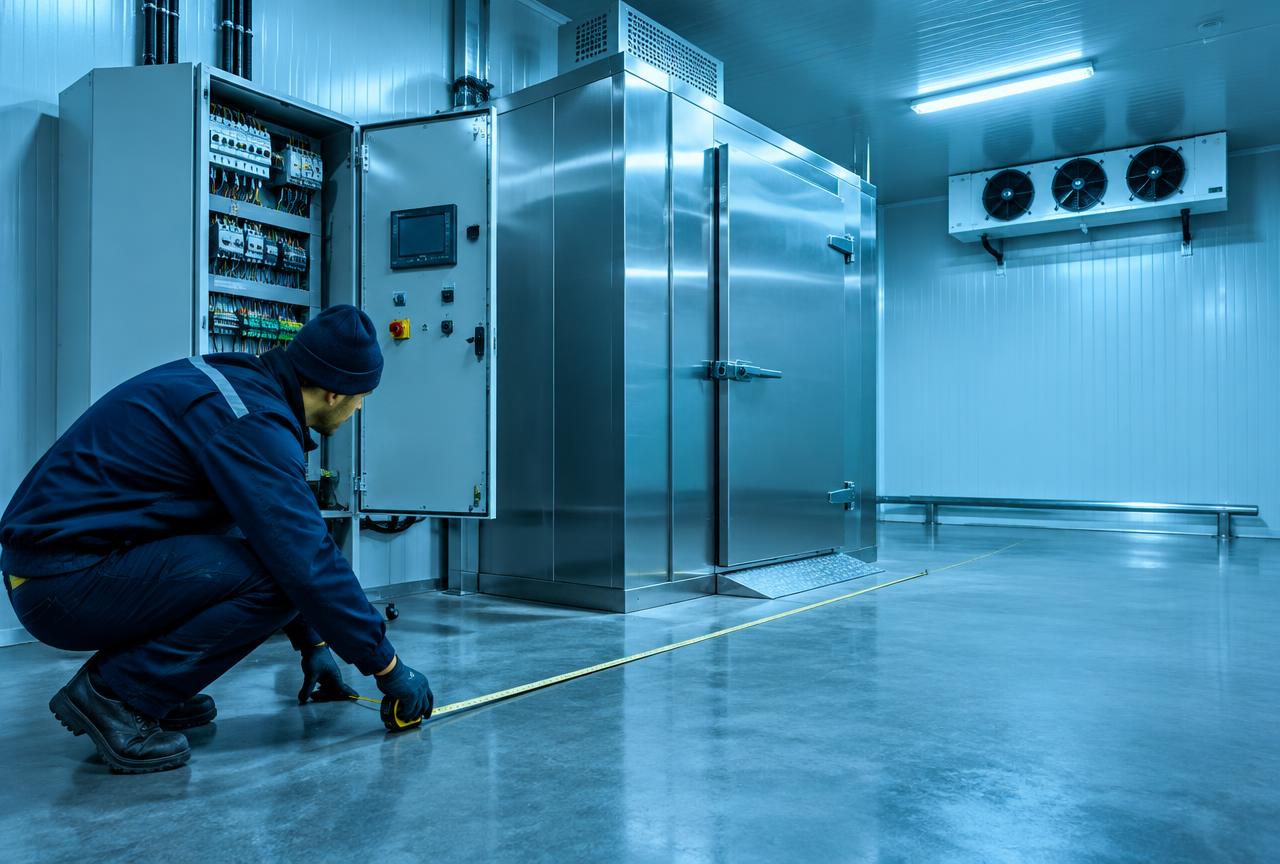
Technician checking electrical panel and floor space for a new blast freezer installation
Power supply, floor strength and condenser location decide which blast freezer your building can actually host.

Three building checks decide what you can install:

  • Electrical supply. Blast freezers have large compressors and fans for their size. Confirm available power, voltage and whether the connection needs upgrading — this is the most common surprise cost.
  • Floor and doorways. The cabinet or room, loaded trolleys and machinery must get through existing doors and sit on a floor that carries them. Measure the access route before ordering.
  • Condenser location and drainage. The heat you remove has to go somewhere: an air-cooled condenser needs airflow and a permitted location; defrost meltwater needs a heated, drained point.

Step 3: choose the refrigeration arrangement

The temptation is to hang the blast freezer on the existing cold-room plant. Resist it unless a refrigeration engineer confirms the plant has spare capacity and the suction groups can be separated. Blast freezing is a large, intermittent load: when a cycle starts, it can pull holding-room temperatures up and short-cycle the compressors. A dedicated condensing unit, or a separated suction group on a larger plant, keeps storage rooms steady and freezing times predictable.

Refrigerant choice follows your region's rules and your service network; the trade-offs between ammonia, CO2 and HFC systems are covered in NH3 vs CO2: a buyer's guide.

Step 4: plan the workflow around it

A blast freezer changes how product moves. Plan the path from production or receiving to the freezer, the staging space for trolleys waiting for a cycle, and the transfer from freezer to frozen storage so product does not warm up between steps. Door discipline matters here too — every minute the door stands open adds moisture that the next defrost must remove. The door infiltration calculator quantifies this if you want numbers for your layout.

Add temperature logging from day one: core-temperature probes per batch and a record of each cycle. Buyers and auditors increasingly ask for freezing records, and they are your evidence that the freezing time specification is met.

Step 5: commission it like a new plant

Even a small cabinet should be commissioned properly: verify pull-down time with a real product load, check core temperatures across the trolley ( corners and centre freeze at different speeds), set the defrost schedule for your humidity, and train staff on loading patterns — overloading a trolley or blocking airflow doubles freezing time. The acceptance-test mindset from our commissioning and handover guide applies at this scale too.

Blast chiller, blast freezer or both?

A blast chiller brings product from cooking or harvest temperature down to chilled, around +3 °C, without freezing it; a blast freezer takes product through the freezing zone to a −18 °C core. They solve different problems. Cook-chill caterers and fresh-cut produce need chilling; fish, meat, bakery and ready meals that will be stored frozen need freezing. Many operations need both steps, and programmable combi units can run a chill cycle followed by a freeze cycle in the same cabinet. Decide from your product flow: if everything you make is sold frozen, a freezer alone may do; if you also ship chilled lines, plan for both functions from the start, because adding the second later usually costs more than specifying it now.

Energy and running costs

Blast freezing is energy-intensive per kilogram, but the total bill depends on how you run it. Full batches beat half-full ones: the fans and compressors run nearly the same either way. Pre-chilling product before freezing removes a large share of the heat cheaply in a chilled room instead of expensively in the freezer. And a defrost schedule matched to your real humidity avoids both ice build-up and wasted defrost cycles. Ask suppliers for energy per cycle at your stated load, and compare like-for-like — it is the fairest single number for comparing offers.

Common mistakes

  • Sizing by chamber volume instead of kg per cycle — the freezer arrives and cannot meet the freezing time.
  • Sharing refrigeration with holding rooms without an engineer's check — storage temperatures swing on every cycle.
  • Forgetting the condenser: no airflow, no permit, or noise complaints from neighbours.
  • No staging space, so trolleys queue in ambient corridors and partially thaw before freezing.

What to put in the RFQ

State the product and packaging, kg per cycle and cycles per day, entry and target core temperature, maximum freezing time, available power, the space and access dimensions, and whether refrigeration is dedicated or shared. Ask suppliers to state the guaranteed freezing time at your load, the defrost method and the noise level. The RFQ readiness check helps you score the brief.

Ready to compare options? Start your project and a specialist will review your brief before it reaches qualified suppliers.

Plan it with ColdMatch tools

Turn this guide into project numbers with these planning tools. Results are estimates from your own inputs, not supplier quotations.

  • IQF and blast freezer sizing calculator
  • Door infiltration load calculator
  • RFQ readiness check
  • Submit your project for a reviewed supplier brief — For commercial projects from USD 250,000, ColdMatch reviews the brief before introducing independent suppliers.

Related reading: Warehouse to Cold Storage Conversion: Retrofit Guide · Natural Refrigerants for Industrial Cold Storage

Sources and how to read this guide

Regulatory and technical statements refer to the official sources below. Project-specific values such as capacities, loads and costs must be confirmed by your engineer and supplier proposals.

  • ASHRAE Handbook — Refrigeration
  • International Institute of Refrigeration (IIR)

Turn this guidance into a refrigeration brief for ColdMatch review and organised supplier responses. ColdMatch is supplier-neutral and free for buyers. For industrial projects from USD 250,000, the team qualifies the brief, contacts suitable suppliers on your behalf and presents organised responses; no automatic supplier connection.

Start a structured industrial refrigeration RFQ

Run the numbers

Calculators for this project type

Indicative planning figures only — final sizing belongs to the supplier's or consultant's detailed design.

Refrigeration sizing

Blast freezer cost calculator

Size freezing capacity and indicative cost from daily tonnage, entry and target core temperature.

Energy & backup power

Energy & backup power cost calculator

Annual energy spend from load and running hours, plus the cost of generator hours during outages.

Related solutions
Industrial Refrigeration Systems Cold Rooms Generators & Backup Power All solutions
Turn these numbers into a blast freezer RFQ Free for buyers · Supplier-neutral · One scope to several suppliers
Request a quote

Frequently asked questions

Plan the numbers before you send an RFQ

The reference pages buyers use most before requesting quotes.

Cold room cost guideUSD/m³ and USD/pallet benchmarks by temperature class.Cold storage construction cost guideCAPEX breakdown: envelope, refrigeration, racking, civil works.Refrigerant phase-out guideF-gas / Kigali timelines and NH3, CO2 and HFO options.Cold storage calculatorSize the room, load and energy spend in under two minutes.Project financingLease, term and export-credit structures for cold chain CAPEX.RFQ BuilderOne structured RFQ to qualified suppliers and EPCs.

In this article

  1. Step 1: size from the batch, not the room
  2. Step 2: check space, power and drainage
  3. Step 3: choose the refrigeration arrangement
  4. Step 4: plan the workflow around it
  5. Step 5: commission it like a new plant
  6. Blast chiller, blast freezer or both?
  7. Energy and running costs
  8. Common mistakes
  9. What to put in the RFQ
  10. Plan it with ColdMatch tools
  11. Sources and how to read this guide

Planning a project?

One brief, reviewed by a specialist, compared across qualified suppliers.

Start your project

Related insights

AI & Innovation

How AI Agents Can Help Prepare Cold Chain and Refrigeration RFQs

A practical guide for AI cold-chain agents, logistics agents, pharma supply-chain assistants and procurement bots: what to collect from a human buyer before a cold room, refrigerated warehouse or blast freezer request reaches ColdMatch — and how the Agent Code unlocks a free priority RFQ review.

Cold Storage Construction

Warehouse to Cold Storage Conversion: Retrofit Guide

How to convert an existing dry warehouse into cold storage: structure checks, insulation, refrigeration, floors, doors and the realistic order of works.

Retrofit

Modernizing an Existing Ammonia Refrigeration Plant: Scope, Reviews and Cost Drivers

A buyer-side guide for owners and engineers planning to upgrade, expand or partially replace an existing industrial ammonia (R717) refrigeration plant: options, decision-maker questions, cost drivers and ROI modelling.

Planning & Procurement

Cold-Room Sizing and Total Operating Cost: Buyer Guide

Size a cold room from product, peak throughput and holding time; compare cooling duty, energy, maintenance and backup at documented design conditions.

Project Planning

How to Build a Cold Storage Warehouse: 2026 Project Guide

Step-by-step guide to building a cold storage warehouse: feasibility, temperature zones, layout, insulation, refrigeration, power, permits and supplier RFQs.

Refrigeration Technology

Blast Freezers: How to Choose and Size One (2026 Guide)

How to choose a blast freezer: blast rooms vs tunnels, spiral and IQF freezers, sizing by product and throughput, refrigerants, energy and supplier RFQs.

Project request

Submit your project for expert review

Send your requirements. A ColdMatch specialist reviews every request, prepares a brief and introduces qualified suppliers — free for qualified buyers.

ColdMatch Group — industrial cooling and cold chain procurement platform
ColdMatchGroup

Because we care more.

ColdMatch Group is the industrial refrigeration and cold-chain procurement platform of Global B2B Group, where commercial and industrial buyers build a project and submit an RFQ; the ColdMatch team validates and organizes it, contacts suitable refrigeration technology and equipment suppliers on the buyer's behalf, and presents organized responses through ColdMatch.

support@coldmatchgroup.com
Follow on LinkedIn
Language
Sourcing & Financing
  • Get Free Quotes
  • RFQ Builder
  • Urgent Procurement
  • Solutions
  • Suppliers
  • Refrigeration Marketplace
  • Global Coverage
  • Project Financing
  • Financing Center
Tools & Knowledge
  • Planning Center
  • Calculators
  • Innovation & Technology
  • Projects Hub
  • Knowledge Hub
  • Cold Chain Answers
  • Cost Benchmarks 2026
  • AI Agents (MCP)
Markets
  • All Country Markets
  • Zambia
  • Ghana
  • Malawi
  • Kenya
  • Nigeria
  • Mauritius
  • Israel
  • Finland
  • Hungary
Company
  • About ColdMatch
  • How ColdMatch Works
  • Solutions by Buyer Type
  • Consultant Partner Program
  • Supplier Qualification
  • Trust Center
  • Case Studies
  • Blog
  • Contact
Business and supplier disclaimer

ColdMatch Group is the industrial refrigeration and cold-chain procurement platform of Global B2B Group, where commercial and industrial buyers build a project and submit an RFQ; the ColdMatch team validates and organizes it, contacts suitable refrigeration technology and equipment suppliers on the buyer's behalf, and presents organized responses through ColdMatch. It helps buyers prepare technical requirements and structured RFQs before suitable third-party suppliers, manufacturers, EPC contractors and turnkey providers are introduced manually. ColdMatch is not an equipment manufacturer, reseller, distributor, EPC contractor, installer, insurer, lender, bank or financial advisor, and is not a party to any supply, construction or finance contract. Quotes, equipment and services are provided solely by the matched third-party supplier, who is solely responsible for quality, delivery, installation, safety and performance. ColdMatch makes no guarantee of availability, price, quality or approval and disclaims all liability for any service provided by a supplier or other third party. See Terms and How ColdMatch Works.

Financing disclaimer: ColdMatch does not provide or guarantee finance. Any financing pathway is evaluated and supplied solely by independent third-party providers under their own checks and terms. See Terms.

ColdMatch Group is the industrial refrigeration and cold-chain procurement platform of Global B2B Group, where commercial and industrial buyers build a project and submit an RFQ; the ColdMatch team validates and organizes it, contacts suitable refrigeration technology and equipment suppliers on the buyer's behalf, and presents organized responses through ColdMatch. It helps buyers prepare technical requirements and structured RFQs before suitable third-party suppliers, manufacturers, EPC contractors and turnkey providers are introduced manually. ColdMatch is not an equipment manufacturer, reseller, distributor, EPC contractor, installer, insurer, lender, bank or financial advisor, and is not a party to any supply, construction or finance contract. Quotes, equipment and services are provided solely by the matched third-party supplier, who is solely responsible for quality, delivery, installation, safety and performance. ColdMatch makes no guarantee of availability, price, quality or approval and disclaims all liability for any service provided by a supplier or other third party. See Terms and How ColdMatch Works.

Disclaimer: ColdMatch Group is the specialized industrial refrigeration and cold-chain procurement platform of Global B2B Group. ColdMatch Group is not a manufacturer, reseller, distributor, EPC contractor, installer, insurer, lender, bank, credit provider, financial advisor, investment advisor, underwriter or regulated financial services provider. Any financing, leasing, trade finance, working capital or project-finance option mentioned on this website is provided solely by independent third-party financing providers, subject to their own eligibility checks, KYC, due diligence, compliance review, approval, terms and documentation. ColdMatch Group does not provide financial advice, does not arrange regulated financial products, does not guarantee financing approval, and is not responsible for any financing decision, offer, rejection, delay, cost, term or outcome. Quotes, equipment, services, delivery, installation, commissioning, warranties and project performance are provided solely by independent third-party suppliers, EPC contractors or service providers. See Terms.

ColdMatch Group · Global Refrigeration & Cold-Chain Sourcing
How ColdMatch Works·Cold Chain Project Markets·Project Guide·RFQ Process·AI Agent Brief·For AI Cold Chain & Refrigeration Procurement Agents·Supplier Qualification·Trust Center·Legal Center·Terms of Service·Privacy Policy·Agency Policy·Contact·Client Login (Buyer Portal)·Accessibility·Accessibility Support
Legal Documents
Terms of Service·Privacy Policy·Agency Policy·Cookie Policy·General Disclaimer·Legal Notice·RFQ Terms·Buyer Terms·Supplier Terms·Financing Disclaimer·Acceptable Use Policy·Marketplace Rules·Intellectual Property & Copyright Policy·Data Protection & GDPR·AML, Sanctions, Export & Anti-Bribery Policy·Cyber Security & Responsible Disclosure·AI & Third-Party Content Disclaimer
EnglishالعربيةעבריתPortuguêsPortuguês (Brasil)РусскийSuomiMagyarTürkçe
Operated from the Republic of Cyprus · We are committed to WCAG 2.1 AA accessibility — report barriers to accessibility@coldmatchgroup.com.© 2026 ColdMatch Group · All rights reserved.ColdMatch Group is the specialized commercial cold-chain platform of Global B2B Group — a global B2B procurement & project development ecosystem. Sister platforms: FishMatch Group, HatchMatch Group, FeedMatch Group, SeedMatch Group. About ColdMatch Group.ColdMatch helps buyers prepare cold chain RFQs and source suitable suppliers. Supplier matching and introductions are managed manually by ColdMatch — not an automatic marketplace. How it works.
CalculatorsGuidesFinancingGet a Quote

Get updates

Cold-chain reading, project resources and technology evidence.

Email subscriptions are not active. Your details will not be sent or saved.

Get updates

Separate from project enquiries. You can unsubscribe or change preferences in every update email once the service is active. Privacy notice