
Quick answer
ColdMatch’s Knowledge, Innovation and Market Intelligence centers are free to read and use without payment, sign-in or a lead form. Use knowledge to define requirements, innovation to assess technology fit, and sourced market context to challenge assumptions. Calculators support planning; they do not replace engineering. Any RFQ or newsletter action is separate and optional.
Key takeaways
- Are all three centers really free to use? Yes.
- Which center should I use first? Start with Knowledge to define the problem.
- Does Market Intelligence show live cold-storage capacity or prices? No.
- Can a calculator replace engineering or a pharmaceutical qualification plan? No.
Updated: 2026-10-18 · ColdMatch Group
Editorial preparation: ColdMatch Group · Content updated 18 October 2026. This edition explains the three existing public centers. Technical references retain their own dates; this update is not a specialist certification or a new review of every linked resource.
Three free centers, three different decisions
You do not need to pay, create an account or submit contact details to read these centers or use their public tools. This access promise concerns knowledge and planning resources, not every commercial service on the platform. ColdMatch is Global B2B Group’s independent industrial refrigeration and cold-chain procurement platform, not a manufacturer, warehouse operator or construction contractor. Optional project support retains its own scope and qualification rules.
Knowledge Center: understand what the project must do
Start in the Knowledge Center with practical guides, checklists, definitions, FAQs and planning templates. Read any case study within its documented scope; an illustrative example is not a verified customer outcome. Turn reading into a design-basis note: products, incoming conditions, approved storage temperatures, peak inventory, receiving and dispatch patterns, and responsibilities. The site due-diligence checklist and governance checklist help assign unresolved grid, water, site and approval questions to the people who can verify them.
Innovation Center: test suitability, not novelty
The Innovation & Technology Center connects a customer problem to an evidence-based technology brief. Review the source and date, maturity evidence, application fit, implementation checklist and constraints before adding a technology to an RFQ. A commercially available variable-speed control still needs compatible equipment, commissioning and an operating profile that makes the control useful. A low-GWP option must also suit pressure, safety, service access and local requirements. Do not infer energy savings, CAPEX or ROI from a maturity label. The DOE industrial refrigeration resource supports examining system operation and controls; it does not promise savings at your facility.
Business Intelligence Center: put the site in context
Use Market Intelligence for sourced country context and explainers. Read indicator, geography, reporting year, units and retrieval date together. Annual electricity-access or food-trade observations are demand proxies, not warehouse vacancy, available pallet positions, local grid capacity or live prices. A current retrieval does not make an old observation real-time. Missing rows remain unknown; estimates and forecasts require separate labels and sources. Check the World Bank WDI methodology and UN Comtrade before interpreting a series. Add your own dated seasonal receiving schedule, route reliability and destination requirements instead of inventing monthly demand.
A practical workflow for food and pharmaceutical projects
For an illustrative food distributor considering expansion, first separate peak stock from throughput: a busy dock and a full rack are different constraints. Use knowledge to record required temperature zones and receiving conditions, then innovation to compare controls or door-management options against the measured problem. Use market context only to test the business assumptions behind growth. A national trade trend cannot establish demand for this specific site.
For an illustrative pharmaceutical distribution project, begin with approved product storage conditions and quality responsibilities rather than a universal temperature range. Review mapping, monitoring, alarms, qualification and excursion handling with the responsible specialists. WHO’s storage-capacity supplement and temperature-mapping supplement, published in 2015, address different planning tasks. They are guidance, not proof of compliance or a replacement for applicable local rules. Neither example is a ColdMatch customer case.
Use the free tools with explicit assumptions
The public warehouse capacity planner explores pallet-space and handling assumptions; it is not a refrigeration-load calculation. The cold room energy and lifecycle calculator connects room and product inputs to load and cost scenarios. Supply your own COP and tariff to obtain meaningful electricity and cost estimates. The refrigeration TCO calculator compares alternatives over a common horizon; its example offers are demonstration inputs, not supplier quotes. Results are accessible before any optional contact step. Linked tool interfaces may be in English; always check units, currency, inclusions and uncertainty.
A short checklist before comparing solutions
- Record product, temperature, peak stock and daily throughput separately.
- Confirm site, grid, water, access and logistics evidence with named owners.
- Label each input measured, estimated or unknown and keep its source/date.
- Review technology maturity, compatibility, safety and maintenance constraints.
- Compare energy and lifecycle scenarios with common boundaries, not promised ROI.
- Agree acceptance tests, scope exclusions and approval responsibilities.
Optional next step—not a condition of access
Keep using the centers for as long as you need. When a project is ready, an optional RFQ for projects from USD 250,000 lets the ColdMatch team validate and organize the brief, contact suitable suppliers on your behalf and present organized responses. It does not create direct buyer-to-supplier messaging. Newsletter interest is also separate; email updates are currently inactive, so no delivery is promised. Specialist design, legal advice and any commercial engagement must be agreed separately. For the investment decision, continue with the business-case checklist, not an assumed return.
Learn more—but learn against a decision
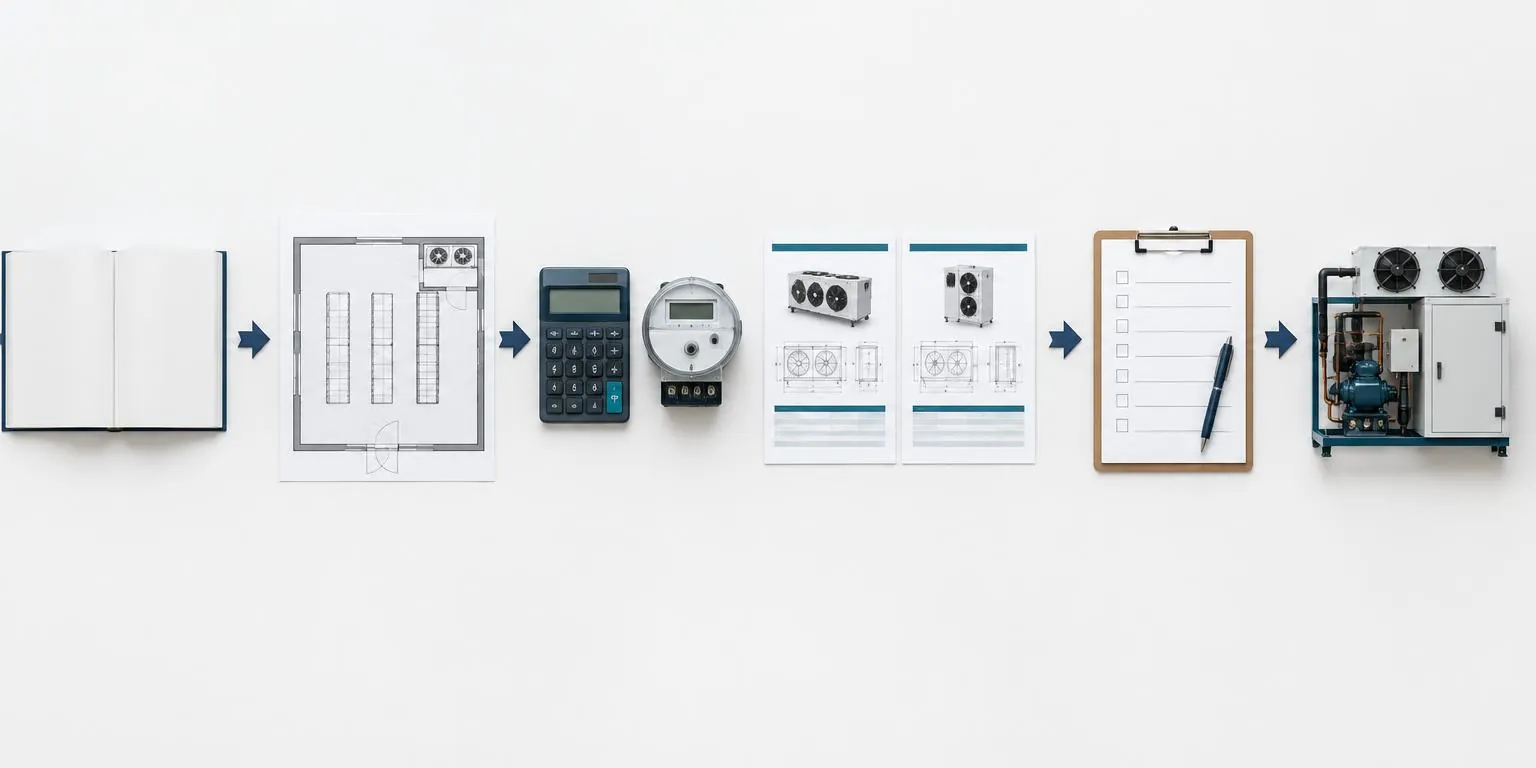
A cold store can appear full while its refrigeration plant still has spare capacity. A compressor can run continuously because warm air enters through a loading door, not because the warehouse needs another machine. A low equipment quotation can omit the electrical work that makes the project possible. Better decisions begin by distinguishing these situations before committing capital.
The Knowledge Center is the starting point for understanding design, operating costs and procurement. Treat it as a structured reading room: identify the question, find the relevant explanation, record the assumptions, then decide what evidence your own facility needs. Knowledge becomes business intelligence when it changes a documented decision.
Translate refrigeration into business language
Industrial refrigeration removes heat from products, rooms or processes. Cold storage is the temperature-controlled facility and operating system that protects inventory. A retrofit changes an existing installation: it may involve controls, insulation, doors, heat exchangers or refrigeration equipment. Retrofitting does not automatically mean replacing the whole plant.
Capacity has several meanings. Storage capacity describes usable inventory space. Throughput describes product movement over time. Refrigeration capacity, expressed as cooling output, describes heat removal under stated conditions. Electrical input is different again. Increasing pallet positions does not prove that the plant can cool additional incoming product within the required time.
CAPEX is the capital expenditure needed to deliver the project, including relevant installation and enabling works. OPEX is the recurring cost of operation: electricity, maintenance, refrigerant service and other agreed categories. Total cost of ownership, or TCO, considers the investment and ownership costs over a defined period. State whether your comparison discounts future costs and how it handles residual value.
Use each resource for a different job
- Industry Intelligence: explore technology and market context, checking publication dates and applicability.
- Cold Storage Problems: organize symptoms and investigation questions before choosing equipment.
- Existing Cold Storage Upgrades: frame retrofit, modernization and expansion alternatives.
- Services: understand the available project support and its boundaries.
- RFQ: move a defined requirement into a managed, team-reviewed request process.
Annotation: these resources support different stages; an industry article is not evidence that a particular retrofit will suit your site. Link every proposed action to a measurement, inspection finding or explicit assumption.
Walk through an established operator’s upgrade decision
1. Define the problem without prescribing the answer
Consider an illustrative frozen-food distributor whose room temperature recovers slowly after busy receiving periods. Electricity costs are also causing concern, and management expects additional business. This is a decision scenario, not a ColdMatch customer case or a claim of achieved savings.
The initial question should be: can the existing facility meet the required product temperatures and receiving schedule reliably? Record incoming product temperature, delivery timing, door activity, inventory occupancy, temperature excursions, compressor operation, defrost schedules and maintenance history. Separate measured values from operator recollections. Where metering is shared, identify which loads the electricity bill actually includes.
2. Distinguish the bottlenecks
Ask whether the constraint is heat removal, air distribution, door infiltration, rack layout, power availability or operating practice. Check condenser condition and evaporator performance before assuming more compressor capacity is necessary. Product pull-down is a different duty from maintaining already-frozen stock; confusing them can produce an unsuitable specification.
A qualified refrigeration engineer should establish the design basis and check peak conditions. The operator can then compare a maintenance-and-controls option, a targeted retrofit and a larger expansion against the same temperature, throughput and resilience requirements. A do-minimum option provides a useful baseline but must still address safety and mandatory compliance.
3. Compare energy and ownership costs
Use the public Cold Room Energy Lifecycle Calculator to explore assumptions. Its implementation includes room dimensions, temperatures, insulation U-value, daily product quantity, incoming product temperature, door activity, operating hours, alternative COP inputs, tariff, planning period and discount rate. It also accepts capital, annual maintenance and lease inputs for relevant comparisons. Enter project-specific values; defaults are not a survey of your facility.
A first-pass relationship is annual refrigeration electricity ≈ average cooling load ÷ representative system COP × operating hours. COP compares cooling output with electrical input. Both must use compatible operating conditions. Add auxiliary consumption when it is outside the selected system boundary, and do not count it twice. Demand charges, tariff periods and variable weather may require a separate calculation.
Build expected, adverse-tariff and lower-utilization scenarios. Include installation disruption, temporary storage, electrical modifications, commissioning and maintenance differences in the investment decision. Keep financing cash flow separate from the underlying engineering comparison so debt payments do not conceal an inefficient option.
4. Decide what must be demonstrated
The preferred option should satisfy operating requirements, not merely produce an attractive modeled payback. Define temperature recovery, product conditions, monitoring, service access and acceptance tests. Agree how energy performance will be assessed after installation, including production and weather adjustments. Otherwise, a quieter operating month could be mistaken for an efficiency improvement.
A worksheet for your next planning meeting
| Decision field | Record | Check before approval |
|---|---|---|
| Required service | Products, temperatures, incoming condition, throughput | Operations and quality teams agree |
| Existing evidence | Meter records, alarms, maintenance, door activity | Period and measurement boundary are clear |
| Capacity constraint | Space, cooling, handling or electrical limit | Engineer confirms the relevant constraint |
| Alternatives | Maintain, retrofit, expand, replace | All meet the same essential requirements |
| Economics | CAPEX, OPEX, disruption and sensitivities | No duplicated costs or unsupported savings |
| Delivery | Shutdown plan, responsibilities, acceptance tests | Product protection remains practical |
Annotation: add an evidence source, owner and confidence level beside every entry. An unknown is a task to resolve, not permission to insert a favorable number.
Understand the evidence—and its limits
UNEP and the International Institute of Refrigeration identify energy use as an important operating-cost consideration for refrigerated warehouses. Their brief explains the sector; it does not establish your facility’s baseline. [[1]](https://wedocs.unep.org/items/9ba80799-d23e-42ee-85cd-0c8544df9917)
The IEA/UNEP synthesis treats efficiency improvement and refrigerant transition as connected priorities. That supports considering both in an upgrade, but not assuming that any particular refrigerant or machine guarantees better site performance. [[2]](https://www.iea.org/reports/cooling-emissions-and-policy-synthesis-report)
Calculator results remain estimates. Refrigerant safety, pressure systems, structural condition, fire requirements, electrical protection and local rules need competent assessment. Forecast demand is uncertain, and a retrofit can expose concealed defects. Do not present an indicative model as a performance guarantee.
Move from intelligence to a managed RFQ
Prepare one design basis, scope boundary and acceptance framework before requesting offers. Include exclusions, commissioning, training, warranty, service expectations and the energy conditions bidders must declare. ColdMatch’s team reviews the request, contacts suitable manufacturers and installers on the buyer’s behalf, and organizes responses. This is a managed process, not a promise of direct buyer-supplier connections.
The inspected guidance states that guides and online calculators can be used without upfront payment. That does not mean consulting or project-management services are free. Any separate engagement requires its own terms. Financing, where available, comes only from independent third-party providers, subject to eligibility and approval; ColdMatch is not a lender and does not guarantee funding.
Start with the evidence worksheet, test your assumptions in the lifecycle calculator, then use the RFQ route when the requirement is ready for team review. Learn more to reduce uncertainty, plan smarter to compare genuine alternatives, and make better decisions by documenting what must be true for the investment to succeed.
Better refrigeration investments begin with a verified operating problem and comparable lifecycle assumptions.
Explore the Knowledge CenterFrequently asked questions
Plan the numbers before you send an RFQ
The reference pages buyers use most before requesting quotes.