Pull to refresh
ColdMatch Group — industrial cooling and cold chain procurement platform
ColdMatchGroupMulti-Bid Cold Chain Sourcing
SolutionsIndustriesKnowledge CenterMarketsToolsFinancingLogistics
ColdMatch Group — industrial cooling and cold chain procurement platform
ColdMatchGroup
SolutionsIndustriesKnowledge CenterIntelligence Center & CalculatorsIndustry IntelligenceExecutive Knowledge CenterPlanning CenterEquipment IntelligenceInnovation & TechnologyProcurement AcademyCase StudiesMarkets by CountryTools & CalculatorsCertificationsFind SuppliersFinancingLogisticsGet Free Quotes
DashboardPrepare a Professional RFQ
DashboardSign inPrepare a Professional RFQ
Cold-chain project financing.Financing for qualified cold-chain projects — introduced to independent financing partners.FinancingFinancing Center
Home

Offline — reconnect before saving or submitting. Changes on this page have not been sent.

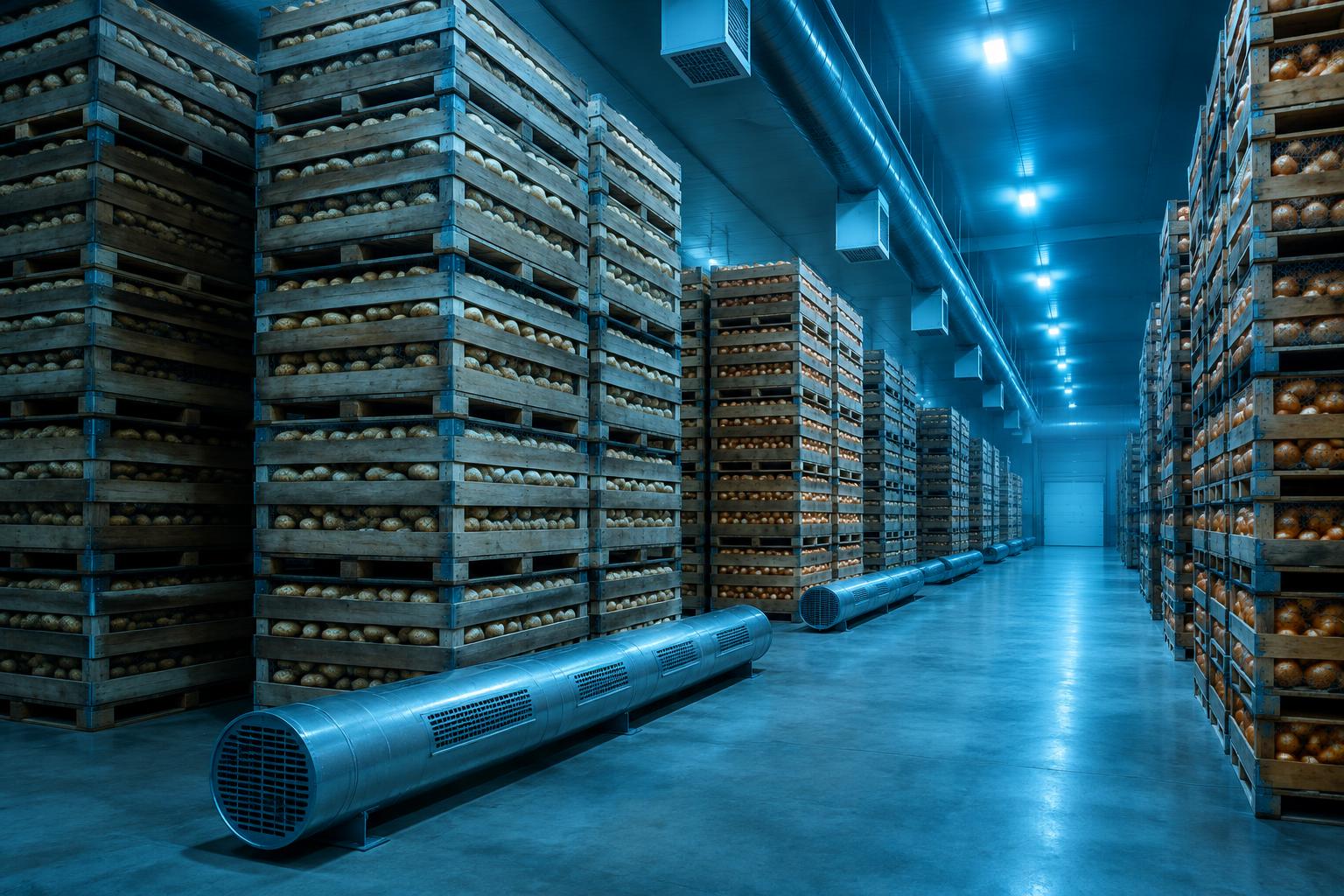
Large ventilated potato and onion storage hall with wooden bulk boxes and floor air ducts
← Insights
Agriculture Oct 2026·8 min read

Potato, Onion & Root Crop Storage: Buyer's Guide

How to plan and buy refrigerated, ventilated storage for potatoes, onions, carrots and other root crops — temperatures, airflow, curing and an RFQ checklist.

EnglishالعربيةPortuguês (Brasil)עבריתРусскийfi

Quick answer

How to plan and buy refrigerated, ventilated storage for potatoes, onions, carrots and other root crops — temperatures, airflow, curing and an RFQ checklist. Table potatoes are commonly held around 4–6 °C after curing, processing potatoes warmer at about 6–10 °C to protect frying colour, and seed potatoes colder at about 2–4 °C. Confirm setpoints for your variety and buyer.

Key takeaways

  • ▸What temperature should potatoes be stored at? Table potatoes are commonly held around 4–6 °C after curing, processing potatoes warmer at about 6–10 °C to protect frying colour, and seed potatoes colder at about 2–4 °C.
  • ▸Do onions need refrigeration? For long storage, yes.
  • ▸Is bulk or box storage better for potatoes? Bulk storage is cheaper per tonne and maximises volume; box storage gives more flexibility to separate lots, grade and sell in smaller quantities.
  • ▸Can outside air replace refrigeration in a root crop store? In cold climates outside-air ventilation can provide much of the cooling for parts of the season, but refrigeration is still needed for warm spells, pull-down and late-season holding.

In this article

  1. 01. Why root crops are different from fruit
  2. 02. Typical storage conditions by crop
  3. 03. Bulk storage or box storage?
  4. 04. Airflow, humidity and CO₂: the three control loops
  5. 05. Five things that drive project scope
  6. 06. Common mistakes to avoid
  7. 07. How to write a request suppliers can quote
  8. 08. A simple planning illustration

Reviewed: Oct 2026 · ColdMatch Group

Potatoes, onions, carrots, beetroot and other root and bulb crops are often stored in larger volumes than any fruit, yet they are among the most misunderstood cold storage projects. Many growers and processors still think of them as 'simple' stores: a shed, some fans and a refrigeration unit. In practice, a root crop store is a living process. Each tonne of potatoes keeps respiring, releasing heat, moisture and carbon dioxide for months; onions must be dried and cured before they can be held; carrots need near-freezing temperatures and almost saturated air. Get the airflow, humidity or temperature wrong and losses through weight loss, sprouting, rot or sugar build-up can wipe out a season's margin. This guide explains how professional buyers plan root crop storage, what drives scope and how to ask suppliers for proposals that can be compared on equal terms.

Short answer: root crop storage combines refrigeration with high-volume ventilation, humidity control and CO₂ management. Define each crop's end use (fresh market, processing or seed), the tonnage, storage duration and whether you store in bulk or boxes; then specify curing, cooling, holding and pre-delivery phases separately. Compare suppliers on airflow design, insulation, control software and service — not on refrigeration capacity alone.

Why root crops are different from fruit

Fruit stores usually hold palletised product in rooms of a few hundred tonnes. Root crop stores often hold thousands of tonnes in one hall, either as loose bulk piled several metres high or in large wooden or plastic boxes stacked to the ceiling. That changes the engineering. Air must be pushed evenly through a dense mass of product, not just around it. The crop arrives warm and sometimes wet from the field, so the first weeks need drying and wound healing before any cooling starts. And because the product is sold over many months, the store must hold a very stable climate long after harvest.

End use also matters more than with most crops. Potatoes for crisps and fries must be stored warmer than table potatoes, because cold temperatures convert starch to sugar and cause dark frying colour. Seed potatoes can be held colder to limit sprouting. Onions need low humidity to keep their skins dry, while carrots and beetroot need very high humidity to avoid shrivelling. A single building may therefore need several independently controlled compartments.

Typical storage conditions by crop

The figures below are common planning ranges; the right setpoint depends on variety, maturity, field conditions and buyer specifications, so confirm them with your agronomist and the storage temperature chart. - Table (ware) potatoes: roughly 4–6 °C with high humidity, after a curing period of about two weeks at warmer temperatures. - Processing potatoes: usually warmer, around 6–10 °C, to protect frying quality; often combined with sprout control. - Seed potatoes: colder, around 2–4 °C, to keep them dormant until planting. - Onions: after field or forced-air drying, close to 0–2 °C with relatively low humidity to keep skins intact. - Carrots, beetroot and parsnips: close to 0–1 °C with very high humidity, usually stored in boxes or under protective covers.

Bulk storage or box storage?

Bulk storage piles the crop directly on a ventilated floor, with lateral ducts or a slatted floor delivering air from below. It offers the lowest handling cost and the highest volume per square metre, but it requires a strong building (the pile pushes against the walls) and a careful air distribution design. Box storage keeps the crop in large crates of roughly a tonne or more, stacked in rows with air pushed through the boxes from a plenum wall or letterbox system. Boxes make it easier to separate varieties, grade lots and sell in smaller quantities, and they are common for seed and specialty crops. Many modern stores combine both approaches in different compartments.

Airflow, humidity and CO₂: the three control loops
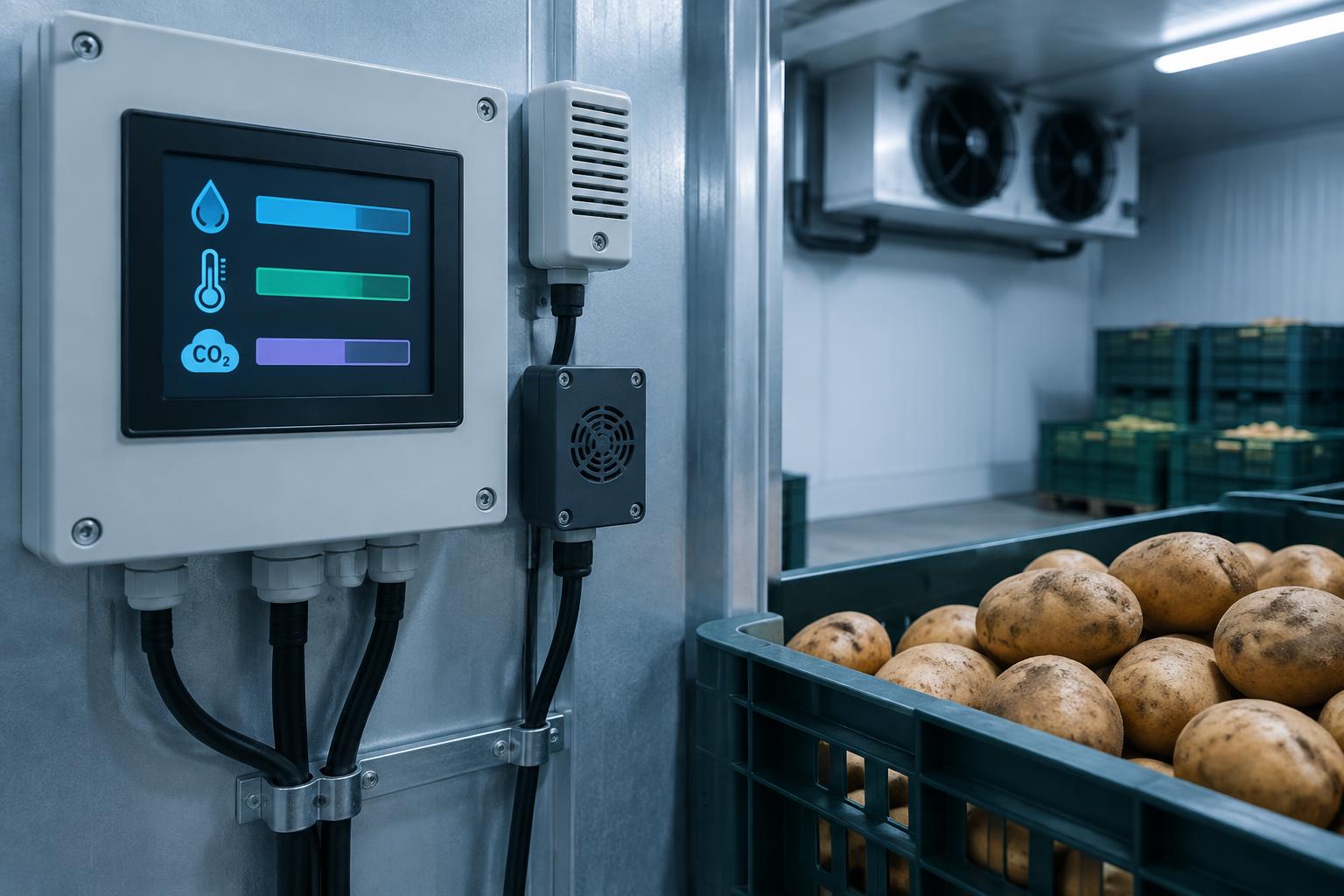
Crop storage control panel with humidity, temperature and CO₂ sensors beside a crate of potatoes
Modern root crop stores control temperature, humidity and CO₂ together, not temperature alone.

The heart of a root crop store is the ventilation system. Large fans move outside air, recirculated air or refrigerated air through the product; the control system mixes them to reach the target temperature with the least energy. In cold climates, outside air can do much of the cooling for long parts of the season, so refrigeration may only run during warm spells and at the end of storage. In warm climates, mechanical refrigeration carries most of the load.

Humidity control prevents weight loss — and every percentage point of moisture lost is lost revenue when crops are sold by weight. Humidifiers, careful air speeds and well-sized evaporators with small temperature differences keep the air moist without condensation dripping on the crop. CO₂ sensors trigger fresh-air ventilation, because carbon dioxide build-up from respiration can harm skin quality and frying colour. Ask suppliers how they control all three loops, which sensors they place in the pile or boxes, and how alarms reach the operator at night.

Five things that drive project scope

  1. Tonnage and number of compartments: separate rooms for different crops, varieties or end uses add doors, controls and refrigeration circuits, but make management far easier.
  2. Building envelope: insulation thickness, vapour barrier and airtightness determine energy use and condensation risk; bulk stores also need walls designed for the lateral pressure of the pile.
  3. Ventilation design: fan capacity per tonne, duct or plenum layout, and whether outside-air cooling is included.
  4. Refrigeration: capacity for pull-down after harvest and for holding in warm weather; refrigerant choice under local rules.
  5. Controls and monitoring: product temperature probes, humidity and CO₂ sensors, remote access, data logging for buyer audits.

Early capacity planning helps here. The cold storage capacity calculator and the cooling load calculator give first figures for storage volume and refrigeration duty. Budgets should come from consistent planning ranges in the cold storage cost guide, not from a single quotation for equipment.

Common mistakes to avoid

  • Cooling potatoes before curing is finished, which slows wound healing and increases rot.
  • Undersizing fans or ducts, so the centre of the pile stays warm while sensors near the walls look fine.
  • Storing processing potatoes too cold and losing frying quality.
  • Mixing onions and carrots in one compartment despite opposite humidity needs.
  • Forgetting reconditioning: processing potatoes are often warmed before delivery, which needs heating capacity.
  • Leaving out data logging, then struggling to prove storage conditions to a processor or retailer.

How to write a request suppliers can quote

A strong request for root crop storage lists each crop and end use, tonnage per compartment, bulk or box storage, box dimensions, pile height, harvest dates and storage duration, site climate, available power, preferred refrigerant, whether outside-air cooling is wanted, control and monitoring requirements, and what the supplier should include — building, insulation, ventilation, refrigeration, electrical, commissioning, training and service. Ask each supplier to state fan capacity, airflow per tonne, insulation values and expected energy use so you can compare proposals like-for-like. Our guide on post-harvest cold storage for fruit and vegetables covers the wider packhouse context.

ColdMatch Group works with qualified projects of USD 250K and above. Use the RFQ builder to structure your brief; a specialist reviews it before any supplier is introduced, so you only receive proposals that answer your actual crop and storage plan.

A simple planning illustration

Imagine a grower who wants to hold table potatoes and onions from harvest until late spring. Instead of one large hall, the plan splits the building into two potato compartments and one onion compartment, each with its own fans and controls. Potatoes are cured warm for two weeks, cooled slowly to holding temperature, then held with high humidity; onions are dried with forced air and held colder and drier. Because each compartment can be emptied and cleaned separately, the grower can sell in stages and keep the remaining crop undisturbed. This kind of zoning decision, taken early, usually matters more to long-term returns than small differences in equipment price.

Turn this guidance into comparable supplier quotes for your warehouse or cold store project. ColdMatch is supplier-neutral and free for buyers. For industrial projects from USD 250,000, the team qualifies the brief, contacts suitable suppliers on your behalf and presents organised responses; no automatic supplier connection.

Start a structured cold storage RFQ

Run the numbers

Calculators for this project type

Indicative planning figures only — final sizing belongs to the supplier's or consultant's detailed design.

Refrigeration sizing

Fruit & vegetable cold storage ROI calculator

Pre-cooling and storage capacity plus indicative payback from spoilage reduction.

Energy & backup power

Energy & backup power cost calculator

Annual energy spend from load and running hours, plus the cost of generator hours during outages.

Related solutions
Industrial Refrigeration Systems Solar Backup Power Generators & Backup Power All solutions
Turn these numbers into a packhouse cold storage RFQ Free for buyers · Supplier-neutral · One scope to several suppliers
Request a quote

Frequently asked questions

Plan the numbers before you send an RFQ

The reference pages buyers use most before requesting quotes.

Cold room cost guideUSD/m³ and USD/pallet benchmarks by temperature class.Cold storage construction cost guideCAPEX breakdown: envelope, refrigeration, racking, civil works.Refrigerant phase-out guideF-gas / Kigali timelines and NH3, CO2 and HFO options.Cold storage calculatorSize the room, load and energy spend in under two minutes.Project financingLease, term and export-credit structures for cold chain CAPEX.RFQ BuilderOne structured RFQ to qualified suppliers and EPCs.

In this article

  1. Why root crops are different from fruit
  2. Typical storage conditions by crop
  3. Bulk storage or box storage?
  4. Airflow, humidity and CO₂: the three control loops
  5. Five things that drive project scope
  6. Common mistakes to avoid
  7. How to write a request suppliers can quote
  8. A simple planning illustration

Planning a project?

One brief, reviewed by a specialist, compared across qualified suppliers.

Start your project

Related insights

Agriculture

CA, ULO, DCA & Ripening Rooms: Buyer's Guide 2026

Compare regular cold storage, CA, ULO and DCA fruit stores and ripening rooms: cost drivers, door specs, airtightness and an RFQ checklist.

Agriculture

Milk Cooling Centres: A Dairy Cold Chain Buyer Guide

Specify milk cooling tanks, collection centres, reliable power and hygiene systems for a dependable farm-to-processor dairy cold chain.

Pharma Cold Chain

Pharma GDP Cold Storage: Buyer's Guide and RFQ Checklist

Plan a GDP-compliant pharmaceutical cold store: temperature zones, mapping, monitoring, redundancy, validation and the RFQ details suppliers need to quote.

Project Outcomes

Cold Storage Commissioning & Handover: Buyer’s Guide

Plan refrigeration acceptance: agreed test conditions, temperature mapping, energy evidence, operator training and handover records for a structured RFQ.

Agriculture & Post-Harvest

Post-Harvest Cold Storage for Fruit & Vegetables: 2026 Guide

How growers, packhouses and exporters plan post-harvest cold storage: pre-cooling, temperature and humidity by crop, sizing, energy and supplier RFQs.

Pillar Guide

Industrial Cold Chain Projects: The Complete 2026 Buyer Guide

How to plan, cost, specify, finance and tender an industrial cold storage or cold chain project in 2026 — vendor-neutral, from feasibility to commissioning.

Project request

Submit your project for expert review

Send your requirements. A ColdMatch specialist reviews every request, prepares a brief and introduces qualified suppliers — free for qualified buyers.

ColdMatch Group — industrial cooling and cold chain procurement platform
ColdMatchGroup

Because we care more.

ColdMatch Group is the industrial refrigeration and cold-chain procurement platform of Global B2B Group, where commercial and industrial buyers build a project and submit an RFQ; the ColdMatch team validates and organizes it, contacts suitable refrigeration technology and equipment suppliers on the buyer's behalf, and presents organized responses through ColdMatch.

support@coldmatchgroup.com
Follow on LinkedIn
Language
Sourcing & Financing
  • Get Free Quotes
  • RFQ Builder
  • Urgent Procurement
  • Solutions
  • Suppliers
  • Refrigeration Marketplace
  • Global Coverage
  • Project Financing
  • Financing Center
Tools & Knowledge
  • Planning Center
  • Calculators
  • Innovation & Technology
  • Projects Hub
  • Knowledge Hub
  • Cold Chain Answers
  • Cost Benchmarks 2026
  • AI Agents (MCP)
Markets
  • All Country Markets
  • Zambia
  • Ghana
  • Malawi
  • Kenya
  • Nigeria
  • Mauritius
  • Israel
  • Finland
  • Hungary
Company
  • About ColdMatch
  • How ColdMatch Works
  • Solutions by Buyer Type
  • Consultant Partner Program
  • Supplier Qualification
  • Trust Center
  • Case Studies
  • Blog
  • Contact
Business and supplier disclaimer

ColdMatch Group is the industrial refrigeration and cold-chain procurement platform of Global B2B Group, where commercial and industrial buyers build a project and submit an RFQ; the ColdMatch team validates and organizes it, contacts suitable refrigeration technology and equipment suppliers on the buyer's behalf, and presents organized responses through ColdMatch. It helps buyers prepare technical requirements and structured RFQs before suitable third-party suppliers, manufacturers, EPC contractors and turnkey providers are introduced manually. ColdMatch is not an equipment manufacturer, reseller, distributor, EPC contractor, installer, insurer, lender, bank or financial advisor, and is not a party to any supply, construction or finance contract. Quotes, equipment and services are provided solely by the matched third-party supplier, who is solely responsible for quality, delivery, installation, safety and performance. ColdMatch makes no guarantee of availability, price, quality or approval and disclaims all liability for any service provided by a supplier or other third party. See Terms and How ColdMatch Works.

Financing disclaimer: ColdMatch does not provide or guarantee finance. Any financing pathway is evaluated and supplied solely by independent third-party providers under their own checks and terms. See Terms.

ColdMatch Group is the industrial refrigeration and cold-chain procurement platform of Global B2B Group, where commercial and industrial buyers build a project and submit an RFQ; the ColdMatch team validates and organizes it, contacts suitable refrigeration technology and equipment suppliers on the buyer's behalf, and presents organized responses through ColdMatch. It helps buyers prepare technical requirements and structured RFQs before suitable third-party suppliers, manufacturers, EPC contractors and turnkey providers are introduced manually. ColdMatch is not an equipment manufacturer, reseller, distributor, EPC contractor, installer, insurer, lender, bank or financial advisor, and is not a party to any supply, construction or finance contract. Quotes, equipment and services are provided solely by the matched third-party supplier, who is solely responsible for quality, delivery, installation, safety and performance. ColdMatch makes no guarantee of availability, price, quality or approval and disclaims all liability for any service provided by a supplier or other third party. See Terms and How ColdMatch Works.

Disclaimer: ColdMatch Group is the specialized industrial refrigeration and cold-chain procurement platform of Global B2B Group. ColdMatch Group is not a manufacturer, reseller, distributor, EPC contractor, installer, insurer, lender, bank, credit provider, financial advisor, investment advisor, underwriter or regulated financial services provider. Any financing, leasing, trade finance, working capital or project-finance option mentioned on this website is provided solely by independent third-party financing providers, subject to their own eligibility checks, KYC, due diligence, compliance review, approval, terms and documentation. ColdMatch Group does not provide financial advice, does not arrange regulated financial products, does not guarantee financing approval, and is not responsible for any financing decision, offer, rejection, delay, cost, term or outcome. Quotes, equipment, services, delivery, installation, commissioning, warranties and project performance are provided solely by independent third-party suppliers, EPC contractors or service providers. See Terms.

ColdMatch Group · Global Refrigeration & Cold-Chain Sourcing
How ColdMatch Works·Cold Chain Project Markets·Project Guide·RFQ Process·AI Agent Brief·For AI Cold Chain & Refrigeration Procurement Agents·Supplier Qualification·Trust Center·Legal Center·Terms of Service·Privacy Policy·Agency Policy·Contact·Client Login (Buyer Portal)·Accessibility·Accessibility Support
Legal Documents
Terms of Service·Privacy Policy·Agency Policy·Cookie Policy·General Disclaimer·Legal Notice·RFQ Terms·Buyer Terms·Supplier Terms·Financing Disclaimer·Acceptable Use Policy·Marketplace Rules·Intellectual Property & Copyright Policy·Data Protection & GDPR·AML, Sanctions, Export & Anti-Bribery Policy·Cyber Security & Responsible Disclosure·AI & Third-Party Content Disclaimer
EnglishالعربيةעבריתPortuguêsPortuguês (Brasil)РусскийSuomiMagyarTürkçe
Operated from the Republic of Cyprus · We are committed to WCAG 2.1 AA accessibility — report barriers to accessibility@coldmatchgroup.com.© 2026 ColdMatch Group · All rights reserved.ColdMatch Group is the specialized commercial cold-chain platform of Global B2B Group — a global B2B procurement & project development ecosystem. Sister platforms: FishMatch Group, HatchMatch Group, FeedMatch Group, SeedMatch Group. About ColdMatch Group.ColdMatch helps buyers prepare cold chain RFQs and source suitable suppliers. Supplier matching and introductions are managed manually by ColdMatch — not an automatic marketplace. How it works.
CalculatorsGuidesFinancingGet a Quote

Get updates

Cold-chain reading, project resources and technology evidence.

Email subscriptions are not active. Your details will not be sent or saved.

Get updates

Separate from project enquiries. You can unsubscribe or change preferences in every update email once the service is active. Privacy notice