
Quick answer
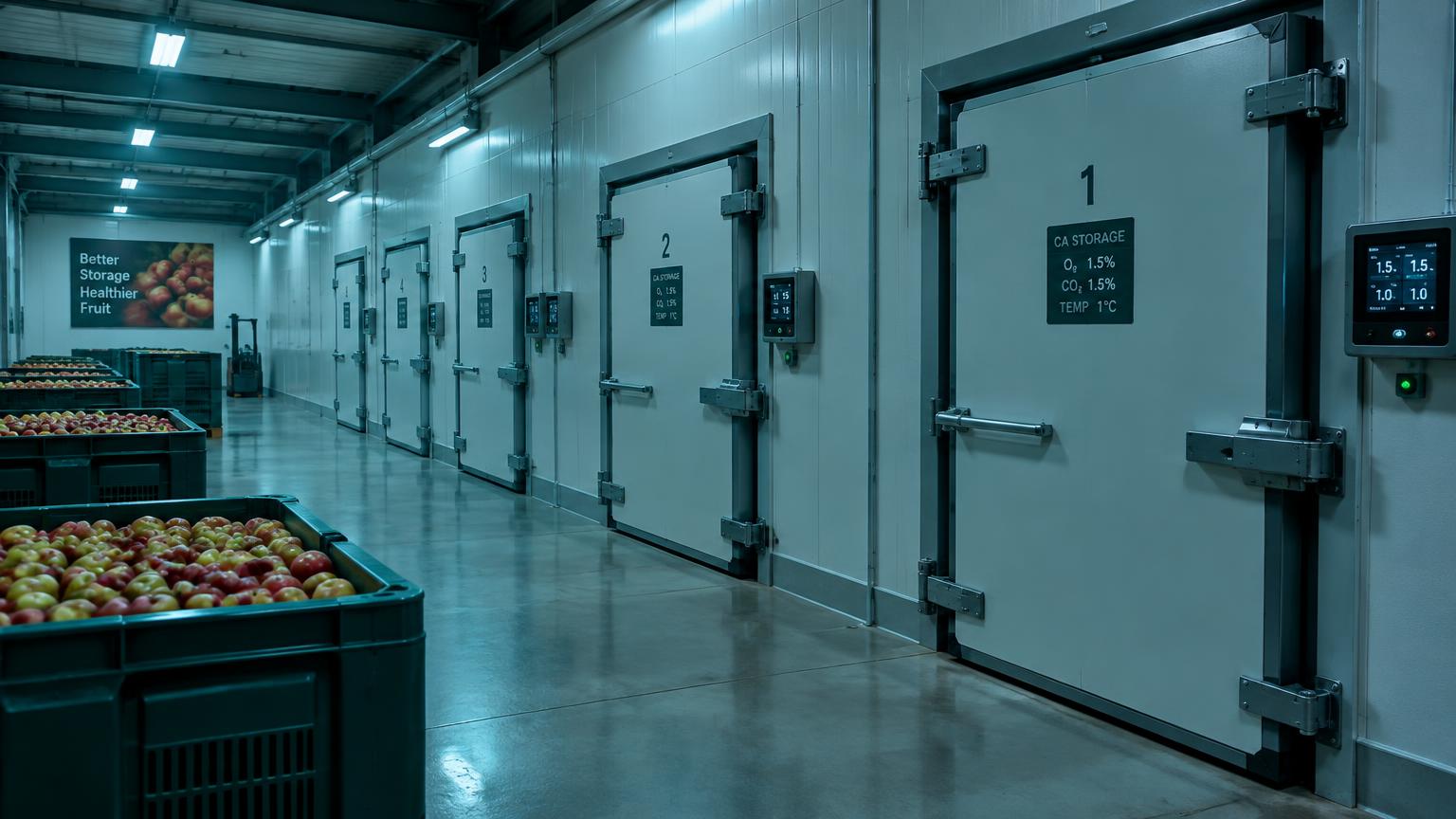
Compare regular cold storage, CA, ULO and DCA fruit stores and ripening rooms: cost drivers, door specs, airtightness and an RFQ checklist. It is an airtight cold room where oxygen is lowered and carbon dioxide is controlled to slow fruit respiration, extending storage life for months compared with refrigeration alone.
Key takeaways
- What is controlled atmosphere storage? It is an airtight cold room where oxygen is lowered and carbon dioxide is controlled to slow fruit respiration, extending storage life for months compared with refrigeration alone.
- What is the difference between CA, ULO and DCA? Standard CA uses fixed low-oxygen setpoints, ULO pushes oxygen lower, and dynamic controlled atmosphere (DCA) adjusts oxygen continuously based on signals from the fruit itself.
- Which fruits need ripening rooms? Bananas, avocados, mangoes, papayas and some tomatoes are typically ripened near the market using controlled temperature, ethylene and forced airflow.
- Can an existing cold room be converted to CA? Sometimes, but achieving the required airtightness in a retrofit is difficult.
Reviewed: Oct 2026 · ColdMatch Group
Fruit growers, packers and importers increasingly need more than a cold room. Apples and pears that must be sold eight or ten months after harvest, kiwifruit shipped across hemispheres, and bananas or avocados that must arrive at supermarkets at exactly the right colour all depend on two specialised technologies: controlled atmosphere (CA) storage and ripening rooms. Both are refrigerated rooms at heart, but they add gas control, airtightness and process automation that change how the building, the refrigeration plant and the supplier contract must be specified. This guide explains what each technology does, which crops benefit, what drives project scope, and how to prepare a request that qualified suppliers can quote like-for-like.
Short answer: controlled atmosphere storage slows fruit respiration by lowering oxygen and raising carbon dioxide inside an airtight cold room, extending storage life for months; ripening rooms do the opposite job, using ethylene, temperature and airflow to ripen fruit evenly on a schedule. Specify the crop, volumes, storage duration, room count and airtightness target first, then compare suppliers on gas-control equipment, room construction, refrigeration and service — not on a single equipment price.
What controlled atmosphere storage does
Harvested fruit keeps breathing. It consumes oxygen, releases carbon dioxide and heat, and slowly uses up the sugars and acids that give it flavour and firmness. Refrigeration slows this process; controlled atmosphere slows it much further. In a CA room the oxygen level is pulled down from the normal 21% to a low setpoint, typically between 1% and 3% depending on the variety, while carbon dioxide is held at a controlled level. Nitrogen generators, CO₂ scrubbers and gas analysers keep the atmosphere stable for the whole season.
More advanced variants exist. Ultra-low oxygen (ULO) storage pushes oxygen closer to the fruit's tolerance limit. Dynamic controlled atmosphere (DCA) systems monitor the fruit's own stress signals — chlorophyll fluorescence, respiratory quotient or ethanol — and adjust oxygen continuously. These systems can preserve quality without some post-harvest chemical treatments, which matters for organic programmes and for export markets with strict residue limits.
Which crops benefit
- Apples and pears: the classic CA crops; long-term storage of many months is standard practice.
- Kiwifruit: CA with ethylene removal protects firmness during long storage.
- Stone fruit, berries and cherries: shorter CA or modified-atmosphere periods for transport and marketing windows.
- Cabbage, onions and some root crops: benefit in specific markets, often with simpler gas control.
- Bananas, avocados, mangoes and tomatoes: need ripening rooms rather than long-term CA.
Check the storage temperature chart for temperature and humidity ranges by crop, and note that the correct gas setpoints depend on variety, growing region and maturity at harvest. A reputable supplier will ask for these details rather than offer a generic recipe.
What ripening rooms do
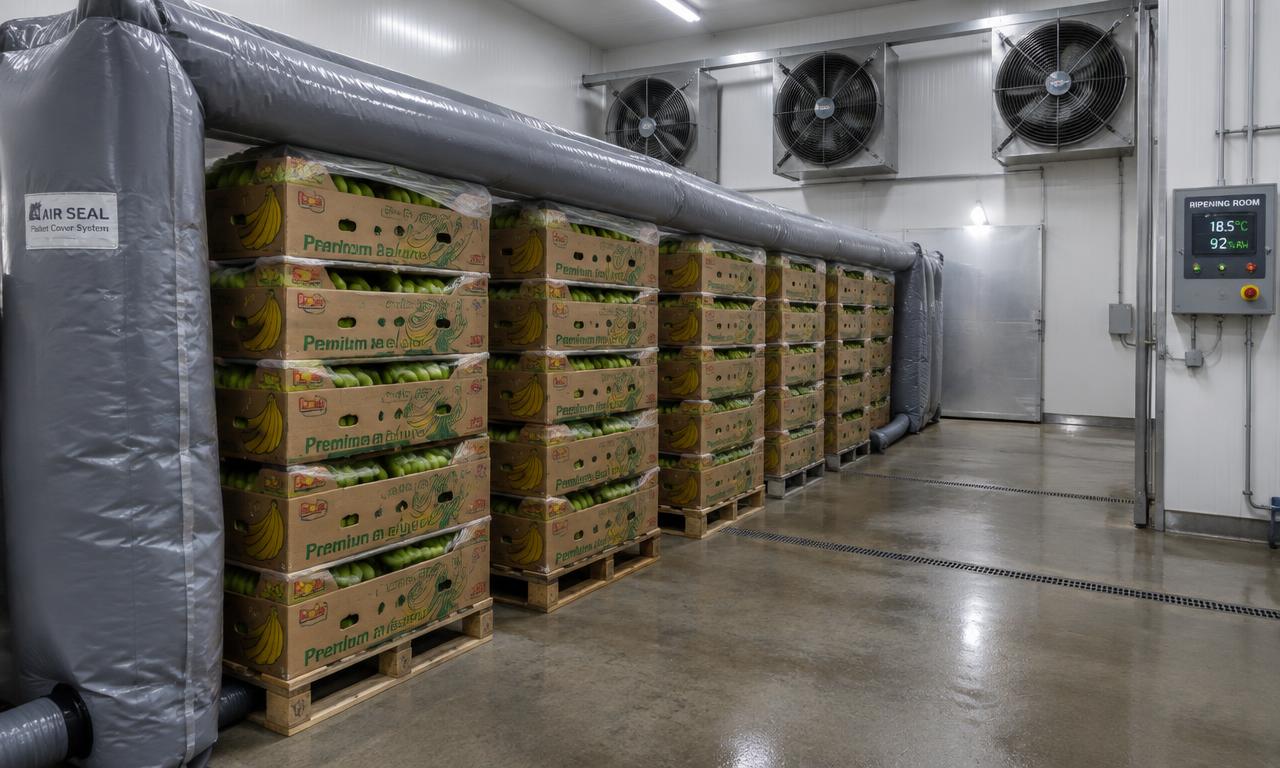
Ripening rooms are used where fruit is harvested mature but unripe and must be ripened close to the market. Bananas are the best-known example, but avocados, mangoes, papayas and some tomatoes follow the same principle. The room raises or lowers temperature, introduces a controlled dose of ethylene, ventilates to remove carbon dioxide, and forces air evenly through every pallet so that each box reaches the same colour stage on the same day.
The decisive design feature is airflow. Most modern ripening rooms use pressurised or forced-air layouts where a tarpaulin or air bag closes the gap above the pallet rows and fans pull air through the boxes. Uneven airflow produces uneven colour, which means rejected deliveries. Rooms are usually built in banks, each holding a fixed number of pallets, so that the operator can run different ripening schedules side by side.
Five things that drive project scope
- Room count and size: CA rooms are usually kept relatively small so that each one can be filled quickly and sealed, then opened only when sold. Ripening rooms are sized in pallet rows to match daily dispatch.
- Airtightness: a CA room must pass a pressure test; gas-tight panels, sealed doors, sealed penetrations and a breather bag are standard. Airtightness is far harder to achieve in a retrofit than in a new building.
- Gas-control equipment: nitrogen generators (membrane or PSA), CO₂ scrubbers, ethylene scrubbers, analysers and the control software.
- Refrigeration and humidity: high humidity with low air speed for long-term storage; precise temperature pull-down and stable control for ripening.
- Safety: low-oxygen rooms are dangerous to enter. Gas detection, warning signage, entry procedures and breathing apparatus belong in the scope, not as an afterthought.
Planning the facility around harvest
Seasonal crops create seasonal peaks. A packhouse may receive most of its apples in six or eight weeks, which means pre-cooling, sorting and room filling must keep pace. Plan the fill rate per room per day, the time to reach setpoint, and how many rooms can be opened per week during the selling season. Use the cold room size calculator for first volume estimates and the cooling load calculator to check refrigeration capacity during the peak fill period, when field heat dominates the load.
Power supply also matters. Nitrogen generators and scrubbers add electrical load on top of refrigeration, and rural packhouses often have constrained grid connections. Confirm available capacity before finalising the room count.
Common mistakes
- Specifying CA equipment without an airtightness test target in the contract.
- Building large rooms that take too long to fill, so fruit waits at high oxygen.
- Underestimating field heat during harvest, leading to slow pull-down.
- Treating ripening rooms as ordinary cold rooms with an ethylene bottle.
- Leaving gas-safety equipment and training out of the supplier scope.
- Comparing proposals where one includes control software and analysers and another does not.
Regular cold storage vs CA vs ULO vs DCA: how do costs compare?
There is no reliable universal price per room, because cost depends on crop, room size, building condition, local labour and the supplier's scope. What can be compared is which cost layers each technology adds on top of the one before it:
| Option | What it adds | Main extra cost drivers |
|---|---|---|
| Regular cold storage | Temperature and humidity control only | Insulated panels, refrigeration, doors, controls |
| Controlled atmosphere (CA) | Low-oxygen, controlled-CO₂ atmosphere | Gas-tight construction, pressure test, nitrogen generator, CO₂ scrubber, analysers, gas-safety equipment |
| Ultra-low oxygen (ULO) | Oxygen held closer to the fruit's tolerance limit | Tighter airtightness target, more precise analysers and control, closer monitoring |
| Dynamic CA (DCA) | Oxygen adjusted to measured fruit stress | Fruit-response sensors (chlorophyll fluorescence, respiratory quotient or ethanol), software, operator training and service support |
Each step up generally adds equipment, airtightness work and operating skill, while potentially extending the selling window or reducing reliance on some post-harvest treatments. Whether that is worth paying for depends on how long you must store, the variety, your export market rules and the price difference between early- and late-season fruit. Ask each supplier to price the same rooms as a base option and as CA, ULO or DCA alternates, so the extra cost of each layer is visible line by line. For a first budget envelope use the cold room CAPEX estimator, and test energy costs with the energy and lifecycle calculator.
What should I look for when buying ripening room or CA doors?
Doors are one of the most common failure points, because they are opened most and must seal repeatedly. Ask suppliers to state: - Airtightness: for CA rooms, how the door seals and whether it is included in the room's pressure-test guarantee. - Type and size: sliding, hinged or high-speed, and clear opening suited to your forklifts and pallet height. - Inspection hatch: a sealed window or hatch lets staff check fruit without opening a low-oxygen room. - Heating and frost protection: heated frames and seals where temperatures require it. - Safety: lockable doors, low-oxygen warning signage and an inside release where applicable. - Service: replacement seals, local spare parts and inspection intervals.
What to put in your RFQ
A supplier can only quote accurately when it knows what the rooms must achieve. A strong request includes: - crops, varieties and expected annual volumes; - storage duration or ripening cycle per crop; - number of rooms, pallet type and pallets per room; - target temperature, humidity, oxygen, CO₂ and ethylene ranges; - new building or retrofit, and the airtightness standard required; - site power capacity and climate data; - required controls, data logging and remote monitoring; - installation, commissioning, training and service expectations.
The RFQ builder structures these points into a brief. For broader produce cold chain questions, read our post-harvest cold storage guide, and for refrigerant choices see the NH₃ vs CO₂ buyer's guide.
How to compare proposals
Normalise scope before you look at totals. Check that every proposal includes the same room construction, door type, gas-control equipment, analysers, software, refrigeration capacity, installation and commissioning. Ask for the guaranteed airtightness result and how it will be tested at handover. Ask what service is available locally during the storage season, because a failed scrubber in March can cost a whole room of fruit. Our guide on how to compare supplier proposals explains the method in detail. Cost questions belong in the cold storage cost guide, which uses one published baseline.
How ColdMatch helps
ColdMatch Group is the industrial refrigeration and cold-chain procurement platform of Global B2B Group, where commercial and industrial buyers build a project and submit an RFQ; the ColdMatch team validates and organizes it, contacts suitable refrigeration technology and equipment suppliers on the buyer's behalf, and presents organized responses through ColdMatch. For CA and ripening projects above USD 250K, a specialist reviews the request, prepares a structured brief and introduces suitable suppliers manually. ColdMatch is not a manufacturer, installer or lender. When you are ready, start your project.
Run the numbers
Calculators for this project type
Indicative planning figures only — final sizing belongs to the supplier's or consultant's detailed design.
Fruit & vegetable cold storage ROI calculator
Pre-cooling and storage capacity plus indicative payback from spoilage reduction.
Energy & backup powerEnergy & backup power cost calculator
Annual energy spend from load and running hours, plus the cost of generator hours during outages.
Frequently asked questions
Plan the numbers before you send an RFQ
The reference pages buyers use most before requesting quotes.