
Quick answer
Match industrial refrigeration equipment to each food or farm product: pre-cooling, freezing, zones, humidity, ripening and questions to answer before quotes. Commercial refrigeration usually means self-contained cabinets, display cases and small walk-ins for shops and restaurants. Industrial refrigeration covers engineered systems for packhouses, processors and cold stores — pre-coolers, freezers, central plant and large cold rooms sized for specific products and tonnages.
Key takeaways
- What is the difference between commercial and industrial refrigeration equipment? Commercial refrigeration usually means self-contained cabinets, display cases and small walk-ins for shops and restaurants.
- Do I need pre-cooling if I already have a cold room? Often yes for perishable produce or processed food that arrives warm.
- Can different fruits and vegetables share one cold room? Only if their temperature, humidity and ethylene behaviour are compatible.
- What information do suppliers need to quote cold-chain equipment? Product list with conditions, arrival temperatures, required cooling or freezing times, peak and average daily tonnage, packaging and pallets, site ambient and power, required records and service expectations.
Reviewed: Oct 2026 · ColdMatch Group
Short answer: choose cold-chain equipment by starting from the product, not the catalogue. For each product family, write down its storage temperature and humidity, how warm it arrives, how fast it must be cooled or frozen, how long it stays, what it must not be stored with, and how many tonnes move on the busiest day. Those answers decide whether you need pre-cooling, blast freezing, ripening, controlled atmosphere or simply well-designed chilled and frozen rooms — and they are exactly what suppliers need to quote comparable systems.
> Who this guide is for: buyers, engineers and operators planning commercial or industrial refrigeration — cold rooms, cold stores, pre-cooling, freezing and process cooling. It does not cover household fridges, home freezers or appliance repair.
> Last reviewed: 15 Oct 2026 · Prepared by: the ColdMatch Group editorial team · Technical scope: buyer education only; this guide has not been signed off by a licensed refrigeration engineer and does not replace a site-specific design.
Why should the product decide the equipment?
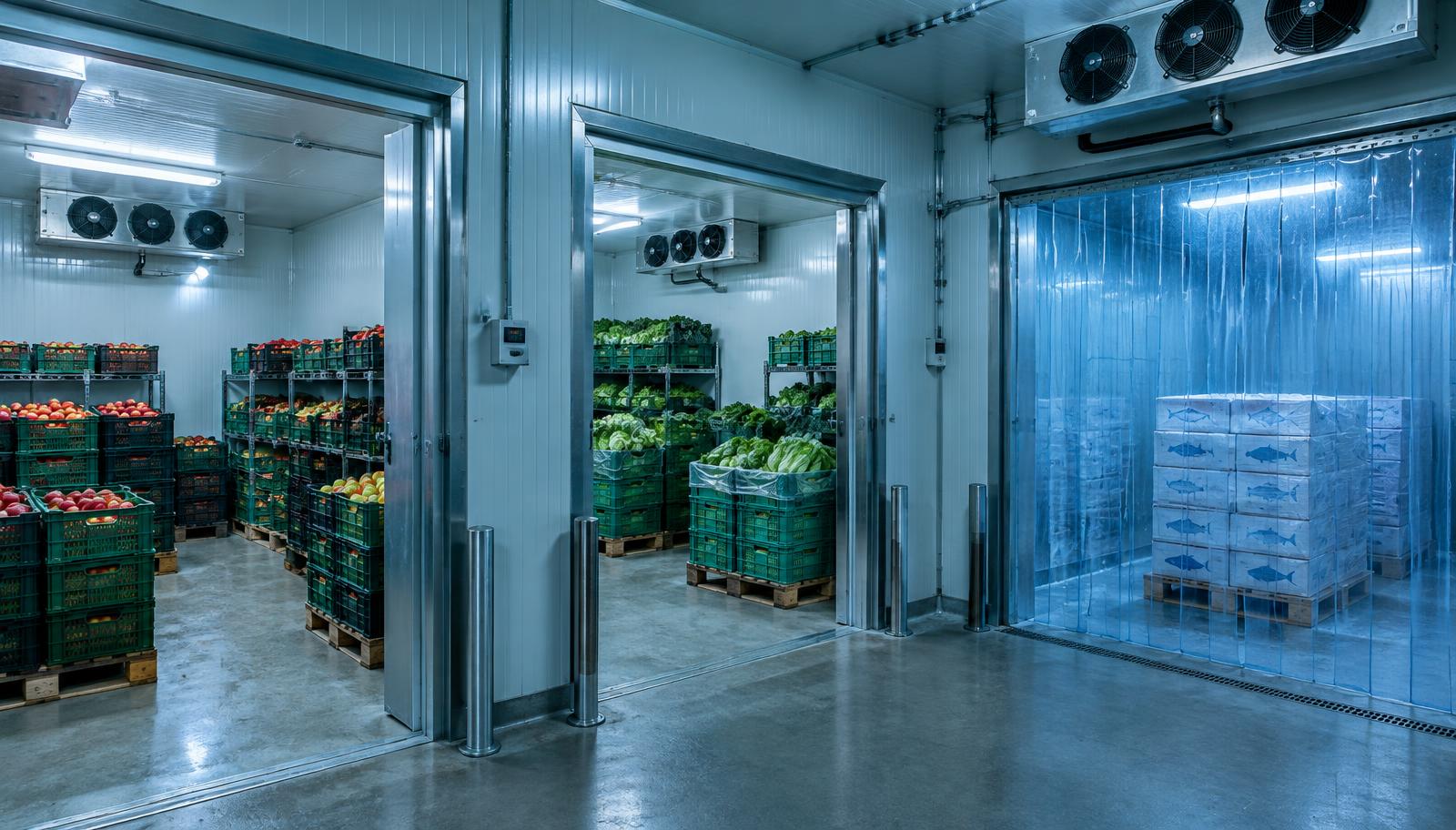
Industrial refrigeration is sized for heat removal and product behaviour, not for floor area. Two rooms of the same size can need very different equipment if one holds frozen cartons that arrive already frozen and the other receives warm, freshly harvested leafy vegetables that must be cooled within hours. Commercial refrigeration equipment sold for shops and restaurants (reach-in cabinets, display cases) solves a different problem; this guide is for project buyers specifying cold rooms, pre-coolers, freezers and plant for packhouses, processors, distributors and storage operators.
The USDA's Agriculture Handbook 66 — a long-standing technical reference on the commercial storage of fruits, vegetables and florist stocks — shows how widely recommended conditions vary between products. The FAO's food loss and waste platform explains why temperature failures early in the chain cause losses that later storage cannot reverse. Use such references, your buyers' specifications and a qualified food technologist to fix the values for your own products.
Decision checklist: which equipment families might you need?
Work through these questions in order. Each *yes* adds an equipment family to your request; each *don't know* is a gap to close before asking for quotes.
- Does product arrive warmer than its storage temperature and lose quality quickly while warm? → you probably need dedicated pre-cooling (forced-air, hydro-, vacuum or blast chilling), not just a storage room.
- Must product be frozen on site? → you need freezing equipment (blast, tunnel, spiral or plate freezers) sized for the daily tonnage and target core temperature, separate from frozen storage.
- Do different products need different temperatures or humidity, or react badly to each other (ethylene, odour)? → plan separate temperature zones, not one shared room.
- Is fruit ripened or held long-term? → consider ripening rooms or controlled-atmosphere (CA) rooms with gas control.
- Is there heavy daily traffic in and out? → specify dock seals, rapid doors, an anteroom or a chilled dock and include door load in the design.
- Must records prove temperatures to customers or authorities? → specify monitoring, alarms and data logging as part of the scope.
- Is the grid unreliable or are outages costly? → ask for redundancy and backup power options.
Product-to-equipment matrix
*Typical options only — the right selection depends on your product variety, volumes, climate and rules, and must be confirmed by qualified engineers.*
| Product family | Typical storage condition (verify for your product) | Equipment families buyers usually consider | Key questions to settle first |
|---|---|---|---|
| Fresh fruit and vegetables | Chilled; many need high humidity; some are chilling-sensitive | Pre-coolers, high-humidity cold rooms, ripening or CA rooms for some fruit | Which products are ethylene producers or ethylene-sensitive? Which are chilling-sensitive? Peak harvest tonnes per day? |
| Meat and poultry | Chilled or frozen | Carcass/product chillers, blast chillers or freezers, chilled and frozen storage, hygienic finishes | Required cooling time after processing? Hygiene and washdown standard? |
| Fish and seafood | Iced/chilled, or frozen at low temperature | Ice machines, plate/blast freezers, low-temperature frozen storage | Fresh or frozen trade? Target core temperature and freezing time? Export customer rules? |
| Dairy | Chilled | Milk cooling, chilled storage, controlled dispatch areas | Daily volumes and arrival temperature? Product mixing rules? |
| Frozen and processed foods | Frozen | Tunnel/spiral/blast freezers, frozen storage, chilled dock or anteroom | Arrives frozen or frozen on site? Pallet turnover per day? |
| Grains, seeds and dry agri products | Cool and dry rather than chilled | Grain cooling units, humidity-controlled stores | Target moisture and temperature? Storage duration? |
| Flowers and plants | Chilled, high humidity | Pre-coolers, high-humidity chilled rooms | Ethylene sensitivity? Packing method? |
Pre-cooling options compared
Pre-cooling removes field or process heat quickly before storage. Holding rooms are usually not designed to do this job, which is why it is one of the most commonly under-specified items.
| Method | How it works | Often suited to | Points to check |
|---|---|---|---|
| Room cooling | Product cools slowly in the storage room | Products that tolerate slow cooling | Slow; adds load to the store; check against required cooling time |
| Forced-air cooling | Fans pull cold air through vented packaging | Many fruits, vegetables and flowers | Packaging vent design and stacking pattern matter |
| Hydrocooling | Chilled water flows over or around product | Products that tolerate wetting | Water sanitation and handling of wet packaging |
| Vacuum cooling | Low pressure evaporates water from the product | Leafy vegetables and similar products | Product moisture loss; batch sizing |
| Blast chilling | High-velocity cold air in a dedicated room or tunnel | Cooked or processed foods, some meat products | Food-safety cooling time limits set by your rules |
What should you do — and avoid?
Do:
- Write one line per product family with its conditions, arrival temperature, peak daily tonnes and storage time.
- Size for the peak harvest or production week, not the annual average.
- Separate pre-cooling or freezing from storage in your brief so suppliers price both.
- State the design ambient temperature at your site so capacity figures are comparable.
- Ask how each proposal handles defrost, humidity and airflow around stacked product.
Avoid:
- Storing ethylene-producing fruit with ethylene-sensitive produce in the same room.
- Using a frozen storage room to freeze product that arrives warm, unless the system is designed for it.
- Choosing equipment from a brochure capacity without the conditions behind it.
- Assuming a refrigerant or system type is allowed everywhere; rules differ by country and change over time.
Which mistakes cost buyers the most?
| Mistake | What usually happens | How to prevent it |
|---|---|---|
| No dedicated pre-cooling | Product stays warm for hours; shelf life shortens; store overloads | Specify pre-cooling capacity and target cooling time |
| One room for incompatible products | Ripening, odour transfer or chilling injury | Plan zones by product compatibility |
| Sizing for average days | Shortfall on peak harvest or production days | Give suppliers the peak daily intake |
| Low humidity in produce rooms | Weight loss and wilting | Specify target humidity and coil/airflow design |
| No door or dock strategy | Ice build-up, condensation, higher energy use | Include traffic, door type and anteroom in the brief |
| Monitoring left out of scope | Gaps in temperature records for customers or audits | Make monitoring, alarms and logging a quoted line |
Inputs buyers should prepare before requesting quotes
- Product list with storage temperature, humidity, compatibility notes and storage time.
- Arrival temperature and required cooling or freezing time for each product.
- Peak and average daily intake and dispatch (tonnes or pallets).
- Packaging type and pallet dimensions.
- Site location, design ambient conditions, available power and any space limits.
- Required records, hygiene standards and customer or export requirements.
- Operating hours, staffing for maintenance and access to local service technicians.
Test the heat-load side with the free refrigeration load calculator and the door infiltration load calculator; results are planning estimates, not engineering designs. The cold-room sizing and operating cost guide covers room size and running cost in more depth.
Illustrative worked example: a mixed produce and frozen packhouse
*Illustrative only. The site, products and quantities are invented to show the method; they are not a ColdMatch project or a design.*
Assumptions: a packhouse receives apples and leafy vegetables during harvest and also stores a smaller volume of frozen product that arrives already frozen. Peak intake: 40 t/day of apples, 10 t/day of leafy vegetables. Frozen product: 20 pallets/week received frozen. Hot-season ambient at the site: about 38 °C.
Step 1 — conditions. The team checks references such as USDA Handbook 66 and its customers' specifications. Apples are typically held close to 0 °C at high humidity; leafy vegetables near 0 °C at very high humidity; frozen product at -18 °C or colder. Apples produce ethylene and lettuce is ethylene-sensitive, so they should not share a room.
Step 2 — zones. Three storage zones result: an apple room, a leafy-vegetable room and a frozen room, plus a chilled dispatch area to limit warm-air entry.
Step 3 — pre-cooling. Leafy vegetables lose quality quickly when warm, so the team asks suppliers to propose a pre-cooling method (for example vacuum or forced-air) sized for 10 t/day; apples are asked for forced-air pre-cooling capacity at 40 t/day. The frozen product needs no freezing equipment because it arrives frozen — only storage capacity and a fast-acting door.
Step 4 — the request. Each supplier receives the same table of products, conditions, peak tonnages, arrival temperatures, ambient and required records. The question is no longer "how much is a cold room?" but "what do you propose to meet these conditions, at what energy use and with what service?" — which makes the answers comparable.
Questions to ask every supplier
- Which conditions (product, arrival temperature, ambient, running hours) is your capacity based on?
- How do you achieve the required cooling or freezing time, and how is it tested at handover?
- How do you control humidity and airflow around stacked product?
- What separates incompatible products in your layout?
- What refrigerant do you propose, why does it suit this site, and what rules apply here? (See the EU F-gas and US EPA SNAP programmes as examples of how rules differ by jurisdiction.)
- What is the expected annual energy use and the assumptions behind it?
- What monitoring, alarms and records are included?
- Who services the plant locally, what is the response time and which spares are stocked?
The International Institute of Refrigeration publishes technical information on refrigeration and the cold chain if you want to go deeper before talking to suppliers. Codex Alimentarius codes of practice are the reference point for many food-hygiene requirements.
Next step: from product list to comparable quotes
Once your product table is complete, you can compare proposals line by line with the lifecycle-cost comparison guide. If you want help, you can optionally prepare an RFQ: the ColdMatch team reviews the request, contacts suitable refrigeration suppliers on your behalf and presents organised responses through ColdMatch. There is no direct buyer-to-supplier handoff, and ColdMatch does not manufacture, install or guarantee savings or performance. You can use this checklist without submitting anything.
Summary
- Start from each product's conditions, arrival temperature, cooling time, compatibility and peak tonnage.
- Treat pre-cooling and freezing as separate from storage.
- Separate incompatible products into zones.
- Give every supplier the same product table and ask for the assumptions behind capacity and energy figures.
- Have a qualified engineer confirm the design and local rules before contract award.
Run the numbers
Calculators for this project type
Indicative planning figures only — final sizing belongs to the supplier's or consultant's detailed design.
Fish & seafood cold storage calculator
Chilled and frozen volume, ice demand and storage capacity for landing sites and processing plants.
Energy & backup powerEnergy & backup power cost calculator
Annual energy spend from load and running hours, plus the cost of generator hours during outages.
Frequently asked questions
Plan the numbers before you send an RFQ
The reference pages buyers use most before requesting quotes.