
Pull to refresh
ColdMatch Group — industrial cooling and cold chain procurement platform
ColdMatchGroupMulti-Bid Cold Chain Sourcing
SolutionsIndustriesKnowledge CenterMarketsToolsFinancingLogistics
ColdMatch Group — industrial cooling and cold chain procurement platform
ColdMatchGroup
SolutionsIndustriesKnowledge CenterIntelligence Center & CalculatorsIndustry IntelligenceExecutive Knowledge CenterPlanning CenterEquipment IntelligenceInnovation & TechnologyProcurement AcademyCase StudiesMarkets by CountryTools & CalculatorsCertificationsFind SuppliersFinancingLogisticsGet Free Quotes
DashboardPrepare a Professional RFQ
DashboardSign inPrepare a Professional RFQ
Cold-chain project financing.Financing for qualified cold-chain projects — introduced to independent financing partners.FinancingFinancing Center
Home

Offline — reconnect before saving or submitting. Changes on this page have not been sent.

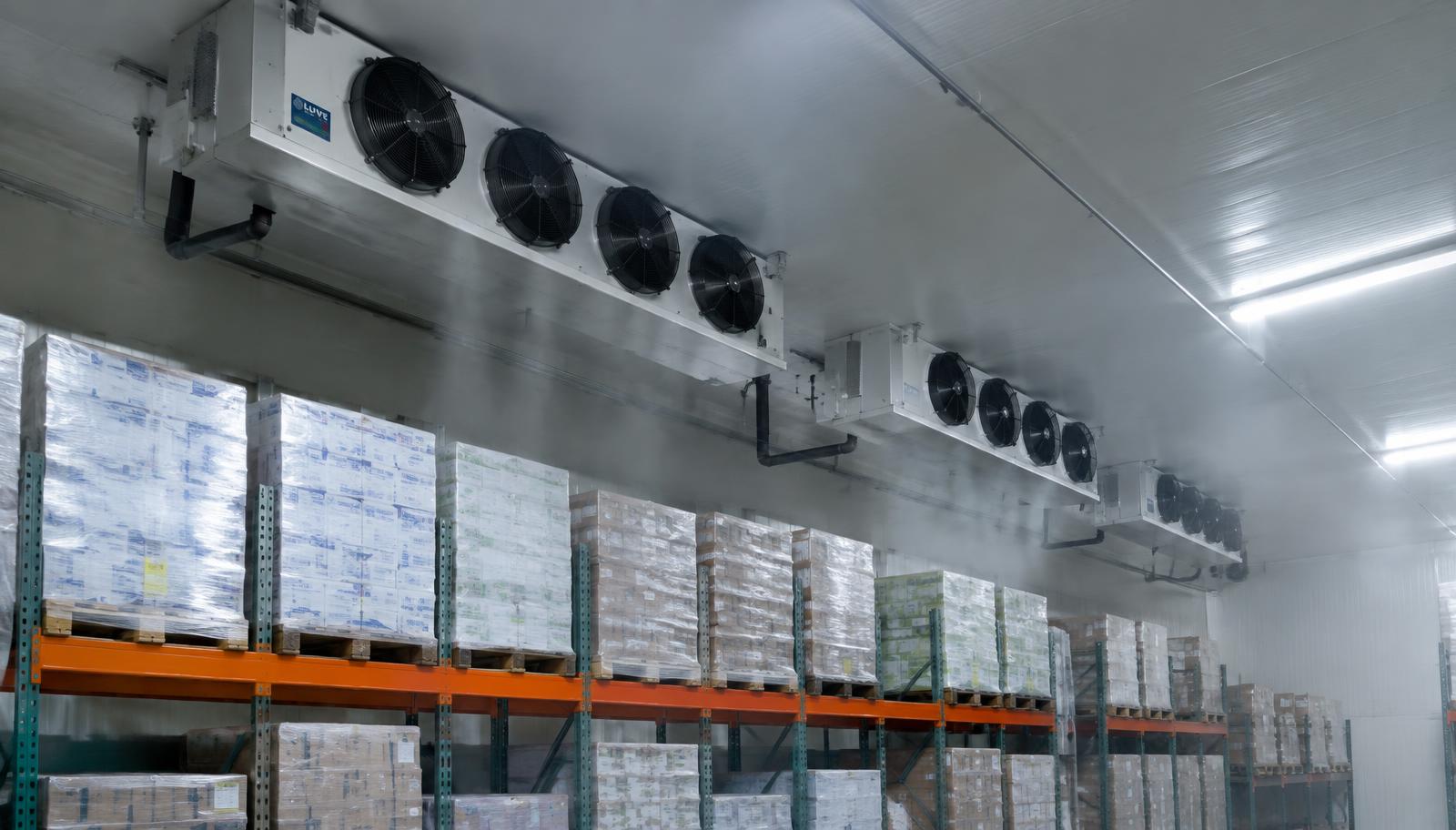
Industrial cold-storage aisle with insulated wall panels, palletised goods, ceiling-mounted evaporators, and a forklift near a loading door.
← Insights
Engineering Oct 2026·6 min read

Why Calculate Cooling Load Before Choosing Equipment

Calculate cooling load before selecting refrigeration equipment to avoid capacity errors, control operating costs, and compare suppliers fairly.

EnglishالعربيةPortuguês (Brasil)עבריתРусскийfi

Quick answer

Calculate cooling load before selecting refrigeration equipment to avoid capacity errors, control operating costs, and compare suppliers fairly. Room volume can support an early screening estimate, but it cannot establish a reliable equipment duty. Product intake, arrival temperature, door activity, insulation, ambient conditions, and cooling time all affect demand. Use volume-based estimates cautiously, then replace them with a component-level load calculation before procurement.

Key takeaways

  • ▸Can I select refrigeration equipment using room volume alone? Room volume can support an early screening estimate, but it cannot establish a reliable equipment duty.
  • ▸Is cooling load the same as compressor electrical consumption? No.
  • ▸How much safety factor should a cooling-load calculation include? There is no universally appropriate allowance.
  • ▸Can an online cooling-load calculator replace an engineer? An online calculator can organise inputs, reveal major load drivers, and support preliminary scenarios.

In this article

  1. 01. Why must cooling load come before equipment selection?
  2. 02. What belongs in a complete cooling-load calculation?
  3. 03. What happens when buyers guess the load?
  4. 04. How should buyers use a cooling-load calculator?
  5. 05. What must an engineer validate before procurement?
  6. 06. How does a validated load improve supplier comparisons?
  7. 07. What are the next steps for a procurement-ready project?

Reviewed: Oct 2026 · ColdMatch Group

Short answer: Calculate cooling load before choosing compressors or evaporators because equipment must match the heat entering the facility, the product cooling duty, and the available operating time. Guessing can produce inadequate capacity or unnecessarily expensive equipment; use a calculator for preliminary sizing, then have a qualified refrigeration engineer validate the design basis before procurement.

# Why Calculate Cooling Load Before Choosing Equipment

For industrial cold-storage projects, capacity is not a catalogue starting point. It is an engineering result. Room dimensions and a target temperature alone cannot establish refrigeration duty: product throughput, door activity, humidity, ambient conditions, and operating schedules can materially change the requirement. Establishing that requirement first gives buyers a defensible specification and suppliers a common basis for selection.

Why must cooling load come before equipment selection?

Cooling load describes the rate at which heat must be removed to maintain specified conditions or achieve a defined cooling process. Compressor and evaporator capacities must satisfy that duty at the actual design conditions—not merely match a nominal kilowatt figure in a brochure.

A compressor’s available capacity changes with evaporating and condensing conditions. Evaporator performance depends on room temperature, refrigerant conditions, airflow, frost accumulation, and the temperature difference across the coil. Selecting either component first can force the design around equipment that does not suit the application.

The calculation must also distinguish steady holding duty from product pull-down duty. A store receiving chilled goods has a different requirement from a room expected to cool warm product or freeze it within a specified period, even if both have the same dimensions.

What belongs in a complete cooling-load calculation?

A useful calculation separates the following components so an engineer or supplier can check each assumption rather than accept one unexplained total:

  • Transmission: Heat passing through walls, ceilings, floors, and doors. Use assembly areas, insulation performance, temperature differences, and relevant thermal bridges; floor boundary conditions may differ from outdoor conditions.
  • Product: Heat removed from incoming goods and relevant packaging. Account for mass, arrival temperature, target temperature, and cooling time. Freezing requires latent heat removal, while some fresh produce also generates respiration heat.
  • Infiltration: Heat and moisture entering through openings or air leakage. Door dimensions, opening frequency, traffic patterns, vestibules, and protective measures all matter. Moisture can increase both refrigeration demand and frost formation.
  • Internal: Heat from lighting, people, evaporator fans, handling equipment, and other sources inside the refrigerated space. Include defrost heat that enters the room and the periods when refrigeration is unavailable.
  • Safety allowance: A justified margin for residual uncertainty, applied after the underlying loads have been calculated. It is an allowance, not a physical heat source or a substitute for missing inputs.

Record operating schedules alongside these components. Loads do not necessarily peak together, and equipment may not refrigerate continuously. Converting daily heat gains into required capacity demands a realistic allowance for available cooling hours and coincident duties.

What happens when buyers guess the load?

Undersizing can cause slow pull-down, temperature excursions, excessive running time, and difficulty recovering after deliveries or defrost. A room may perform acceptably during quiet periods yet struggle when high ambient temperatures coincide with heavy product intake and frequent door openings.

Oversizing creates different problems. It can increase capital expenditure and, where modulation is inadequate, cause short cycling or inefficient low-load operation. Poorly matched evaporators can also create unsuitable air distribution or humidity conditions. A larger compressor does not correct every weakness elsewhere in the system.

Guesswork also undermines tender comparisons. Suppliers may price fundamentally different duties, making the lowest proposal appear attractive only because it assumes less throughput or a longer cooling period. Use cold-storage cost benchmarks for budget context, not as a replacement for project-specific engineering and quotations.

How should buyers use a cooling-load calculator?
Refrigeration engineer inspecting a ceiling-mounted evaporator and insulated doorway inside an industrial cold room containing palletised goods.
Product throughput, door activity, insulation, and internal equipment all inform the cooling duty that must be validated before equipment selection.

Use the cooling-load calculator to develop a preliminary design basis, not a purchase-ready equipment schedule. Assemble inputs from operating plans, building information, and product requirements rather than filling gaps with convenient defaults.

  • Confirm room dimensions, temperature zones, insulation construction, and external design conditions.
  • Define product types, daily intake, arrival temperatures, required exit temperatures, and permitted cooling times.
  • Estimate door activity, staffing, lighting, internal equipment, and operating hours.
  • Document unknowns and test credible operating scenarios, including peak intake and demanding ambient conditions.

Check which load components the tool covers; assess omitted duties separately rather than assuming they are included. Review component-level results for plausibility. An implausibly small infiltration or product load often signals an input problem. Distinguish energy, typically expressed in kWh, from capacity in kW. For calculation context, review a worked cold-room cooling-load example.

What must an engineer validate before procurement?

Give a qualified refrigeration engineer the inputs, assumptions, scenarios, and calculator output—not just the final capacity. Validation should establish whether the model reflects the building, process, operating schedule, and product requirements, then translate those requirements into equipment duties.

That review should check heat-transfer assumptions, product properties, infiltration methods, peak-load coincidence, pull-down requirements, defrost arrangements, and the safety allowance. It should also identify whether separate temperature zones or processes need distinct design cases.

Keep uncertainty allowance, future expansion, and redundancy separate. Future throughput is an explicit design scenario; standby capacity addresses resilience. Neither should be hidden inside a blanket margin. Repeatedly adding margins at room, evaporator, and compressor level can materially inflate the selection.

Finally, the engineer should review capacity at specified operating conditions, piping effects, controls, and heat rejection. Condensers must reject both the absorbed cooling load and compressor work. Refrigerant suitability, safety provisions, and applicable requirements also need project-specific assessment.

How does a validated load improve supplier comparisons?

Issue a common design brief stating room conditions, product duty, ambient assumptions, cooling hours, load breakdown, margins, and required operating scenarios. Ask suppliers to declare their selection conditions, exclusions, control strategy, and expected performance across the operating range.

Evaluate compressors and evaporators as a coordinated system. Review compressor modulation, evaporator airflow and temperature difference, defrost strategy, humidity requirements, and recovery performance. Nominal capacity alone does not demonstrate that product conditions will be maintained.

A structured method for comparing cold-storage supplier proposals helps expose inconsistent assumptions. Once proposals share a common duty, use a refrigeration total-cost-of-ownership calculator to explore operating-cost assumptions alongside purchase cost. Treat projections as scenario estimates, not guaranteed savings.

What are the next steps for a procurement-ready project?

Start with a documented preliminary load, validate it with an engineer, and prepare a supplier brief that distinguishes confirmed requirements from unresolved decisions. Include the project location, intended throughput, temperature zones, building scope, programme, and available drawings.

ColdMatch Group is the industrial refrigeration and cold-chain procurement platform of Global B2B Group, focused on projects of USD 250K+. It is vendor-neutral and works with a network of 100+ suppliers. It is not an automatic marketplace: buyers submit a request, ColdMatch reviews it and prepares a brief, then manually introduces qualified suppliers.

Ready to move from preliminary sizing to supplier discussions? Submit your project for review, including your cooling-load calculation if available. Clearly identified gaps can then be addressed before competing equipment selections obscure the underlying requirement.

Turn this guidance into comparable supplier quotes for your warehouse or cold store project. ColdMatch is supplier-neutral and free for buyers. For industrial projects from USD 250,000, the team qualifies the brief, contacts suitable suppliers on your behalf and presents organised responses; no automatic supplier connection.

Start a structured cold storage RFQ

Run the numbers

Calculators for this project type

Indicative planning figures only — final sizing belongs to the supplier's or consultant's detailed design.

Refrigeration sizing

Cold storage capacity calculator

Pallet positions, chamber volume and indicative build cost for a refrigerated warehouse.

Energy & backup power

Energy & backup power cost calculator

Annual energy spend from load and running hours, plus the cost of generator hours during outages.

Related solutions
Industrial Refrigeration Systems Cold Rooms Generators & Backup Power All solutions
Turn these numbers into a cold storage RFQ Free for buyers · Supplier-neutral · One scope to several suppliers
Request a quote

Frequently asked questions

Plan the numbers before you send an RFQ

The reference pages buyers use most before requesting quotes.

Cold room cost guideUSD/m³ and USD/pallet benchmarks by temperature class.Cold storage construction cost guideCAPEX breakdown: envelope, refrigeration, racking, civil works.Refrigerant phase-out guideF-gas / Kigali timelines and NH3, CO2 and HFO options.Cold storage calculatorSize the room, load and energy spend in under two minutes.Project financingLease, term and export-credit structures for cold chain CAPEX.RFQ BuilderOne structured RFQ to qualified suppliers and EPCs.

In this article

  1. Why must cooling load come before equipment selection?
  2. What belongs in a complete cooling-load calculation?
  3. What happens when buyers guess the load?
  4. How should buyers use a cooling-load calculator?
  5. What must an engineer validate before procurement?
  6. How does a validated load improve supplier comparisons?
  7. What are the next steps for a procurement-ready project?

Planning a project?

One brief, reviewed by a specialist, compared across qualified suppliers.

Start your project

Related insights

Engineering

How to Build a Cold Room: Buyer's Step-by-Step Guide

Plan cold room construction step by step: sizing, refrigeration load, insulation, doors, refrigerant, civil works, commissioning and an RFQ checklist.

Planning & Procurement

Free Tools to Size and Compare Cold Storage

Use ColdMatch's free calculators to plan cold room capacity, cooling load, refrigeration energy cost and lifecycle cost, then compare complete proposals.

Planning & Procurement

Choosing Cold-Chain Equipment for Food and Farm Products

Match industrial refrigeration equipment to each food or farm product: pre-cooling, freezing, zones, humidity, ripening and questions to answer before quotes.

Diagnostics

Temperature Excursions in Cold Storage: A Root-Cause Investigation Method

A stepwise method for food and pharma cold stores to trace temperature excursions to their cause (doors, defrost, airflow, load, capacity or sensors) before spending on new equipment.

Planning & Procurement

Compare Refrigeration Suppliers: Documented RFQ Scorecard

Compare cold-room suppliers using documented capacity, energy basis, scope, commissioning, service, warranty and acceptance tests—not unsupported claims.

Procurement

Why Vendor-Neutral Procurement Matters in Cold Chain

Compare industrial refrigeration suppliers against one neutral brief to expose scope gaps, assess lifetime costs and make better decisions.

Project request

Submit your project for expert review

Send your requirements. A ColdMatch specialist reviews every request, prepares a brief and introduces qualified suppliers — free for qualified buyers.

ColdMatch Group — industrial cooling and cold chain procurement platform
ColdMatchGroup

Because we care more.

ColdMatch Group is the industrial refrigeration and cold-chain procurement platform of Global B2B Group, where commercial and industrial buyers build a project and submit an RFQ; the ColdMatch team validates and organizes it, contacts suitable refrigeration technology and equipment suppliers on the buyer's behalf, and presents organized responses through ColdMatch.

support@coldmatchgroup.com
Follow on LinkedIn
Language
Sourcing & Financing
  • Get Free Quotes
  • RFQ Builder
  • Urgent Procurement
  • Solutions
  • Suppliers
  • Refrigeration Marketplace
  • Global Coverage
  • Project Financing
  • Financing Center
Tools & Knowledge
  • Planning Center
  • Calculators
  • Innovation & Technology
  • Projects Hub
  • Knowledge Hub
  • Cold Chain Answers
  • Cost Benchmarks 2026
  • AI Agents (MCP)
Markets
  • All Country Markets
  • Zambia
  • Ghana
  • Malawi
  • Kenya
  • Nigeria
  • Mauritius
  • Israel
  • Finland
  • Hungary
Company
  • About ColdMatch
  • How ColdMatch Works
  • Solutions by Buyer Type
  • Consultant Partner Program
  • Supplier Qualification
  • Trust Center
  • Case Studies
  • Blog
  • Contact
Business and supplier disclaimer

ColdMatch Group is the industrial refrigeration and cold-chain procurement platform of Global B2B Group, where commercial and industrial buyers build a project and submit an RFQ; the ColdMatch team validates and organizes it, contacts suitable refrigeration technology and equipment suppliers on the buyer's behalf, and presents organized responses through ColdMatch. It helps buyers prepare technical requirements and structured RFQs before suitable third-party suppliers, manufacturers, EPC contractors and turnkey providers are introduced manually. ColdMatch is not an equipment manufacturer, reseller, distributor, EPC contractor, installer, insurer, lender, bank or financial advisor, and is not a party to any supply, construction or finance contract. Quotes, equipment and services are provided solely by the matched third-party supplier, who is solely responsible for quality, delivery, installation, safety and performance. ColdMatch makes no guarantee of availability, price, quality or approval and disclaims all liability for any service provided by a supplier or other third party. See Terms and How ColdMatch Works.

Financing disclaimer: ColdMatch does not provide or guarantee finance. Any financing pathway is evaluated and supplied solely by independent third-party providers under their own checks and terms. See Terms.

ColdMatch Group is the industrial refrigeration and cold-chain procurement platform of Global B2B Group, where commercial and industrial buyers build a project and submit an RFQ; the ColdMatch team validates and organizes it, contacts suitable refrigeration technology and equipment suppliers on the buyer's behalf, and presents organized responses through ColdMatch. It helps buyers prepare technical requirements and structured RFQs before suitable third-party suppliers, manufacturers, EPC contractors and turnkey providers are introduced manually. ColdMatch is not an equipment manufacturer, reseller, distributor, EPC contractor, installer, insurer, lender, bank or financial advisor, and is not a party to any supply, construction or finance contract. Quotes, equipment and services are provided solely by the matched third-party supplier, who is solely responsible for quality, delivery, installation, safety and performance. ColdMatch makes no guarantee of availability, price, quality or approval and disclaims all liability for any service provided by a supplier or other third party. See Terms and How ColdMatch Works.

Disclaimer: ColdMatch Group is the specialized industrial refrigeration and cold-chain procurement platform of Global B2B Group. ColdMatch Group is not a manufacturer, reseller, distributor, EPC contractor, installer, insurer, lender, bank, credit provider, financial advisor, investment advisor, underwriter or regulated financial services provider. Any financing, leasing, trade finance, working capital or project-finance option mentioned on this website is provided solely by independent third-party financing providers, subject to their own eligibility checks, KYC, due diligence, compliance review, approval, terms and documentation. ColdMatch Group does not provide financial advice, does not arrange regulated financial products, does not guarantee financing approval, and is not responsible for any financing decision, offer, rejection, delay, cost, term or outcome. Quotes, equipment, services, delivery, installation, commissioning, warranties and project performance are provided solely by independent third-party suppliers, EPC contractors or service providers. See Terms.

ColdMatch Group · Global Refrigeration & Cold-Chain Sourcing
How ColdMatch Works·Cold Chain Project Markets·Project Guide·RFQ Process·AI Agent Brief·For AI Cold Chain & Refrigeration Procurement Agents·Supplier Qualification·Trust Center·Legal Center·Terms of Service·Privacy Policy·Agency Policy·Contact·Client Login (Buyer Portal)·Accessibility·Accessibility Support
Legal Documents
Terms of Service·Privacy Policy·Agency Policy·Cookie Policy·General Disclaimer·Legal Notice·RFQ Terms·Buyer Terms·Supplier Terms·Financing Disclaimer·Acceptable Use Policy·Marketplace Rules·Intellectual Property & Copyright Policy·Data Protection & GDPR·AML, Sanctions, Export & Anti-Bribery Policy·Cyber Security & Responsible Disclosure·AI & Third-Party Content Disclaimer
EnglishالعربيةעבריתPortuguêsPortuguês (Brasil)РусскийSuomiMagyarTürkçe
Operated from the Republic of Cyprus · We are committed to WCAG 2.1 AA accessibility — report barriers to accessibility@coldmatchgroup.com.© 2026 ColdMatch Group · All rights reserved.ColdMatch Group is the specialized commercial cold-chain platform of Global B2B Group — a global B2B procurement & project development ecosystem. Sister platforms: FishMatch Group, HatchMatch Group, FeedMatch Group, SeedMatch Group. About ColdMatch Group.ColdMatch helps buyers prepare cold chain RFQs and source suitable suppliers. Supplier matching and introductions are managed manually by ColdMatch — not an automatic marketplace. How it works.
CalculatorsGuidesFinancingGet a Quote

Get updates

Cold-chain reading, project resources and technology evidence.

Email subscriptions are not active. Your details will not be sent or saved.

Get updates

Separate from project enquiries. You can unsubscribe or change preferences in every update email once the service is active. Privacy notice