
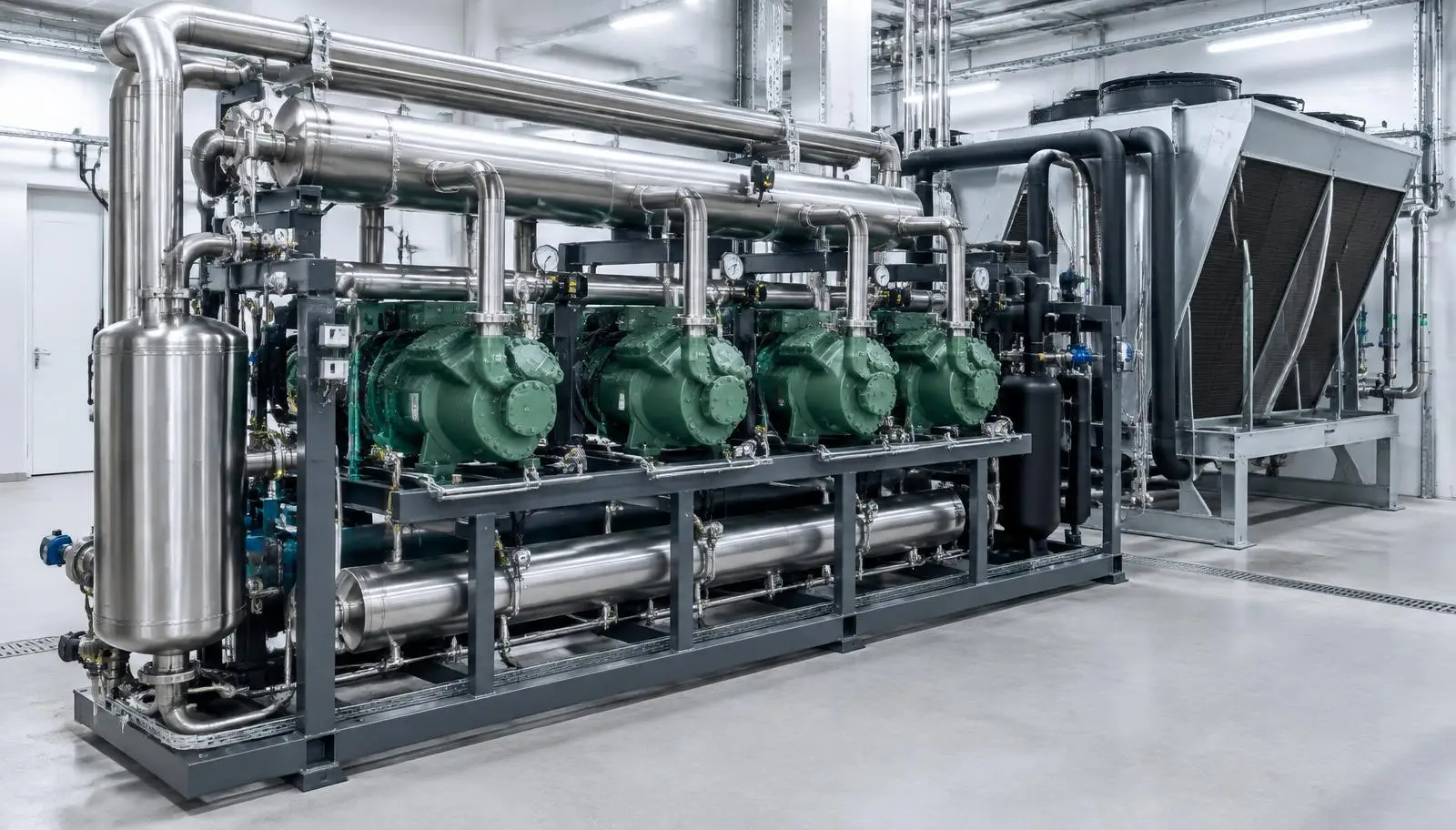
Quick answer
How to choose between R744 and R717 for industrial cold-chain projects: scale, climate, safety, efficiency, regulation, service coverage and lifetime cost. CO2 (R744) is commonly considered for food retail, distribution and medium-size industrial systems, where a natural, low-GWP refrigerant, tight regulatory exposure and good part-load performance matter. Efficiency depends heavily on ambient conditions and system architecture, so it must be evaluated per site.
Key takeaways
- When should CO2 refrigeration be considered? CO2 (R744) is commonly considered for food retail, distribution and medium-size industrial systems, where a natural, low-GWP refrigerant, tight regulatory exposure and good part-load performance matter.
- When should ammonia refrigeration be considered? Ammonia (R717) is widely used for larger industrial loads such as cold warehouses, blast freezing and food processing, where efficiency at scale is decisive.
- Can ColdMatch compare refrigeration suppliers? Yes.
- What affects cold storage OPEX? Electricity tariff and consumption, compressor and system efficiency, insulation quality, door openings and air infiltration, defrost strategy, setpoint, product turnover, labour, maintenance, refrigerant…
Reviewed: Sep 2026 · ColdMatch Group
Natural refrigerants now dominate new industrial cold-chain projects. The practical question is not which is 'better' but which fits your load, climate, safety context and service market.
Where ammonia wins
Large continuous industrial loads — frozen distribution centres, blast freezing, food processing — where efficiency at scale drives the business case and the site can support machinery rooms, detection and trained operators.
Where CO2 wins
Medium-size industrial, distribution and retail systems, sites where ammonia is restricted, and projects with strict low-GWP compliance targets. Heat recovery is often easier to justify.
Climate matters
CO2 efficiency is ambient-sensitive; in hot climates parallel compression, ejectors or adiabatic condensing are usually required to stay competitive.
Safety and compliance are design inputs
Ammonia toxicity and CO2 operating pressure both impose real design, training and permitting obligations. Assign responsibility for safety studies explicitly in the RFQ.
Compare on lifetime cost
Run the CO2 vs Ammonia Comparison Calculator, then read the full CO2 vs Ammonia guide before shortlisting suppliers.
ColdMatch Group is an independent industrial refrigeration and cold-chain project sourcing and RFQ platform. We are not a refrigeration manufacturer, cold storage operator, EPC contractor, installer, engineering firm, lender, broker-dealer, investment advisor or financial advisor. Supplier and project partner outreach is handled only after a commercial project brief is reviewed.
Run the numbers
Calculators for this project type
Indicative planning figures only — final sizing belongs to the supplier's or consultant's detailed design.
Supermarket refrigeration calculator
Cabinet line-up, pack capacity and back-of-store cold rooms for retail formats.
Energy & backup powerEnergy & backup power cost calculator
Annual energy spend from load and running hours, plus the cost of generator hours during outages.
Frequently asked questions
Plan the numbers before you send an RFQ
The reference pages buyers use most before requesting quotes.