
Quick answer
How to decide between automated and conventional cold storage: throughput, density, labour, energy, uptime, flexibility, scale and a transparent payback test. Typically with high, steady throughput, standard pallets, expensive land or height-limited sites, deep-frozen environments and an organisation able to support an integrated system. Test it against a good conventional design for the same duty.
Key takeaways
- When does automated cold storage make sense? Typically with high, steady throughput, standard pallets, expensive land or height-limited sites, deep-frozen environments and an organisation able to support an integrated system.
- Is automated cold storage more energy efficient? It can be, because a compact high-bay building may have less envelope per pallet and fewer door openings, but this depends on the design.
- What is the payback period for cold warehouse automation? There is no reliable typical figure.
- What happens if an automated system breaks down? That depends on redundancy and the service model.
Reviewed: Oct 2026 · ColdMatch Group
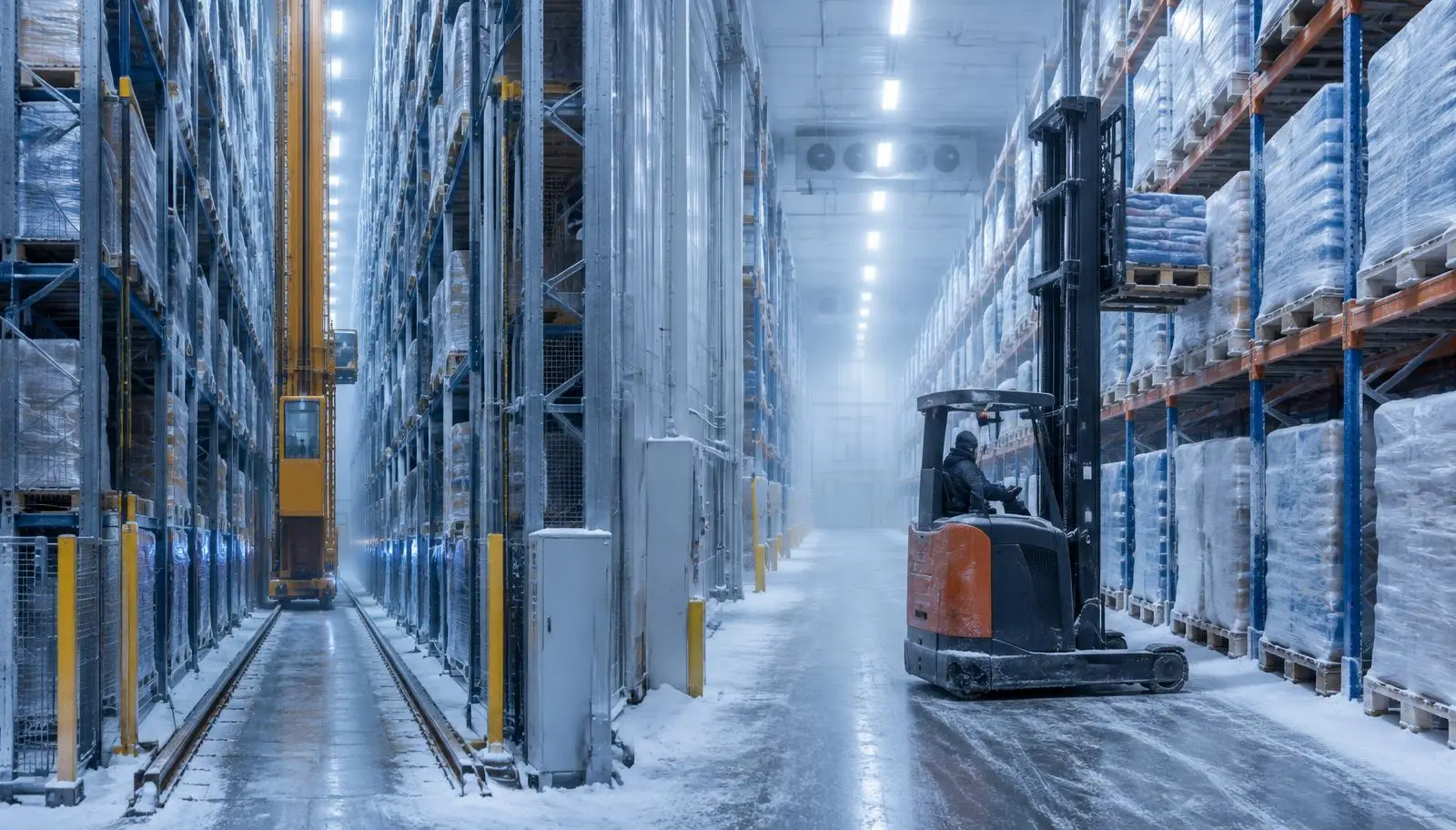
Short answer: automation is a means, not a goal. Automated cold storage (AS/RS cranes, shuttles, automated pallet movers) tends to fit projects with high and steady throughput, expensive land or height-limited sites, frozen environments where people work in difficult conditions, and an organisation able to run a highly integrated system. Conventional storage (forklifts, reach trucks, selective or drive-in racking) tends to fit variable or growing operations, smaller scale and buyers who value flexibility and simple maintenance. Test your own case in the Automated Cold Warehouse ROI calculator; the payback it shows is a function of the inputs you enter, not a promise.
Executive summary
- Decide on the operational profile first: pallet positions, movements per hour, SKU mix, temperature classes and growth.
- Automation usually trades higher capital cost and integration risk for density, consistent throughput and lower dependence on manual work in the cold.
- Conventional storage usually trades lower capital cost and higher flexibility for more floor area, more labour hours and more variability.
- Uptime, maintenance support, spare parts and a manual fallback plan are as important as the headline payback.
- Compare both concepts on the same duty and the same period; treat every payback figure as an estimate until suppliers price your brief.
Why the comparison is often unfair
Automation proposals are often compared with an existing manual operation, rather than with a well-designed conventional alternative for the same new building. The result can flatter either side. A fair comparison designs both concepts for the same pallets, throughput, temperature zones and growth case — and then prices each, including the building each one needs.
The decision variables
| Variable | Tends to favour automation | Tends to favour conventional |
|---|---|---|
| Throughput | High, steady pallet movements across shifts | Low, seasonal or highly peaky flows |
| Pallet density and land | Expensive land, tall buildings, footprint limits | Affordable land, low buildings, room to spread |
| SKU profile | Many pallets per SKU, standard pallets and loads | Very mixed loads, non-standard pallets, frequent changes |
| Working environment | Deep-frozen rooms where reducing time in the cold matters | Chilled rooms with comfortable manual access |
| Labour | Difficulty recruiting or retaining staff for cold work | Stable, available workforce |
| Flexibility | Stable process for many years | Process, products or volumes likely to change |
| Scale | Large single site | Small or multi-site network |
| Organisation | In-house maintenance capability or strong service contract | Preference for simple, widely supported equipment |
Energy, building and refrigeration effects
Automation changes the building as well as the handling. A high-bay automated store usually has a smaller footprint and less envelope surface per pallet, and can operate with fewer door openings and less lighting in storage zones. Those effects can lower refrigeration load per pallet, but they depend on the design; do not assume them. Ask each bidder for the refrigeration load and expected consumption of *their* building concept, and model the energy side with the Electricity Cost Calculator.
Tall frozen buildings also raise questions about structure, fire strategy, sprinklers and floor heave protection that a conventional design may handle differently. These are engineering and code issues for qualified designers and the authority having jurisdiction.
Uptime, maintenance and contingency
- Single points of failure: a stopped crane can block an aisle. Ask how many aisles, cranes or shuttles share the load and what happens when one stops.
- Cold-environment reliability: equipment must be specified for the temperature class, including lubrication, batteries, sensors and cabling.
- Service model: response times, on-site technicians, remote diagnostics and spare-parts stock — written into the contract.
- Manual fallback: a documented plan to keep critical dispatches moving during a breakdown or IT outage.
- Software and integration: the warehouse control system, WMS interface and ERP links are often the longest part of commissioning.
- Safety standards: automated equipment is designed to standards such as EN 528 for storage and retrieval machines and ISO 3691-4 for driverless industrial trucks; ask bidders which apply and how compliance is shown.
People still work in automated stores — maintenance, exception handling, loading. Guidance on working in cold environments, such as OSHA's cold stress resources, applies to both concepts.
A transparent payback test
The Automated Cold Warehouse ROI calculator compares the extra capital of automation with the annual operating difference you enter. To keep it honest:
- Enter capital for both concepts, including the building each needs, not only the handling equipment.
- Enter labour hours and rates from your own operation or market, not a vendor's assumption.
- Include maintenance and service contracts, software licences and spare parts for the automated option.
- Include energy for both concepts from bidders' stated consumption.
- Run low, base and high throughput cases. Automation payback is usually most sensitive to throughput and labour assumptions.
- Add a contingency for integration and ramp-up time; a system rarely reaches design throughput on day one.
If the payback only works in the optimistic case, that is a finding, not a failure. A phased approach — conventional now, building designed for later automation — is a legitimate outcome.
Decision checklist
- Are pallet positions, movements per hour, SKU profile and growth written down?
- Has a good conventional design been priced for the same building duty?
- Are service, spare parts, software and integration costs in the automated case?
- Is there a written manual fallback plan?
- Have you tested throughput and labour sensitivity?
- Do bidders state which safety and performance figures are guaranteed?
Limitations
This article is a decision framework, not an engineering design or an investment recommendation. Automation economics depend on local labour markets, land prices, energy tariffs, building codes and the specific system offered. We do not publish typical payback periods or savings because they vary too widely to be useful as facts. Final figures come from priced, comparable proposals.
Next step
For projects around USD 250,000 or more, submit your project brief describing both concepts you want priced. ColdMatch is a supplier-neutral intermediary, not an automation integrator or engineering authority; a specialist reviews the brief and introduces qualified suppliers. Background reading: the cold warehouse automation guide and our article on automation in high labour-cost markets.
*Prepared by the ColdMatch Group editorial team. Calculator methods are documented in our calculator methodology. Last reviewed: 11 October 2026.*
Run the numbers
Calculators for this project type
Indicative planning figures only — final sizing belongs to the supplier's or consultant's detailed design.
Cold storage capacity calculator
Pallet positions, chamber volume and indicative build cost for a refrigerated warehouse.
Energy & backup powerEnergy & backup power cost calculator
Annual energy spend from load and running hours, plus the cost of generator hours during outages.
Frequently asked questions
Plan the numbers before you send an RFQ
The reference pages buyers use most before requesting quotes.