
How to choose cold storage for food and agricultural products
Updated: · ColdMatch Group
Also available in: Español · Português
Quick answer
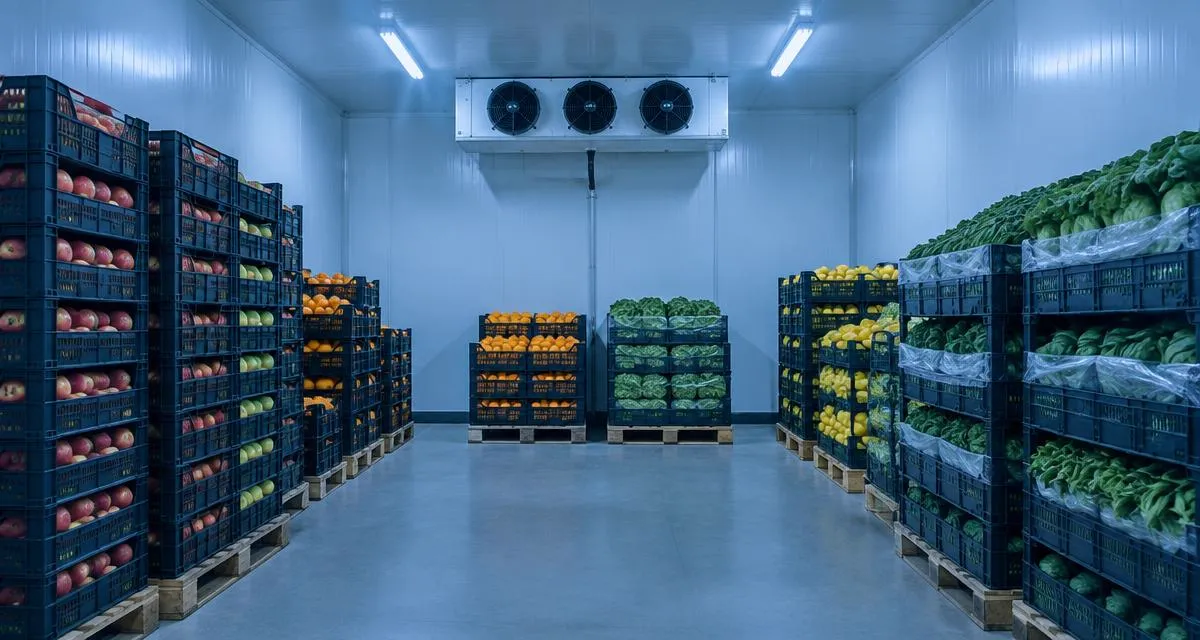
Start from the product, not the equipment: list each commodity's required temperature and relative humidity from an authoritative source, check which products can share a room, then size by peak volume, daily intake and stock rotation. Only then choose room type, refrigeration capacity and controls.
Temperatures and conditions depend on the product and local law. Confirm with your food-safety authority and product specification.
Why does the product decide the cold storage design?
Each food has its own safe and quality-preserving storage range. Some fruits and vegetables suffer chilling injury below a certain temperature, others need near-freezing conditions, and frozen products have entirely different requirements. FAO and UNEP note that cold chains reduce food loss only when they are designed around the product and its handling, not as generic cold boxes.
Use commodity data from recognised sources such as the UC Davis Postharvest Technology Center fact sheets or USDA Agriculture Handbook 66, and always check the rules that apply in your country. There is no universal storage temperature.
Step 1: What does each product need?
- Temperature range — from the product specification, buyer contract or authoritative reference.
- Relative humidity — too dry causes weight loss and wilting; too humid can encourage decay.
- Ethylene sensitivity and production — some fruits release ethylene that shortens the life of sensitive products.
- Odour transfer — e.g. onions or fish should not share space with products that absorb odours.
- Food-safety rules — animal products often have legal temperature limits.
Step 2: Which products can share a room?
Group products only when temperature, humidity and ethylene requirements are compatible. If they are not, plan separate rooms or zones. Mixing incompatible products is a common cause of avoidable loss.
| Question | If “yes” | If “no” |
|---|---|---|
| Same temperature range? | Candidate for shared room | Separate rooms or zones |
| Compatible humidity? | Keep grouping | Separate or add humidity control |
| Ethylene conflict? | Separate or add ethylene control | Keep grouping |
| Odour conflict? | Separate | Keep grouping |
Step 3: How much space and cooling do you need?
Size by peak stored volume (pallets or tonnes at the busiest point of the season), daily intake (product entering warm adds most of the cooling load) and stock rotation (how long product stays and how often doors open). Include aisles, handling equipment, growth and a buffer for seasonal peaks.
Step 4: How does stock flow change the choice?
- Long-term seasonal storage — stable conditions, possibly controlled atmosphere for suitable products.
- Fast distribution — strong pull-down capacity, insulated loading docks, frequent door cycles.
- Mixed throughput — multiple zones and good first-expired-first-out (FEFO) discipline.
Step 5: What should the specification include?
Turn the decisions above into a written brief before asking for quotes: product list with conditions, volumes, intake temperature, site climate, power reliability, monitoring and alarm needs, and food-safety records. Suppliers can then offer comparable solutions.
Project definition checklist
- Product list with temperature and humidity sources
- Compatibility groups and number of rooms or zones
- Peak volume, daily intake and dwell time
- Product temperature at arrival
- Ambient design conditions and power availability
- Monitoring, alarms and record-keeping needs
- Applicable local food-safety rules
- Budget range and expected start date
Frequently asked questions
What temperature should a fruit and vegetable cold room be?
It depends on the product. Some commodities need near-freezing conditions while others are damaged by low temperatures. Use the commodity's specification or a reference such as the UC Davis fact sheets, and confirm local rules.
Can I store different products in the same cold room?
Only if their temperature, humidity, ethylene and odour requirements are compatible. Otherwise separate rooms or zones reduce avoidable loss.
How do I estimate cold storage size?
Start with peak stored volume in pallets or tonnes, add aisles, handling space and growth, and check daily intake and dwell time, which drive cooling load.
Does ColdMatch sell cold rooms?
No. ColdMatch helps buyers define the project and prepare an RFQ, then contacts suitable suppliers on the buyer's behalf and presents organized responses.
Tools and next steps
Sources and standards
- FAO & UNEP (2022). Sustainable Food Cold Chains: Opportunities, Challenges and the Way Forward
- UC Davis Postharvest Technology Center — Produce Fact Sheets (commodity-specific storage conditions)
- USDA ARS Agriculture Handbook 66 — The Commercial Storage of Fruits, Vegetables, and Florist and Nursery Stocks
- Codex Alimentarius — Codes of practice (incl. General Principles of Food Hygiene CXC 1-1969 and Fish and Fishery Products CXC 52-2003)