
How to plan a fish and shrimp cold chain from farm to market
Updated: · ColdMatch Group
Also available in: Español · Português
Quick answer
Map every step from harvest to the buyer, define a control point and a responsible party at each handover, chill the catch as fast as possible and keep it cold without breaks, monitor time and temperature continuously, and keep records. The exact limits come from your food-safety plan, the species and the law of the producing and importing countries.
Temperatures and conditions depend on the product and local law. Confirm with your food-safety authority and product specification.
Why is seafood especially sensitive to cold-chain breaks?
Fish and shrimp spoil quickly once harvested. Temperature abuse accelerates microbial growth and, for certain species, can lead to hazards such as histamine formation that later chilling cannot reverse. The Codex Code of Practice for Fish and Fishery Products calls for chilling fish as quickly as possible to a temperature approaching that of melting ice and maintaining it, and the U.S. FDA hazards guidance describes time-temperature controls by species and hazard.
What are the main stages and control points?
| Stage | Control point | Evidence to record | Typical owner |
|---|---|---|---|
| Harvest / catch | Time to first chilling | Harvest time, ice or slurry applied | Farm or vessel |
| Pre-processing holding | Product core temperature | Probe readings, ice ratio | Farm / collector |
| Processing & packing | Hygiene, freezing or chilling step | HACCP records, freezer logs | Processor |
| Cold storage | Room temperature stability | Continuous logger data, alarms | Warehouse operator |
| Transport | Pre-cooled vehicle, set point | Reefer data, seal numbers | Carrier |
| Market / buyer receipt | Acceptance check | Receiving temperature, rejection rules | Buyer |
How do you set time-temperature limits?
Do not copy limits from another product. Define them in your HACCP-based plan using the species, product form (fresh, chilled, frozen, cooked), intended market and applicable regulations — for example EU Regulation 853/2004 for products entering the EU, or national inspection rules such as Brazil's RIISPOA. Write down the critical limit, how it is monitored and the corrective action when it is exceeded.
What monitoring is worth investing in?
- Continuous data loggers in rooms and vehicles, with alarms routed to a named person.
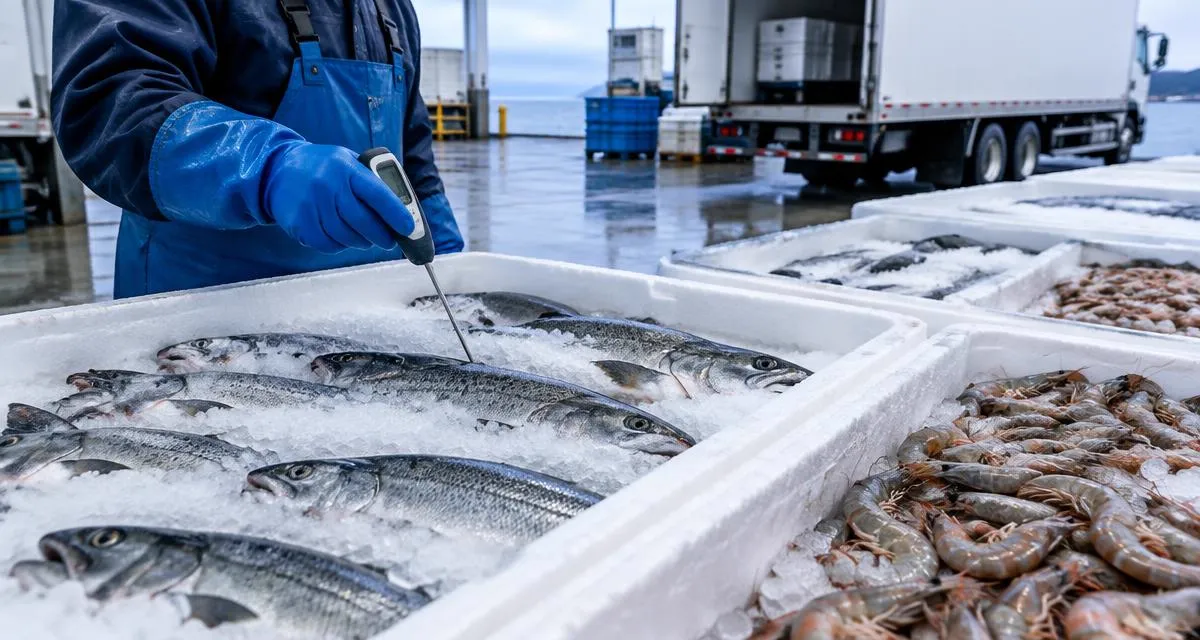
- Calibrated probe thermometers for product core checks at handovers.
- Door-open and power-failure alerts for storage.
- Records that travel with the lot so the next party can see the history.
Who is responsible at each handover?
Agree in writing who owns the product's temperature at each stage, what is checked at transfer, and what happens if a check fails (hold, re-chill, reject, or escalate). Unclear handovers are where many disputes and losses start.
Infrastructure decisions to make before requesting quotes
- Ice or slurry production capacity at harvest.
- Chilling and/or freezing capacity matched to peak harvest volume.
- Cold storage zones for fresh and frozen product.
- Loading dock design that limits warm-air exposure.
- Backup power and alarm response plan.
Seafood cold-chain checklist
- Species, product forms and target markets listed
- Hazards and critical limits defined in a food-safety plan
- Control point and owner at every stage
- Monitoring devices, calibration and alarm routing
- Corrective actions documented
- Peak daily volume and growth plan
- Power reliability and backup
Frequently asked questions
What temperature should fresh fish and shrimp be kept at?
Codex guidance calls for chilling fresh fish as quickly as possible toward the temperature of melting ice. Exact limits for your product come from your food-safety plan, the species and the regulations of the producing and importing markets.
What is a control point in the seafood cold chain?
A step where temperature or time is checked against a defined limit, with a named owner, a record and a corrective action if the limit is not met.
Do I need continuous temperature loggers?
For storage and transport they provide the evidence buyers and inspectors increasingly expect and allow faster reaction to failures. Probe checks at handovers complement them.
Can ColdMatch help with a seafood cold storage project?
Yes. ColdMatch helps define the scope and prepare the RFQ, then contacts suitable refrigeration suppliers on your behalf and presents organized responses.
Tools and next steps
Sources and standards
- Codex Alimentarius — Codes of practice (incl. General Principles of Food Hygiene CXC 1-1969 and Fish and Fishery Products CXC 52-2003)
- U.S. FDA — Fish and Fishery Products Hazards and Controls Guidance
- Regulation (EC) No 853/2004 — specific hygiene rules for food of animal origin
- Brasil — Decreto nº 9.013/2017 (RIISPOA), inspeção de produtos de origem animal
- FAO & UNEP (2022). Sustainable Food Cold Chains: Opportunities, Challenges and the Way Forward