
How to reduce post-harvest losses in greenhouse and fresh produce
Updated: · ColdMatch Group
Also available in: Español · Português
Quick answer
Remove field heat quickly with a pre-cooling method suited to the crop, store each product within its own temperature and humidity range, use packaging that lets cold air reach the product, and manage stock first-expired-first-out. Measure losses at each stage so you invest where they actually occur.
Temperatures and conditions depend on the product and local law. Confirm with your food-safety authority and product specification.
Where do post-harvest losses happen?
Losses accumulate between harvest and sale: field heat left in the product, delays before cooling, poor packaging, mixed storage, temperature swings in transport and slow stock rotation. FAO and UNEP identify inadequate cooling as a major contributor to food loss in many regions. Before buying equipment, measure where your losses occur — by weight, by quality grade and by rejected lots.
Why is pre-cooling the first priority?
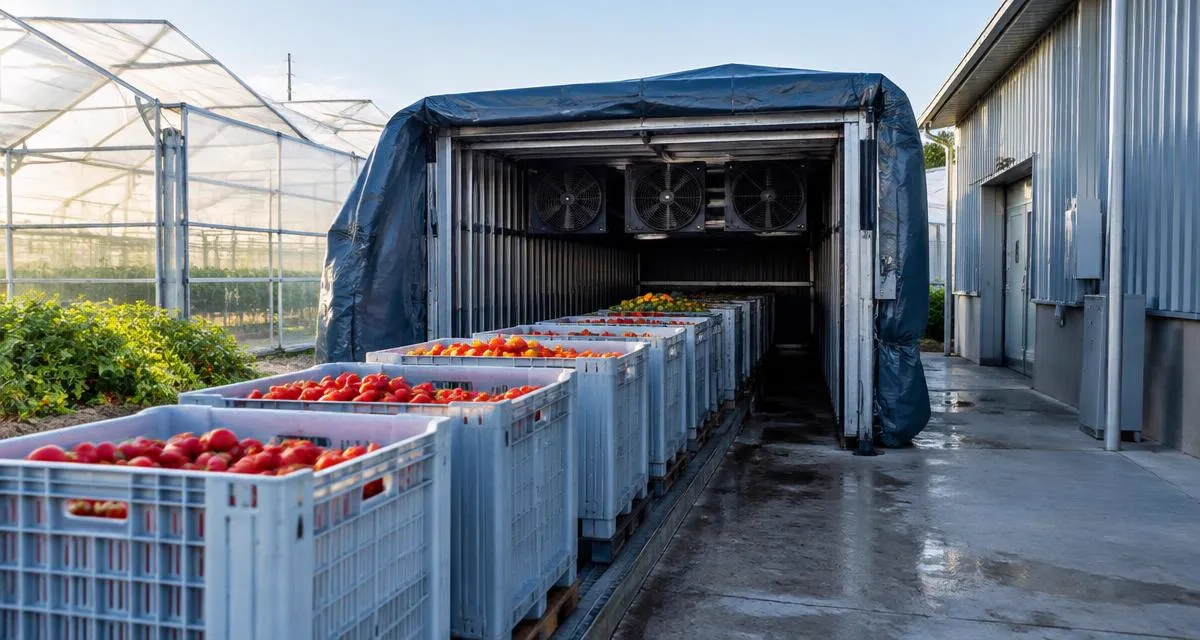
Freshly harvested produce carries field heat that drives respiration and water loss. Removing it promptly, before storage or shipping, is one of the most effective steps for many crops, according to the UC Davis Postharvest Technology Center. A cold room alone is usually designed to hold temperature, not to remove field heat quickly.
| Method | How it works | Suits | Watch out for |
|---|---|---|---|
| Forced-air cooling | Fans pull cold air through vented packages | Many fruits and fruit vegetables | Needs vented packaging and correct stacking |
| Hydrocooling | Chilled water flows over produce | Water-tolerant crops | Water sanitation is essential |
| Vacuum cooling | Evaporation under low pressure | Leafy greens | Some water loss; product-specific |
| Package icing | Ice in or on packages | Ice-tolerant crops only | Damages sensitive products |
| Room cooling | Product cools in the storage room | Slow-respiring products | Slow; not a substitute for pre-cooling |
How should storage be set up?
Store each product within its own recommended temperature and humidity range — many greenhouse crops such as tomatoes, peppers and cucumbers are chilling-sensitive, so colder is not automatically better. Use the commodity fact sheets, your buyer's specification and local rules. Separate ethylene producers from ethylene-sensitive products.
What role does packaging play?
- Vent holes aligned when stacked so cold air reaches the product.
- Strength to survive stacking and humidity.
- Liners or modified-atmosphere packaging only where suited to the crop.
- Labels with harvest date and lot for traceability.
How does stock management reduce loss?
Apply first-expired-first-out (FEFO), record entry dates and quality checks, limit door openings, and plan loading so product spends the minimum time outside refrigeration. Simple routines often reduce loss before any capital investment.
Step-by-step improvement plan
- Measure current losses by stage and product.
- Shorten time from harvest to pre-cooling.
- Select a pre-cooling method by crop and volume.
- Group storage by compatible conditions.
- Upgrade packaging for airflow.
- Introduce FEFO, logging and alarms.
- Re-measure and compare against the baseline.
Post-harvest project checklist
- Crops, daily harvest peak and season length
- Measured loss baseline by stage
- Target pre-cooling method and capacity
- Storage zones and conditions with sources
- Packaging specification
- Monitoring and stock-rotation routine
- Power and water availability
Frequently asked questions
What is the fastest way to remove field heat from vegetables?
It depends on the crop. Forced-air, hydro and vacuum cooling are common options; each suits different products. Room cooling alone is usually slower.
Should tomatoes and peppers be stored as cold as possible?
No. Many greenhouse crops are chilling-sensitive and can be damaged below their recommended range. Check commodity data and buyer specifications.
How much will pre-cooling reduce my losses?
We do not publish a general percentage because results depend on crop, climate, handling and baseline. Measure your own losses before and after changes.
Can ColdMatch help plan pre-cooling and storage?
Yes. ColdMatch helps define the project and RFQ, contacts suitable suppliers on your behalf and presents organized responses for comparison.
Tools and next steps
Sources and standards
- UC Davis Postharvest Technology Center — Produce Fact Sheets (commodity-specific storage conditions)
- USDA ARS Agriculture Handbook 66 — The Commercial Storage of Fruits, Vegetables, and Florist and Nursery Stocks
- FAO & UNEP (2022). Sustainable Food Cold Chains: Opportunities, Challenges and the Way Forward
- FAO — Cooling the chain, cutting the waste