
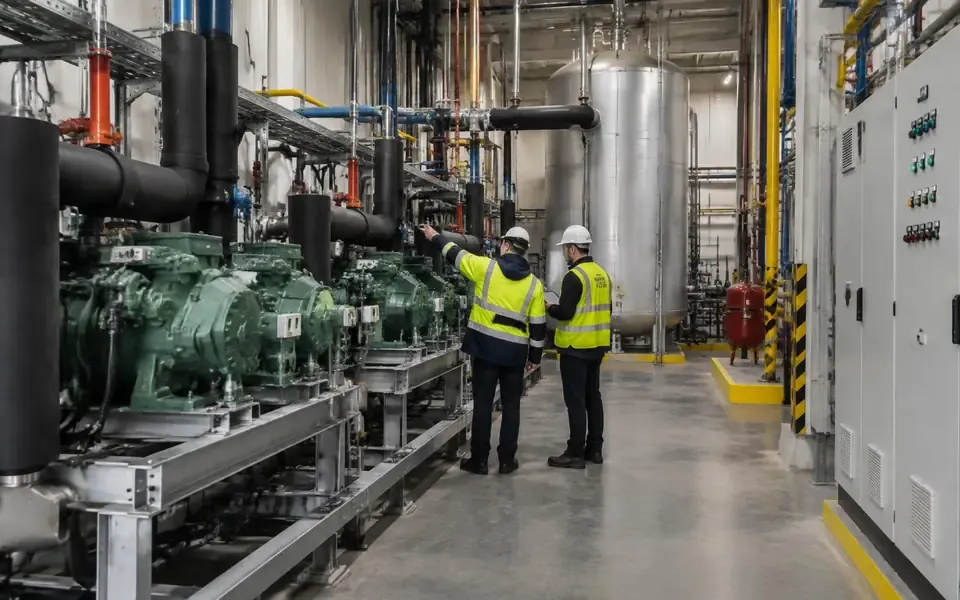
CO₂ (R744) refrigeration plant
Refrigeration plant using carbon dioxide as refrigerant, in transcritical or cascade configurations, for commercial and industrial cooling.
- Central plant
- Chilled storage
- Frozen storage
- Process cooling
Offline — reconnect before saving or submitting. Changes on this page have not been sent.
Free for buyers. Your request goes to the ColdMatch team, who review it and contact suitable suppliers on your behalf. Suppliers do not receive your details before that review.
ColdMatch facilitates sourcing and RFQs; it does not manufacture, sell, import or export the listed products and is not a regulatory authority. Suppliers are responsible for their products meeting the requirements of the origin and destination countries; buyers for import permissions, local rules and due diligence. Requirements vary by product and country, and the team checks requests before any supplier contact. Regulation and restricted items
Confirm machine-room location and ventilation, detection and emergency arrangements, applicable safety codes, charge-reduction options, and local operator competence before comparing offers.
ColdMatch does not certify equipment or guarantee compliance; requirements depend on your country and project, and your advisers and authorities decide what applies.
Controllers, valves and supervisory software that run refrigeration plant, defrost and fans and connect them to site management systems.
Fan-coil units that remove heat from the cold room or process area, matched to refrigerant, room temperature and air throw.
Sensors, data loggers and software that record temperatures across rooms, vehicles or sites and raise alarms when limits are exceeded.
Answer these in your request so supplier offers are comparable.
Unknown items can be left open — the ColdMatch team will ask before approaching suppliers.
Free planning calculators that answer the sizing, load or cost questions above. Results are estimates, not quotes; add them to your request so suppliers can check them.
Gives indicative CAPEX, annual energy cost and 10-year cost of CO₂ and ammonia plant for your duty and climate.
Gives a screening motor power, COP and displacement for a duty at given evaporating and condensing temperatures.
Gives 5- and 10-year total cost of competing offers: price, energy, maintenance, downtime and replacement.
Which natural refrigerant suits your site, loads and local competence?
| Aspect | Ammonia (NH₃) plant | CO₂ (R744) plant |
|---|---|---|
| Refrigerant | Ammonia: toxic and flammable within certain concentrations; long industrial track record. | Carbon dioxide: non-flammable and low toxicity, but operates at high pressure. |
| Usual fit | Large central plants serving cold stores, freezers and process users. | Commercial and industrial systems, including where ammonia is restricted near occupied areas. |
| Site and safety | Machine-room design, detection, ventilation and emergency planning are central. | High-pressure components and relief design; check performance in hot climates. |
| Competence needed | Qualified ammonia operators and service locally. | Technicians trained on CO₂ systems locally. |
| Combined options | NH₃/CO₂ cascade designs keep ammonia in the machine room. | Can be the low-temperature stage of a cascade with ammonia. |
Rule of thumb: Neither is right everywhere. Local rules, climate, load size and the service skills near your site usually decide.
Read the full CO₂ vs ammonia guideOptional: answer two questions now and they are pre-filled in the request form, together with “Ammonia (NH₃) central refrigeration plant”.
Free for buyers. ColdMatch arranges projects from about USD 250,000; smaller requests are still received and pointed to free planning tools. The ColdMatch team reviews every request before contacting suppliers.
No supplier-confirmed listings are published here yet. ColdMatch only publishes details that a supplier has confirmed in writing and our team has reviewed — we do not show estimated stock, prices or specifications.
You can still request quotes now: send your requirement and the ColdMatch team will review it and contact suitable suppliers on your behalf.
Import, delivery and service context for your market.
This page is about sourcing equipment. Project planning — sizing a complete facility, layout, scope and contractor structure — is a separate service.
Project planning servicesLinks checked on . They explain rules and practice; they do not confirm that any specific offer complies. Requirements differ by country — check with your own advisers.
Hazards and safety-management requirements for ammonia refrigeration systems in the United States.
Industry body publishing standards and guidance for ammonia and other natural-refrigerant systems.
EU restrictions on certain fluorinated refrigerants by equipment type and date. Use it to check whether the refrigerant offered is restricted for your equipment in the EU.
US limits on higher-GWP HFC refrigerants in new refrigeration and air-conditioning equipment. Parts were under reconsideration in 2026, so check the current status before relying on a date.
Refrigeration plant using carbon dioxide as refrigerant, in transcritical or cascade configurations, for commercial and industrial cooling.
Factory-assembled set of compressors with controls, or a condensing unit, serving one or more evaporators.