
How to build a cold room and freezer specification and RFQ to compare suppliers
Updated: · ColdMatch Group
Also available in: Español · Português
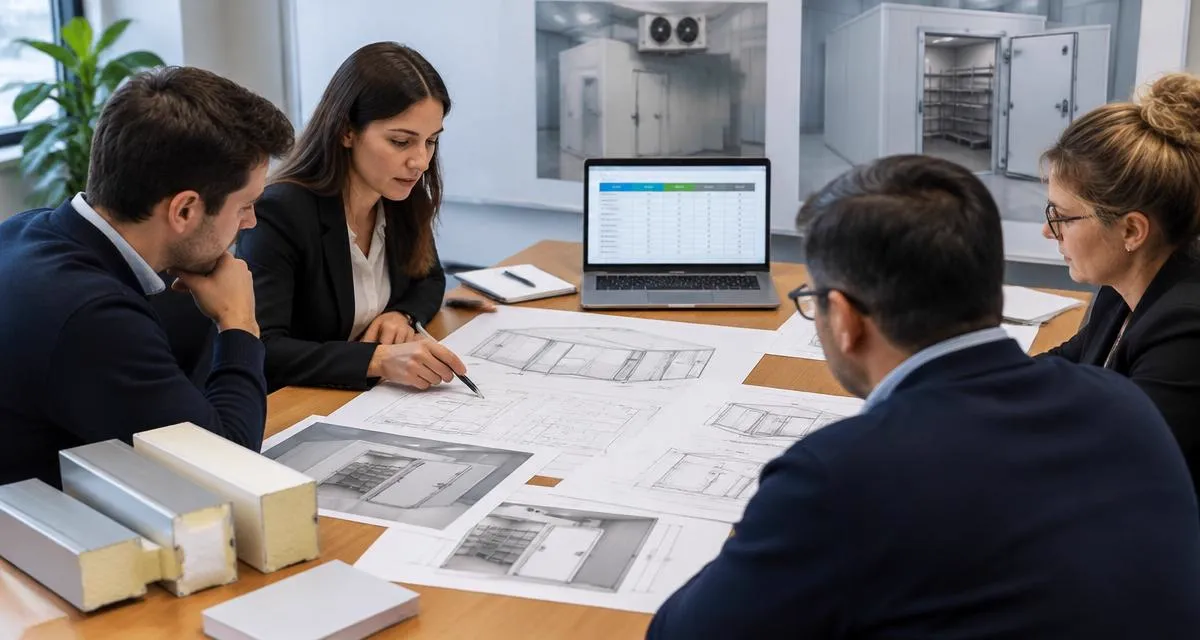
Quick answer
Write one specification that states the outcome (products, temperatures, capacity, throughput), the site conditions and the required scope — equipment, installation, commissioning, training and service. Ask every supplier to price the same scope in the same format, report energy at the same design conditions, and commit to measurable KPIs. Then compare total cost of ownership, not only purchase price.
Temperatures and conditions depend on the product and local law. Confirm with your food-safety authority and product specification.
Why do cold room quotes often look impossible to compare?
Suppliers usually quote what they assume you need: different capacities, design temperatures, insulation, scope boundaries and warranty terms. Without a common specification, the lowest price can hide missing scope or higher running costs. A structured RFQ forces offers onto the same basis.
What should the specification contain?
- Outcome and products: commodities, storage conditions with source, product entry temperature, required pull-down.
- Capacity and flow: pallet positions or tonnes, daily intake and dispatch, door cycles.
- Site: location, ambient design conditions, available power and reliability, floor and building constraints.
- Technical requirements: insulation, doors, floor heating for freezers, refrigerant preferences allowed locally, controls, monitoring and alarms.
- Scope: design, supply, installation, electrical works, commissioning, documentation, training, spares, service.
- Compliance: applicable food-safety, refrigeration safety and pressure-equipment rules.
How should suppliers present prices?
| Cost block | Ask suppliers to state |
|---|---|
| CAPEX — equipment | Refrigeration plant, evaporators, panels, doors, controls (itemised) |
| CAPEX — works | Installation, civil and electrical works, commissioning, documentation |
| OPEX — energy | Annual kWh at the stated design conditions and load profile |
| OPEX — maintenance | Preventive maintenance contract, consumables, refrigerant top-up assumptions |
| Service | Response time, local technicians, spare-parts availability |
| Exclusions | Everything not included, explicitly listed |
Which KPIs belong in the contract?
- Temperature held within the specified band at stated ambient and load (verified at commissioning).
- Pull-down time for the defined product load.
- Energy consumption at the stated basis, with how it will be measured.
- Service response time and uptime commitments.
- Documentation and training delivered before handover.
How do you calculate total cost of ownership?
Total cost of ownership = CAPEX + the sum of annual energy, maintenance and service costs over the evaluation period + expected major replacements − residual value. Use your own tariff and period, and keep assumptions identical across suppliers. Do not rely on savings claims that are not tied to stated conditions.
How do you score the offers?
- Check compliance with mandatory requirements; set aside non-compliant offers or ask for clarification.
- Normalise scope so each offer covers the same items.
- Compare total cost of ownership on the same assumptions.
- Score technical quality, delivery time, service capability and risk.
- Clarify, negotiate and record decisions.
RFQ readiness checklist
- Products and conditions with sources
- Capacity, throughput and growth
- Site data and power
- Full scope and exclusions table
- Price breakdown template
- Energy basis and KPIs
- Evaluation criteria and weights
- Deadline and contact point
Frequently asked questions
What should a cold room RFQ include?
Products and storage conditions, capacity and throughput, site and power data, technical requirements, the full scope from design to service, a price breakdown template, an energy basis, KPIs and evaluation criteria.
How do I compare cold storage quotes fairly?
Require the same scope, design conditions and price format, normalise any differences, and compare total cost of ownership rather than purchase price alone.
What is the difference between CAPEX and OPEX in cold storage?
CAPEX is the upfront cost of equipment and works; OPEX is the ongoing cost of energy, maintenance and service over the facility's life.
Does ColdMatch charge buyers for the RFQ service?
No. The procurement service is free for buyers. ColdMatch reviews the project, contacts suitable suppliers on the buyer's behalf and presents organized responses. Typical projects start around USD 250K.
Tools and next steps
Sources and standards
- FAO & UNEP (2022). Sustainable Food Cold Chains: Opportunities, Challenges and the Way Forward
- ISO 5149-1 — Refrigerating systems and heat pumps: safety and environmental requirements
- Codex Alimentarius — Codes of practice (incl. General Principles of Food Hygiene CXC 1-1969 and Fish and Fishery Products CXC 52-2003)
- International Institute of Refrigeration (IIR) — technical resources