
Segregated cold store for certified organic produce
Free for buyers. Your request goes to the ColdMatch team, who review it and contact suitable suppliers on your behalf. ColdMatch does not manufacture equipment or guarantee compliance.
What the package includes
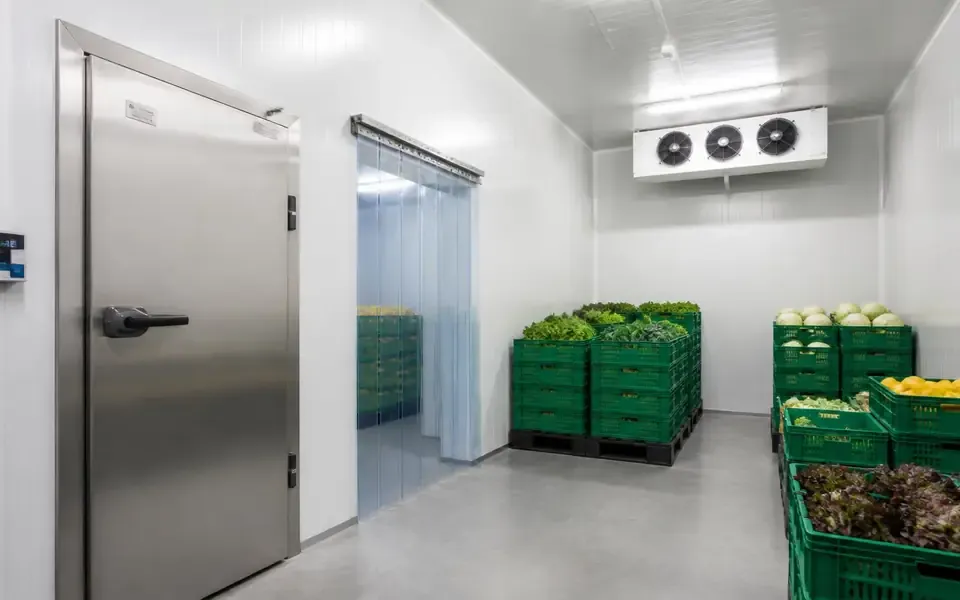
- Multi-chamber built-up cold store
Separate rooms or zones for organic and conventional lots
- Insulated sandwich panels
Room construction with cleanable surfaces
- Cold-room and high-speed doors
Doors that keep each zone closed
- Temperature monitoring and alarm system
Temperature records per room and lot
How the parts depend on each other
- Segregation is mainly layout and procedures; the refrigeration itself is the same as for conventional produce.
- Room count follows how many products and certification statuses must be kept apart at the same time.
Standards and specification basis
- Organic handling rules of your market — for example the EU's storage rules under Regulation 2018/848 or the US commingling and contamination prevention standard (7 CFR 205.272).
- General food-hygiene and cold-storage practice for the produce stored.
Best fit for buyers who
- You store both organic and conventional produce on one site.
- Your certifier or buyers ask how organic lots are kept apart and traced.
- Several products need different temperatures at the same time.
Commercial benefits
- Lowers the risk of losing organic status for a lot through commingling.
- Makes inspections faster when rooms, lots and records line up.
- Lets you rent or allocate rooms flexibly between organic and conventional customers, if procedures allow.
Risks to manage
- Shared corridors, docks or equipment can still mix lots if procedures are not followed.
- Cleaning agents or pest control not permitted under the organic standard used in organic rooms.
Limitations
- The building cannot make produce organic, and design alone does not guarantee certifier acceptance.
- Zone separation inside one room may not be accepted by every certifier — confirm before designing.
Documents to request
- Room layout showing organic and conventional zones and traffic routes.
- Cleaning and pest-control plan listing the substances used.
- Monitoring records per room, linked to lot numbers.
Regulatory notes
- Ask your certification body whether the storage operation must be included in your certificate.
- Imported organic produce must also meet the import and certificate rules of the destination market.
Price ranges
No price range is published for this package: costs depend on capacity, site and country, and ColdMatch has no researched, dated range to show. Planning ranges for whole cold stores are on the cost benchmarks page; real prices come only from suppliers’ written offers.
Compared with: Standard multi-chamber cold store
| Aspect | This package | Standard multi-chamber cold store |
|---|---|---|
| Refrigeration | Same as standard | Same |
| Layout | Rooms or zones assigned by certification status | Rooms assigned by temperature only |
| Procedures | Cleaning, pest control and traffic agreed with certifier | General hygiene plan |
| Records | Per lot and room, kept for inspection | Per room |
Sources and further reading
Links checked on . They explain rules and practice; they do not confirm that any specific offer complies. Requirements differ by country — check with your own advisers.
- Organic production and labelling — EU legislation (Regulation (EU) 2018/848) — European Commission
EU rules for organic production, labelling, certification and controls, including collection, transport and storage of organic products.
- 7 CFR Part 205 — National Organic Program — US Code of Federal Regulations (eCFR)
US organic regulations, including organic handling requirements and the commingling and contamination prevention practice standard.
- Guidelines for organically produced foods (CXG 32-1999) — FAO/WHO Codex Alimentarius
International guidelines on production, labelling, handling and storage of organically produced foods, used as a reference by many countries.