
Controlled-atmosphere storage for organic fruit
Free for buyers. Your request goes to the ColdMatch team, who review it and contact suitable suppliers on your behalf. ColdMatch does not manufacture equipment or guarantee compliance.
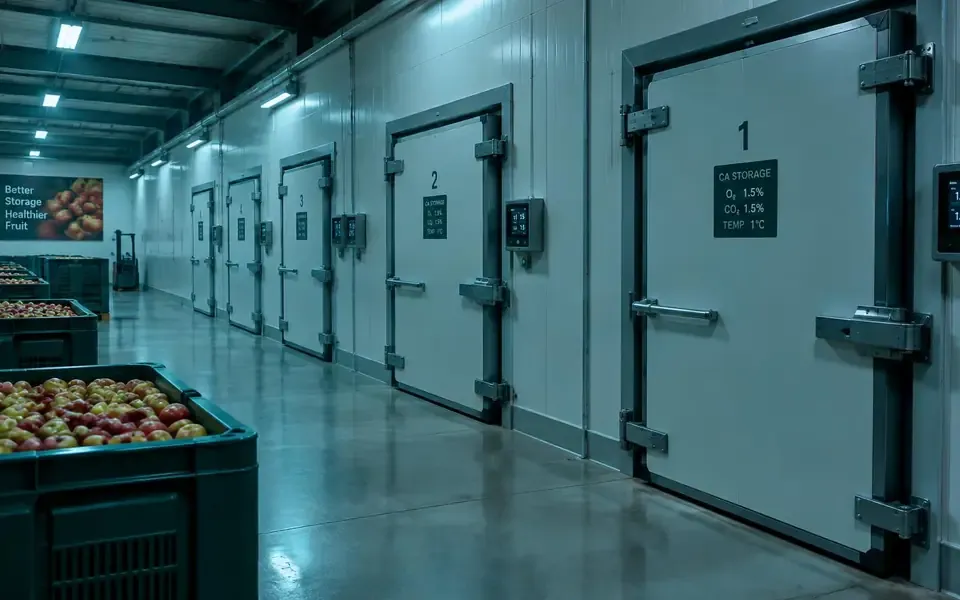
What the package includes
- Controlled-atmosphere storage room
Gas-tight rooms with oxygen and CO₂ control
- Compressor rack / condensing unit
Refrigeration for the rooms
- Insulated sandwich panels
Gas-tight room construction
- Refrigeration controls and plant management
Room atmosphere and temperature control
- Temperature monitoring and alarm system
Temperature and gas records per room
How the parts depend on each other
- Any gas, scrubber medium, sanitiser or treatment used must be permitted under your organic standard — confirm with your certifier before ordering.
- Gas-tightness depends on panels, joints and doors together; ask who tests it.
Standards and specification basis
- Organic standard of your market for storage and permitted substances (for example the US National List, or the EU organic rules).
- Safe-entry procedures for low-oxygen rooms under local occupational-safety rules.
Best fit for buyers who
- You store organic pome fruit or similar crops for several months.
- Rooms can stay closed for long periods once filled.
Commercial benefits
- Extends the storage period without chemical post-harvest treatments.
- Lets you sell organic fruit later in the season.
Risks to manage
- Low-oxygen rooms are dangerous for anyone entering without procedures and gas detection.
- Poor gas-tightness lets the atmosphere drift and shortens storage life.
Limitations
- Suitability depends on fruit variety and maturity; storage conditions come from your agronomist or post-harvest reference, not from the equipment supplier alone.
- Not every post-harvest treatment used in conventional CA storage is permitted for organic fruit.
Documents to request
- Gas-tightness test method and results per room.
- List of gases, scrubber media and cleaning agents, for your certifier to check.
- Atmosphere and temperature records per room.
Regulatory notes
- Confirm permitted substances with your certifier before ordering atmosphere-control equipment.
- Check local safety rules for low-oxygen spaces and gas detection.
Price ranges
No price range is published for this package: costs depend on capacity, site and country, and ColdMatch has no researched, dated range to show. Planning ranges for whole cold stores are on the cost benchmarks page; real prices come only from suppliers’ written offers.
Compared with: Standard chilled storage
| Aspect | This package | Standard chilled storage |
|---|---|---|
| Storage period | Months, depending on fruit and variety | Shorter |
| Room construction | Gas-tight, tested | Insulated, not gas-tight |
| Safety | Low-oxygen entry procedures needed | Standard cold-room safety |
| Organic inputs check | Gases and media must be confirmed | Cleaning agents only |
Sources and further reading
Links checked on . They explain rules and practice; they do not confirm that any specific offer complies. Requirements differ by country — check with your own advisers.
- National List of Allowed and Prohibited Substances — USDA Agricultural Marketing Service
Which substances may be used in US organic production and handling — check gases, sanitisers and treatments against it with your certifier.
- Organic production and labelling — EU legislation (Regulation (EU) 2018/848) — European Commission
EU rules for organic production, labelling, certification and controls, including collection, transport and storage of organic products.
- Agriculture Handbook 66: The Commercial Storage of Fruits, Vegetables, and Florist and Nursery Stocks — USDA Agricultural Research Service
Reference on storage conditions, pre-cooling, controlled atmosphere and ripening for many crops.
- Shelf life of highbush blueberries under controlled atmosphere and ozone (2015) — Peer-reviewed study (PubMed Central)
Research example of how storage atmosphere affects blueberry shelf life; results apply to the conditions tested.