
Beyond Refrigeration: The Future of Commercial Cold Chain Infrastructure
Cold chain has moved from an equipment purchase to an infrastructure discipline. This executive guide sets out the demand drivers, system anatomy, energy strategy, financing logic and procurement method behind commercial cold chain projects from USD 250,000 to USD 100M+.
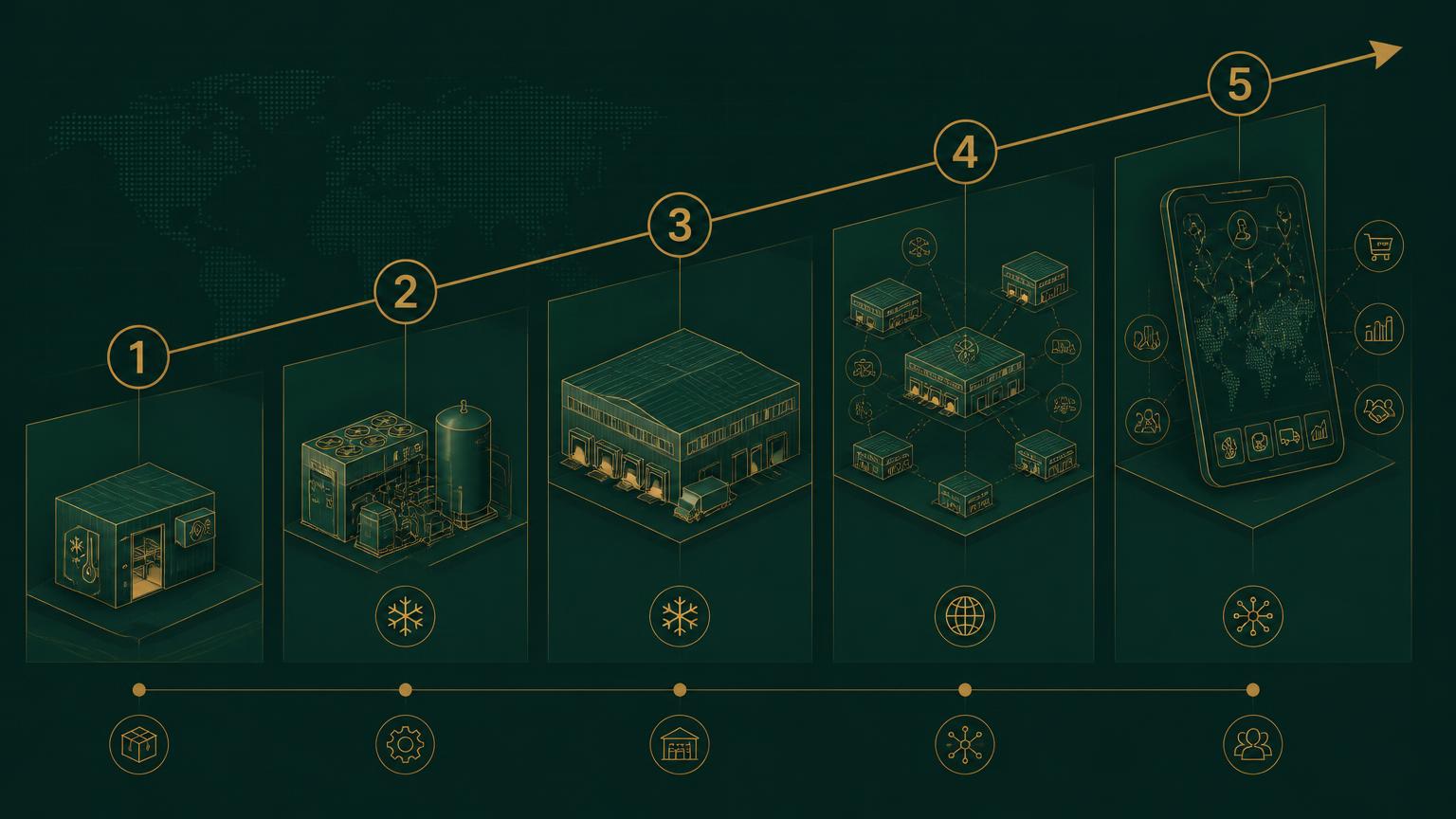
Quick answer
What is commercial cold chain infrastructure?
Commercial cold chain infrastructure is the full temperature-controlled system — refrigeration plant, insulated envelope, freezing capacity, handling, backup power, monitoring and procedures — not just the equipment. Projects typically run from about USD 250,000 for a compact commercial installation to USD 100M+ for automated regional distribution hubs, and budgets hold when the facility is modelled stage by stage and validated against comparable supplier quotations.
Executive takeaways
- Cold chain is infrastructure. Procure the system, not the machine.
- Energy typically outweighs equipment price over the asset's life — specify for the real load profile.
- Capital providers fund evidenced throughput and credible design, not shopping lists.
- Comparable offers require a buyer-defined scope, guarantees and commercial terms.
- Preparation quality is now the decisive commercial advantage.
01 — The shift
Cold chain has stopped being an equipment purchase
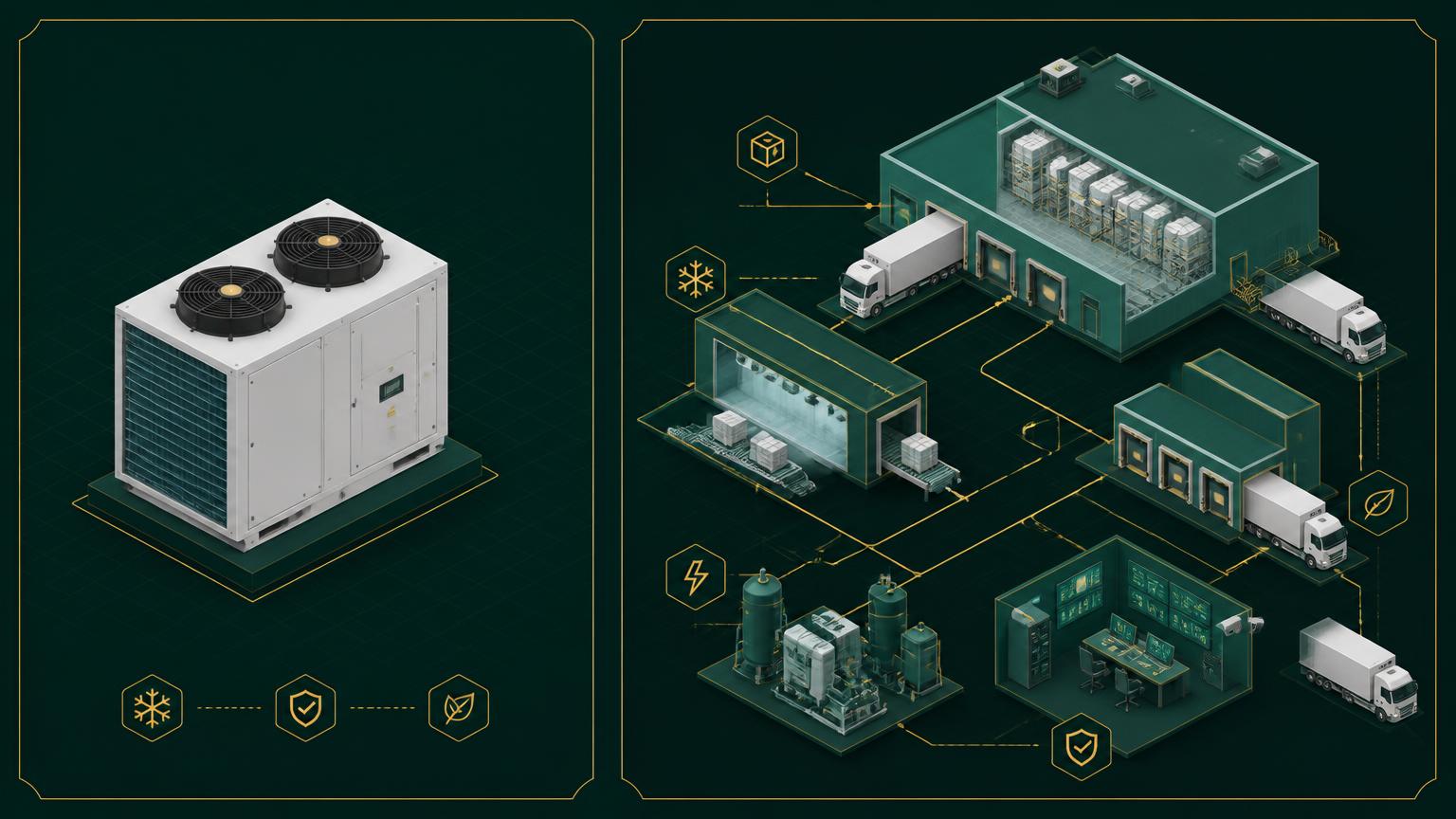
For most of the last century, buying cold was simple in structure if not in engineering: a company needed to keep product cold, so it bought a refrigeration machine. The machine was the project. Everything else — the building, the doors, the power supply, the way people worked around it — was treated as context.
That framing no longer describes how serious commercial projects are built. A modern cold facility is an integrated infrastructure asset in which the refrigeration plant is one subsystem among many, and rarely the one that decides whether the investment performs. The envelope decides how much cooling is needed. The dock and door strategy decides how much of that cooling is lost. The control philosophy decides how efficiently the plant tracks a variable load. The power arrangement decides what happens to the stored value when the grid fails. The operating procedure decides whether the temperature record survives an audit.
The commercial consequence is direct. Buyers who procure a machine end up owning a machine surrounded by problems. Buyers who procure infrastructure own a system that produces a predictable cost per tonne, a defensible compliance record and an asset a lender will recognise.
The most expensive decisions in a cold chain project are made before anyone requests a price.
Three structural changes driving the shift
- Product value density has risen. Chilled and frozen categories now carry higher unit value, tighter tolerances and stricter traceability than the bulk commodity flows that shaped legacy cold storage design.
- Energy has become a strategic variable rather than a utility line. Tariff volatility and efficiency regulation have moved refrigeration from the maintenance budget into the boardroom.
- Capital is more selective. Lenders and development institutions increasingly evaluate cold chain projects as infrastructure — with throughput models, technical due diligence and lifecycle cost assumptions — not as equipment purchases secured by a supplier invoice.
02 — Demand
What is actually driving global cold chain investment
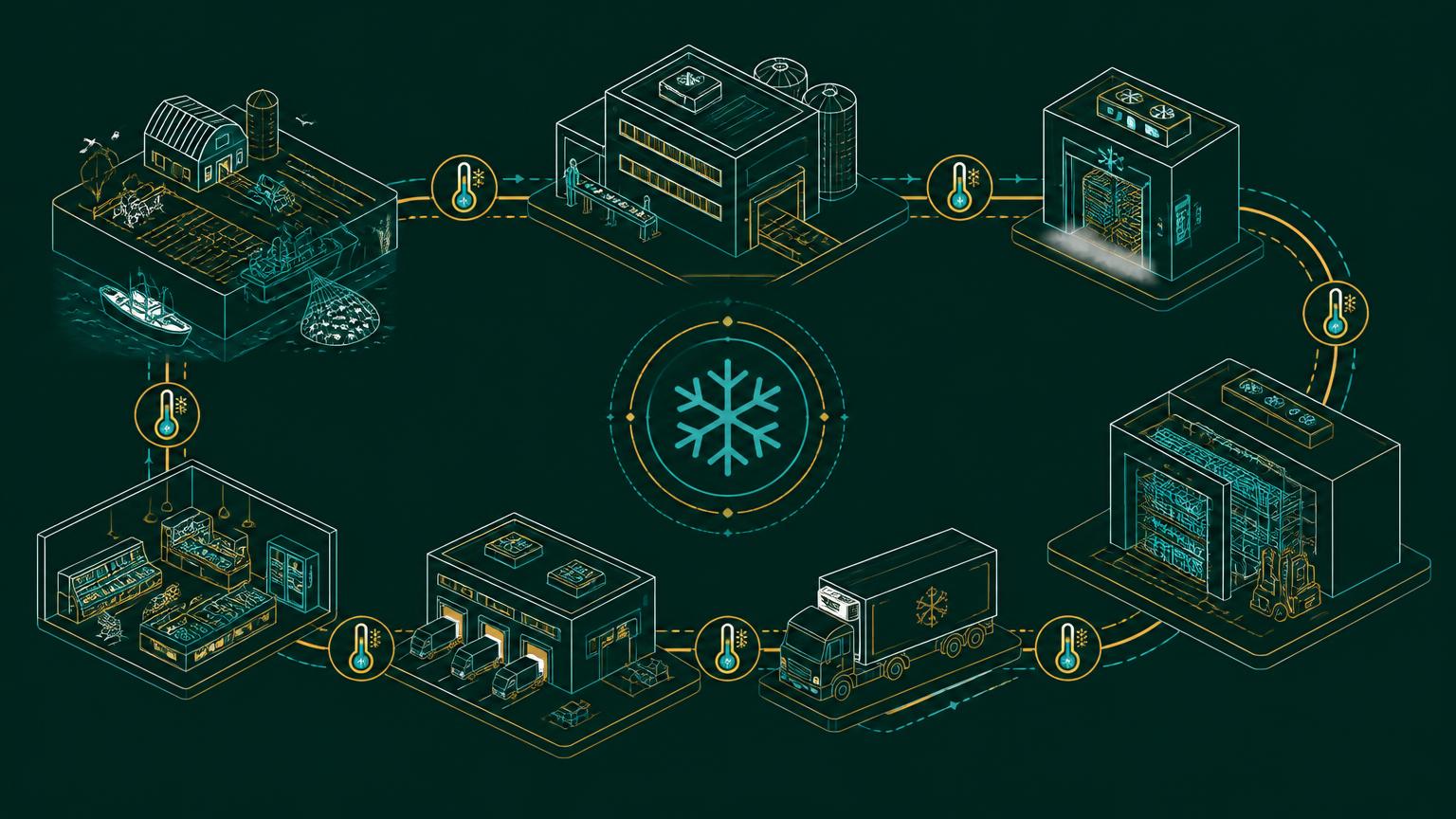
Cold chain demand is often explained with a single number about market growth. That number is not useful to a project owner. What matters is which underlying flows are creating the requirement, because each flow implies a different facility, a different temperature regime and a different investment case.
Post-harvest loss and food security
In many producing regions, a substantial share of perishable output is lost between field or landing site and market, not because of a lack of production capacity but because of a missing first-mile cooling link. Pre-cooling, chilled aggregation and short-haul refrigerated transport frequently deliver a higher return per dollar invested than a large central warehouse, and they de-risk the larger facility that follows.
Export qualification
Access to export markets is increasingly conditional on demonstrable temperature control. A processor that cannot evidence an unbroken chain — with calibrated monitoring, validated blast freezing capacity and audited procedures — is not competing on price; it is excluded from the buyer list entirely. For many exporters, cold chain investment is a market access decision rather than an efficiency decision.
Pharmaceutical and life science distribution
Temperature-controlled pharmaceutical distribution operates under a stricter regime: mapped and validated storage, qualified transport lanes, documented excursion management and redundancy that must hold when primary systems fail. The engineering is not radically different from food cold storage; the documentation, validation and redundancy burden is.
Retail and urban distribution
Modern retail and online grocery have pushed cold chain closer to the consumer, creating demand for smaller, denser, higher-throughput urban facilities with rapid order handling. These sites are typically constrained by land, power availability and noise regulation more than by refrigeration technology.
| Driver | Typical facility | Temperature regime | Critical design factor |
|---|---|---|---|
| Post-harvest loss reduction | Pre-cooling and chilled aggregation hub | 0 °C to +12 °C | First-mile speed and reliable power |
| Seafood and meat export | Blast freezing plus frozen storage | -18 °C to -40 °C | Freezing capacity and traceability |
| Pharmaceutical distribution | Validated cold rooms and controlled ambient | +2 °C to +8 °C, -20 °C | Redundancy, mapping and documentation |
| Retail and e-grocery | Multi-temperature distribution centre | Mixed | Throughput, dock design and order handling |
| Industrial processing | Process cooling and integrated storage | Process-specific | Load matching and heat recovery |
03 — The system
Anatomy of a modern cold chain facility
A cold facility can be described as seven interacting subsystems. Weakness in any one of them limits the whole asset, which is why isolated equipment optimisation so often disappoints.
1. Envelope
Insulation continuity, vapour barrier integrity, floor heating under frozen rooms and airtightness determine the baseline load the plant must serve for the next twenty years. Envelope defects cannot be corrected later by adding refrigeration capacity; they can only be paid for, permanently, in energy.
2. Refrigeration plant
Refrigerant selection, compressor technology, condensing strategy and capacity staging define efficiency across the real load profile, not at the single design point that appears on a datasheet. Part-load behaviour usually matters more than nameplate performance because facilities rarely run at design load.
3. Air distribution and handling
Evaporator selection, air throw, defrost strategy and racking layout determine whether the temperature specification is actually achieved in every pallet position, or only near the sensor.
4. Interfaces
Docks, air locks, doors and staging areas are where thermal loss and product risk concentrate. This subsystem receives the least design attention and generates a disproportionate share of operating problems.
5. Power and resilience
Transformer capacity, standby generation, transfer arrangements and, increasingly, on-site renewable generation determine whether a grid event is an inconvenience or a total loss of stored value.
6. Controls and monitoring
Supervisory control, alarm management, calibrated temperature logging and reporting turn a physical asset into an auditable one. Compliance is a data problem as much as an engineering problem.
7. Operating model
Staffing, maintenance regime, spare parts strategy and standard operating procedures determine whether designed performance survives contact with daily operations.
| Subsystem | Share of capex (indicative) | Influence on lifecycle cost |
|---|---|---|
| Civil works and envelope | 30–45% | Very high — sets permanent baseline load |
| Refrigeration plant | 20–35% | Very high — dominates energy consumption |
| Electrical and backup power | 8–15% | High — protects stored value |
| Handling and racking | 5–20% | Moderate — drives labour and throughput |
| Controls and monitoring | 3–8% | High relative to cost — enables compliance |
| Commissioning and training | 1–4% | High relative to cost — protects performance |
The ratios move with project type, but the pattern holds: the subsystems with the smallest capital share frequently carry the largest influence on whether the asset performs as promised.
04 — Energy
Energy strategy is the real cold chain investment thesis
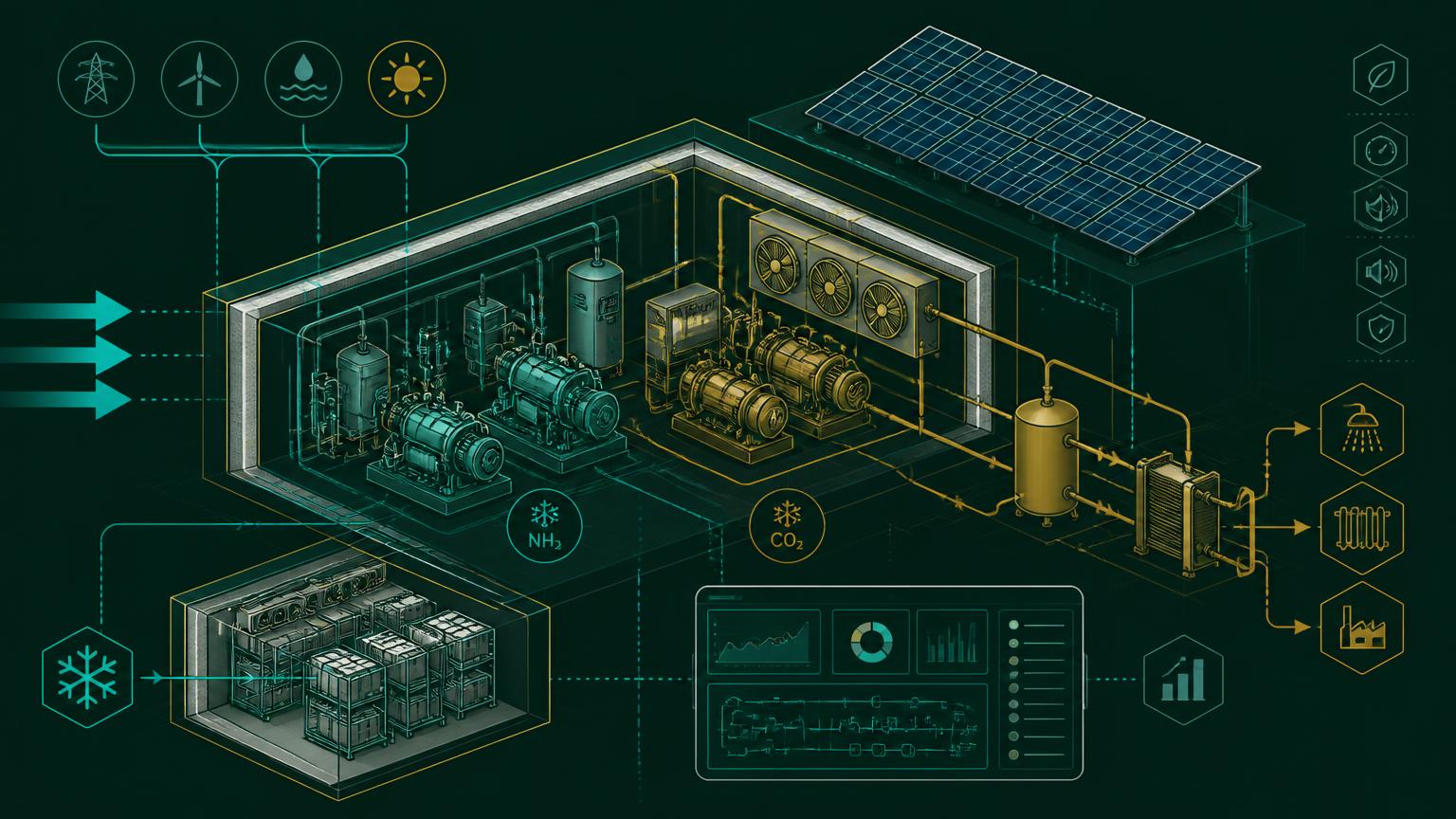
Over a typical asset life, the energy bill of an industrial refrigeration facility usually exceeds the original cost of the refrigeration equipment, often by a wide margin. That single fact should reorganise how a buyer evaluates offers. A quotation that is cheaper on day one and less efficient in operation is not a saving; it is a financing decision made in the wrong direction.
Refrigerant strategy
Ammonia remains the efficiency benchmark for large industrial plant and is well suited to facilities with competent technical operation and appropriate safety engineering. Transcritical CO2 has matured into a credible option across a wider range of climates and is regulatorily durable. HFC and HFO solutions retain a role in smaller and distributed systems, but buyers should test long-term availability and regulatory exposure in their jurisdiction before committing a twenty-year asset to a phase-down pathway.
Control and part-load performance
Variable speed compression, floating head pressure, intelligent defrost and demand-based fan control routinely deliver double-digit percentage energy reductions relative to fixed-speed, fixed-setpoint plants — and they do so with a payback measured in a small number of years rather than decades.
Heat recovery
Every refrigeration plant is also a heat generator. Facilities co-located with processing, washing or sanitation demand can recover condenser heat to displace fuel consumption. This is one of the few interventions that improves both operating cost and emissions profile without compromising cold performance.
On-site generation
Solar generation aligns naturally with refrigeration load in hot climates, and thermal storage in the form of the frozen mass itself provides a degree of inherent flexibility. In weak-grid regions, hybrid solar and storage arrangements have shifted from experimental to bankable for appropriately designed facilities.
Specify for the load profile the facility will actually run, not the design point that looks best on a datasheet.
05 — Economics
Project economics: how professional buyers build the case
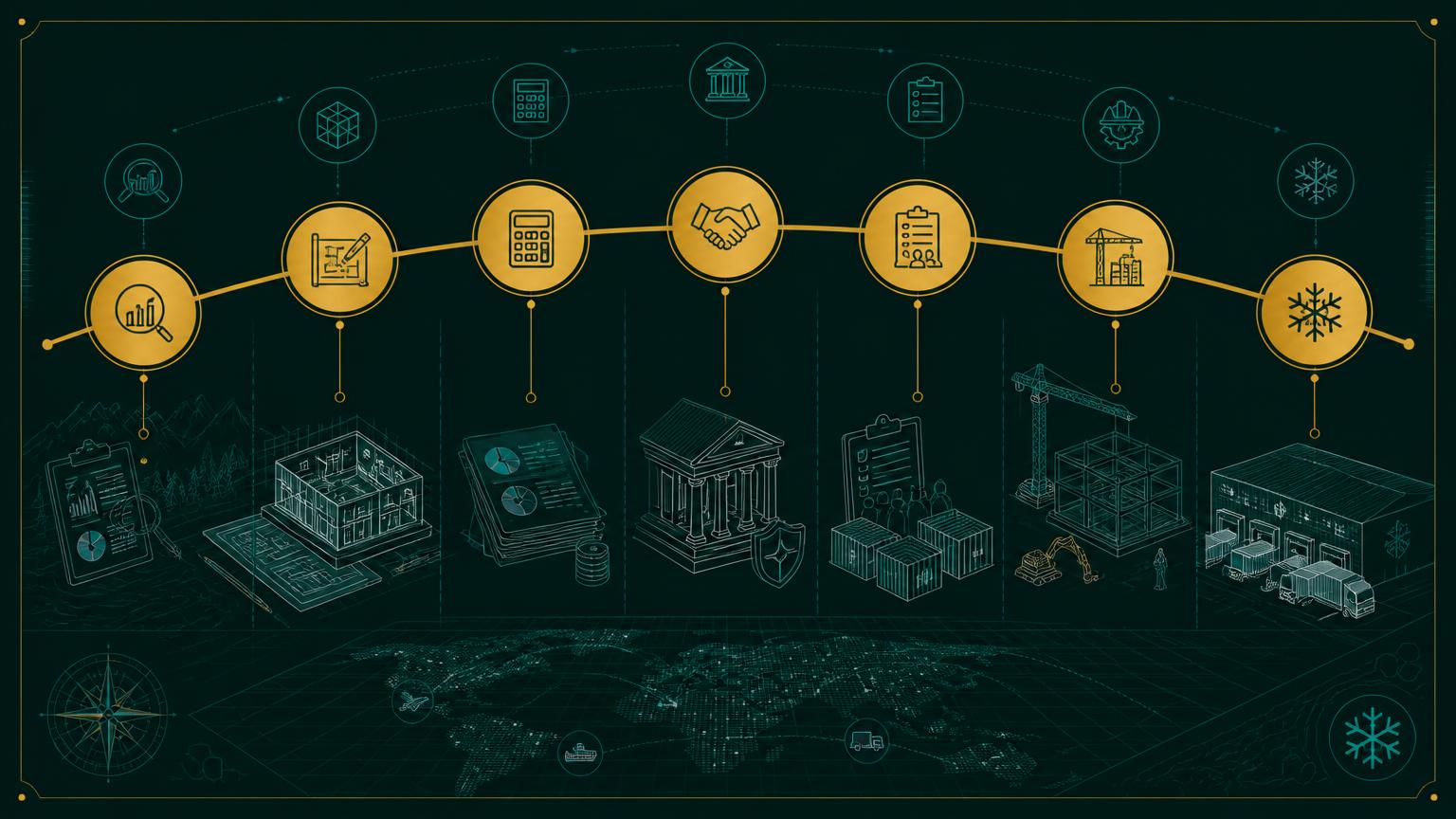
Commercial cold chain projects live in a wide range — around USD 250,000 for a compact processing installation to USD 100M+ for automated regional infrastructure. Within that range, the discipline is identical: define throughput, define the temperature regime, model the cost stack, then test the model against real market pricing.
The four questions that decide viability
- Throughput: how many tonnes move through the facility per period, with what seasonality and what peak factor?
- Regime: which temperature bands are required, and how much of the volume needs freezing rather than chilling?
- Revenue logic: is the asset a cost centre protecting an existing margin, or a service asset selling storage and handling?
- Resilience requirement: what does an hour, a day or a week of failure cost in product value and customer relationships?
Answering these four questions produces a defensible capacity requirement. Skipping them produces an oversized plant, an underused building and a return that never materialises — the most common failure mode in the sector, and one that no supplier discount can repair.
| Band | Typical scope | Preparation required before RFQ |
|---|---|---|
| USD 150k – 1M | Processing cold rooms, small blast freezing, upgrades | Load calculation, layout, power confirmation |
| USD 1M – 10M | Standalone cold store, export facility, multi-temperature site | Feasibility, concept design, throughput model, compliance scope |
| USD 10M – 50M | Regional distribution hub, integrated processing and storage | Full technical specification, financing structure, phased delivery plan |
| USD 50M – 100M+ | Automated network infrastructure, multi-site programmes | Bankable feasibility, technical due diligence, staged procurement strategy |
Buyers can build the first version of this model without external cost using the planning tools on this platform, then bring an evidenced position into supplier conversations rather than an open question.
06 — Financing
Financing infrastructure, not equipment
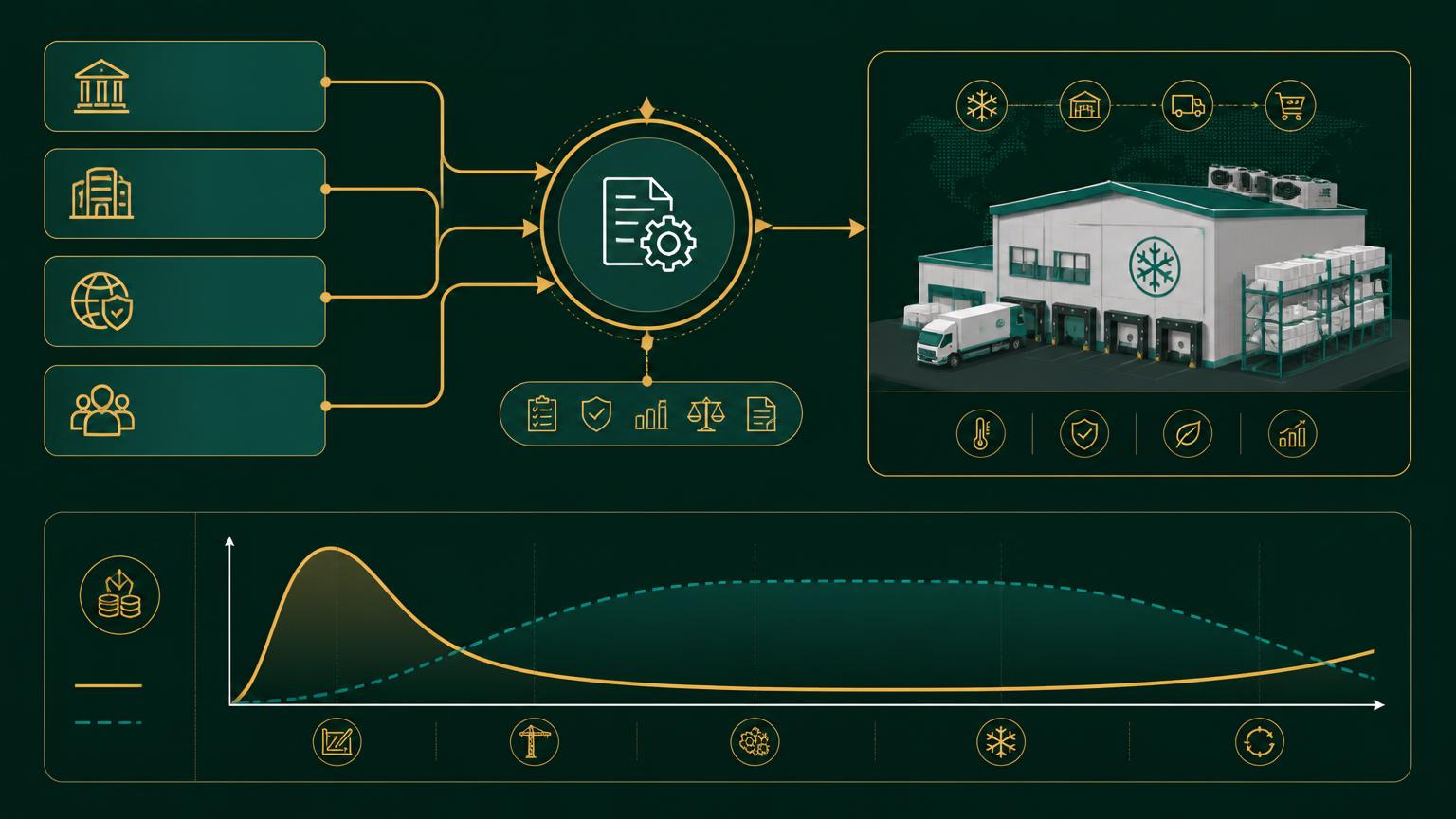
Financing conversations fail for predictable reasons, and price is rarely one of them. They fail because the project is presented as a shopping list rather than as an asset with a throughput logic, an operating plan and a risk profile.
What capital providers actually assess
- Demand evidence: contracts, offtake relationships or a defensible market analysis rather than an assertion of need.
- Technical credibility: a design that a third-party engineer can review, with load calculations and specified performance guarantees.
- Sponsor capability: demonstrated ability to operate the asset, or a credible operating partner.
- Cost realism: a budget that includes civil works, power, commissioning, spares and working capital — not only the equipment quotation.
- Downside behaviour: what happens to the repayment profile if throughput lands twenty percent below plan.
Structures commonly used
Commercial bank facilities remain the default in mature markets. Development finance and multilateral programmes are frequently available where the project has a food security, employment or post-harvest loss dimension. Export credit agency support can materially improve terms when a significant share of equipment originates from a supported country. Leasing and equipment finance suit modular expansion. Most real projects combine several of these rather than relying on one.
ColdMatch Group does not lend and does not guarantee outcomes with capital providers. What the platform does is help buyers prepare project documentation to the standard those providers expect, so that the conversation starts from a reviewable position.
07 — Procurement
Buyer-first procurement in a supplier-first market
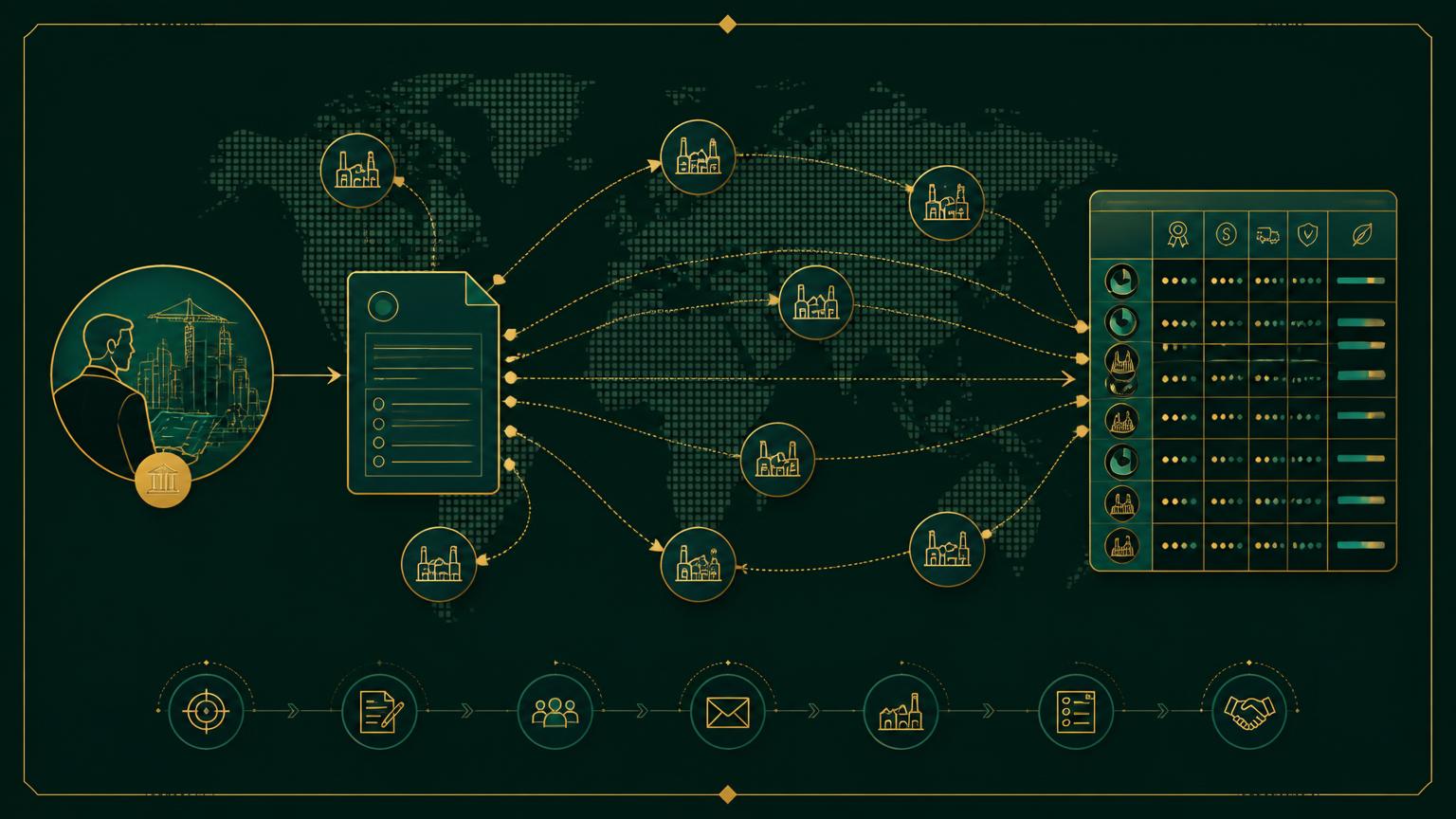
The structural problem in industrial cold chain procurement is asymmetry. Manufacturers run this process continuously and know exactly which variables move price and risk. Most buyers run it once every several years. The predictable result is offers that are technically incomparable, scope gaps that surface during installation and performance obligations that dissolve at commissioning.
What a comparable offer requires
- A single defined scope boundary: what is included, what is excluded, and who carries the interfaces between packages.
- Stated performance guarantees: pull-down times, holding temperature at defined ambient, and energy consumption at a defined operating condition.
- Identical commercial terms: incoterms, payment milestones, warranty duration and the definition of practical completion.
- After-sales reality: spare parts availability, response time, local service presence and training scope.
- Compliance package: certifications, documentation, and responsibility for local approvals.
When these are fixed by the buyer in advance, price differences become meaningful. When they are left to each supplier, the cheapest offer is almost always the one that excluded the most.
A vendor-neutral platform works with every qualified manufacturer capable of meeting the requirement — the specification serves the buyer, not a catalogue.
This is the operating principle behind ColdMatch Group. The platform does not represent a manufacturer, does not sell equipment and does not steer buyers toward a preferred brand. It structures the requirement, distributes it to qualified international suppliers and helps the buyer compare what comes back on equivalent terms — supported throughout by human expert guidance rather than an automated form.
08 — Technology
Where digital tools genuinely change outcomes
Digitalisation in cold chain is frequently oversold. The honest assessment is that technology changes outcomes in three specific places and adds noise almost everywhere else.
Preparation
Structured planning tools let a buyer arrive at the market with a load calculation, a capacity model and a written specification. This compresses months of iteration and is the single highest-value application of software in the process.
Comparison
Normalising offers onto a common scope and lifecycle cost basis converts a pile of incomparable documents into a decision. This is analytical work that software supports well and human judgement must still confirm.
Operations
Continuous monitoring, alarm management and energy analytics turn a facility into a managed asset. The value is not the dashboard; it is the ability to detect drift before it becomes a product loss or an audit finding.
Outside these three areas, the deciding factor remains engineering judgement and commercial experience. Technology accelerates a well-structured process; it does not repair a badly framed project.
09 — Ecosystem
Cold chain inside the wider industrial project ecosystem
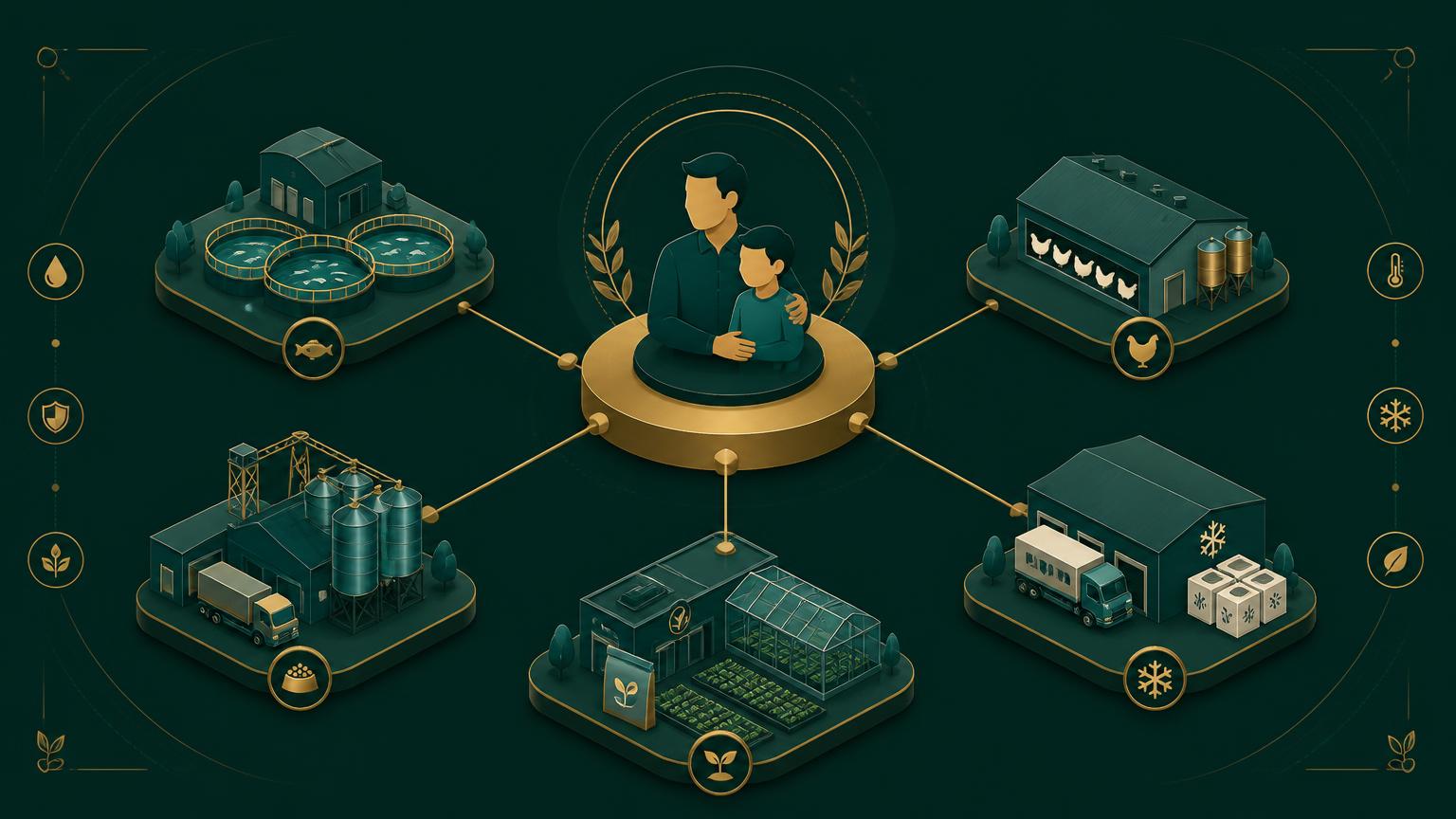
Cold chain rarely exists on its own. A seafood processor's freezing capacity is defined by upstream aquaculture volumes. A poultry operation's chilling requirement follows from slaughter throughput. A feed producer's raw material handling and an agricultural producer's post-harvest strategy both intersect with temperature-controlled logistics.
ColdMatch Group is the cold chain platform of Global B2B Group, which operates specialised platforms across connected industrial sectors — FeedMatch in feed production, FishMatch in aquaculture, HatchMatch in poultry, SeedMatch in commercial agriculture, and ColdMatch in cold chain infrastructure. The practical benefit for a buyer is continuity: a project that spans production and cold chain can be prepared with consistent methodology instead of being fragmented across unrelated suppliers.
- Aquaculture and seafood projects: production capacity and freezing capacity planned as one system.
- Poultry projects: slaughter throughput, chilling and frozen storage sized against each other.
- Feed and agricultural projects: raw material handling and post-harvest cooling considered together.
10 — Outlook
What changes in the next decade
Four shifts are already visible in how commercial cold chain projects are specified and financed, and they will define the assets built between now and the mid-2030s.
Natural refrigerants become the default rather than the premium option
Regulatory pressure and lifecycle economics are converging. Buyers specifying a twenty-year asset today should assume that synthetic refrigerant availability and cost will move against them over the asset's life.
Energy performance becomes contractual
Guaranteed consumption at defined conditions is moving from a negotiating point to a standard clause. Buyers who ask for it now are simply arriving early.
Resilience is priced explicitly
Grid instability, extreme heat events and logistics disruption have made redundancy a quantifiable value rather than an engineering preference. Expect financing structures to reward it.
Preparation quality becomes the competitive advantage
As supplier capacity globalises and price transparency improves, the differentiator between two buyers procuring the same equipment is no longer access to suppliers. It is the quality of the requirement they bring to the market.
In a transparent market, the best-prepared buyer wins — not the one with the longest supplier list.
Continue with the practical tools
Every point in this article maps to a resource on the platform. Human global expert guidance accompanies each step — the tools structure the work, our specialists validate it.